
12V DC LED strip lights
12V DC LED Strip Lights are a versatile and efficient solution for both decorative and functional lighting, offering easy installation and great flexibility in residential and professional projects.

Our featured products from 12V DC LED strip lights
- -10%
Essential
Before £8.69
£7.79
 (5)
(5)Ref 107547
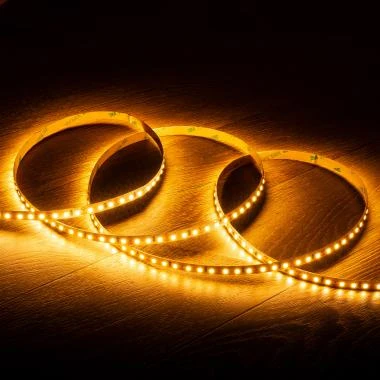
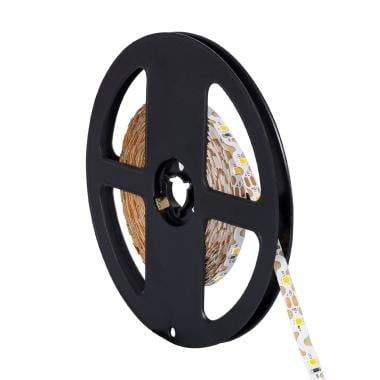
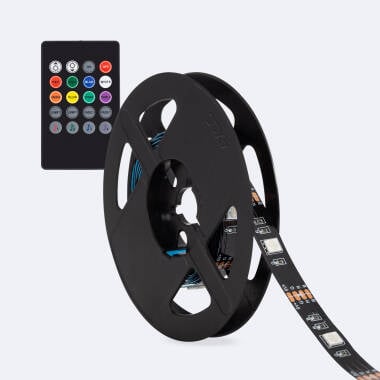
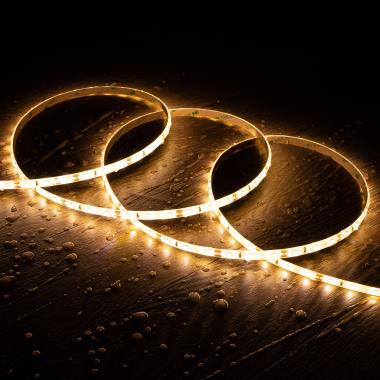
Adjustable5m 12V LED Strip SMD 120LED/m 10W/m 1000lm/W 8mm Wide cut every 2.5cm IP20
In Stock, delivery in 24/48h
- Voltage Range 12V DC
- Cut Points 2.5 cm
- Type Of Dimming Controller
4 options - -13%
Advanced
Before £15.89
£13.79
(16)Ref 107907
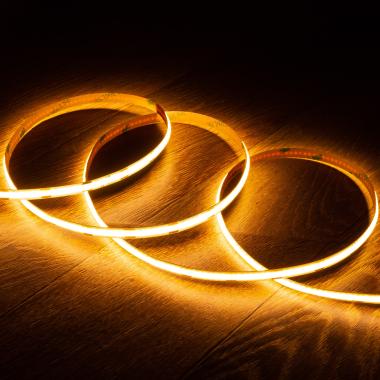
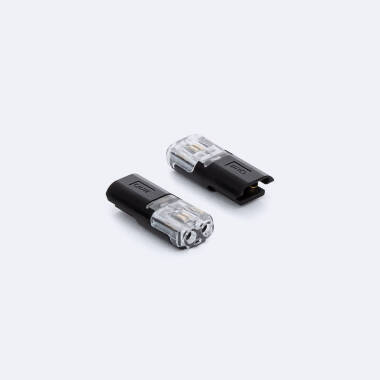
Adjustable5m 12V LED Strip COB 320LED/m 10W/m 1000lm/m 8mm Wide Cut at Every 2.5cm IP20 CRI90
In Stock, delivery in 15-20 days
- Voltage Range 12V DC
- Cut Points 2.5 cm
- Type Of Dimming Controller
4 options - -10%
Essential
Before £11.99
£10.79
Ref 107565
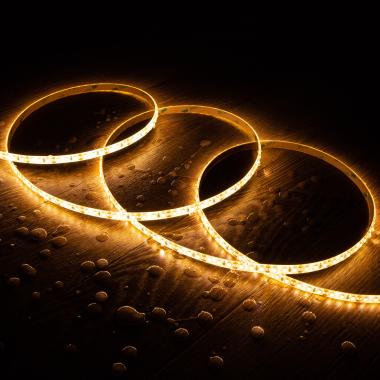
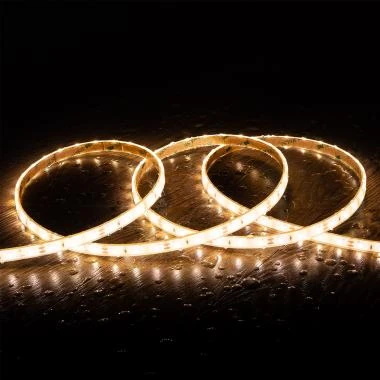
Adjustable5m 12V LED Strip SMD 120LED/m 10W/m 1000lm/W 8mm Wide cut at every 2.5cm IP65
In Stock, delivery in 24/48h
- Voltage Range 12V DC
- Cut Points 2.5 cm
- Type Of Dimming Controller
4 options - -9%
Advanced
Before £34.99
£31.69
Ref 103776
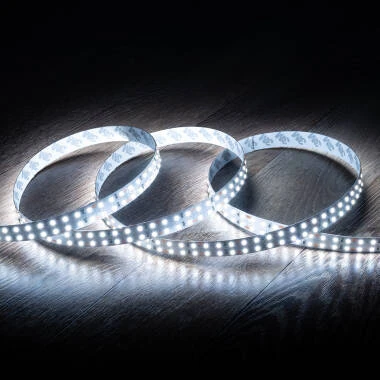
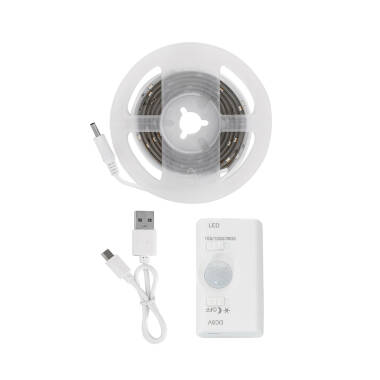
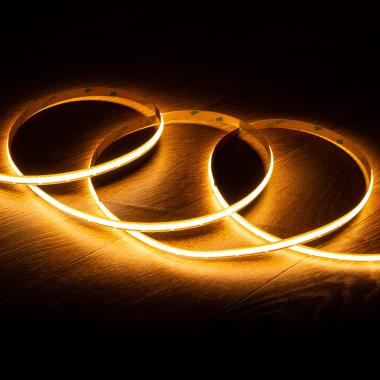
Adjustable5m 12V LED Strip SMD 204LED/m 17.5W/m 1700lm/m 14mm Wide Cut at Every 3cm IP20
In Stock, delivery in 15-20 days
- Voltage Range 12V DC
- Cut Points 3 cm
- Type Of Dimming Controller
3 options





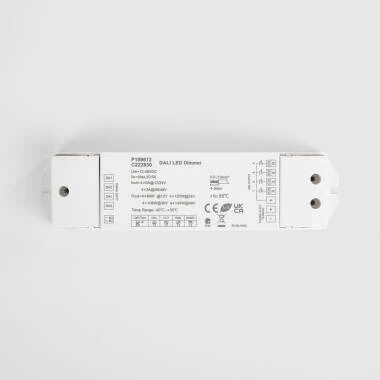
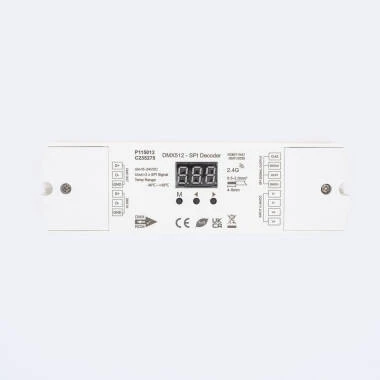
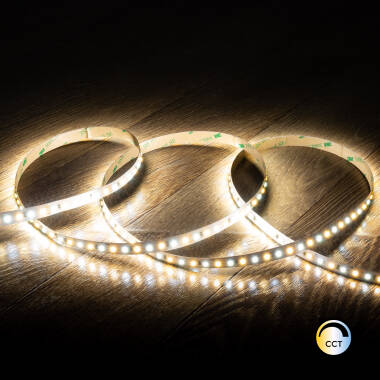
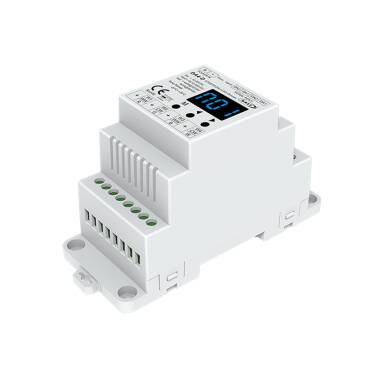
You may also be interested in
Brands related to this category


About 12V DC LED strip lights
Lighting solutions based on Low Voltage LED Strip Lights have become increasingly popular in both domestic and professional applications. Within this context, 12V strips have established themselves as a balanced option, combining ease of installation, system control, and adaptability to a wide range of environments.
What are 12V DC LED Strip Lights
These are LED Strip Lights that operate on 12-volt direct current. They consist of a flexible printed circuit board where LED chips, resistors, and cutting points are integrated, allowing the strip length to be adjusted to suit each installation.
Unlike higher voltage solutions, these strips are designed to work with external power supplies, providing greater control over the installation and reducing electrical risks. For this reason, they are widely used in environments where safety and installation precision are key factors.
Differences compared to other voltages
Although they share similar design and functionality, the operating voltage directly affects installation performance, particularly in terms of maximum run length, voltage drop, and light distribution.
Comparison with 24V and 48V LED Strip Lights
24V DC LED Strip Lights allow for longer runs without noticeable loss of light intensity, making them more suitable for continuous installations over large distances, such as architectural lighting lines or commercial projects.
48V DC LED Strip Lights, on the other hand, are designed for even more demanding applications, where long runs are required with minimal voltage drop and more stable light output.
In comparison, 12V strips have greater limitations in terms of maximum run length, typically not exceeding 5 meters without additional power injection. However, they offer greater cutting precision and are easier to adapt in smaller installations or more complex layouts.
Differences with 5V LED Strip Lights
5V DC LED Strip Lights are mainly used in specific decorative applications or addressable digital systems, where individual LED control is essential.
By contrast, 12V strips are designed for general and functional lighting, offering better stability in standard installations and a more balanced relationship between power, length, and energy consumption.
Types of 12V DC LED Strip Lights
Within this category, different configurations are available to suit a wide range of lighting requirements.
By LED density
LED density refers to the number of LEDs per meter and directly affects light uniformity. For decorative or indirect lighting, 60 LEDs/m is usually sufficient, while for continuous lighting with no visible dots, 120 LEDs/m or higher is recommended.
Higher density reduces the dotted light effect and improves uniformity, especially when installed in profiles with diffusers.
By LED chip type
Common chip types in 12V strips include SMD 2835, 3528, and 5050. Each offers different levels of efficiency, output, and size.
For example, SMD 2835 chips provide a good balance between performance and energy consumption, while 5050 chips allow for RGB configurations or higher output per LED.
By color temperature and RGB control
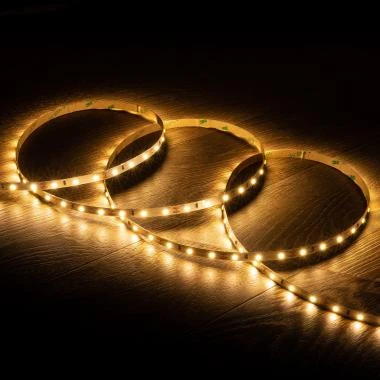
12V LED Strip Lights are available in a range of color temperatures to suit different applications. Warm white (around 2700K–3000K) is commonly used in residential settings, while neutral white (4000K) is typical for kitchens, workspaces, and retail environments.
In technical or industrial applications, cooler temperatures (5000K–6000K) improve visual clarity and contrast.
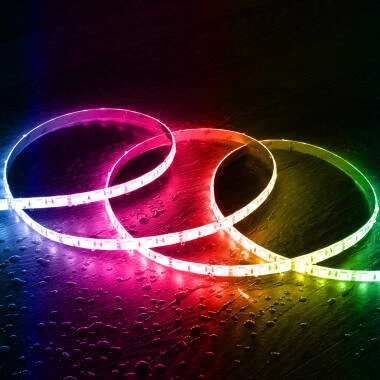
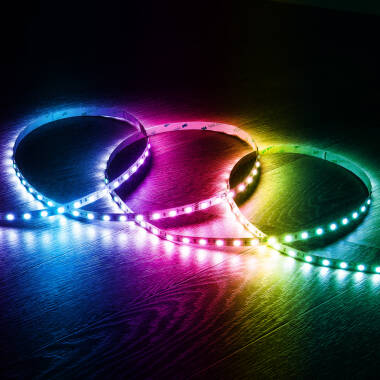
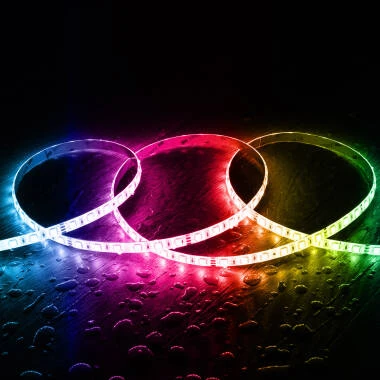
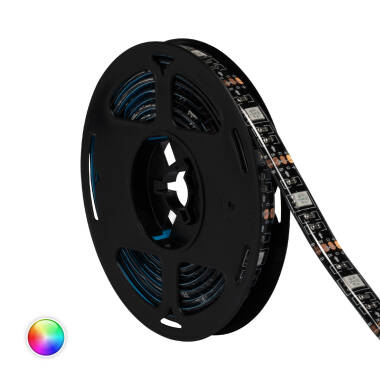
In addition to single-color options, 12V RGB LED Strip Lights are available, allowing multiple colors to be generated through the combination of red, green, and blue diodes. These are mainly used in decorative lighting, signage, or projects where dynamic lighting effects are required.
RGB systems can be controlled via remotes, controllers, or smart home systems, enabling both color and brightness adjustment. In some cases, strips include an additional white channel (RGBW), improving performance when functional lighting is required alongside decorative effects.
How to choose 12V DC LED Strip Lights
Selecting the right 12V LED Strip Lights requires considering several technical factors that determine the final performance of the installation.
Length and voltage drop
One of the key aspects is voltage drop. In 12V systems, this becomes significant after a certain length, potentially causing a visible reduction in brightness at the end of the strip.
To prevent this, it is recommended to power the strip from both ends or divide the installation into multiple sections with independent power supplies. In standard setups, each run is typically limited to around 5 meters to maintain consistent brightness.
Power and luminous output
Power is expressed in watts per meter (W/m) and is directly related to luminous output. For example, a 10 W/m strip can deliver between 900 and 1,200 lumens per meter, depending on the LED chip and its efficiency.
This allows the installation to be properly sized based on the required lighting level, whether decorative or functional.
Installation profile and heat dissipation
LED strips generate heat during operation, so it is recommended to install them on surfaces that help dissipate it, such as aluminum profiles.
In addition to improving lifespan, profiles allow the use of diffusers that soften the light and eliminate visible LED dots, enhancing visual comfort.
IP rating (protection level)
The IP rating determines resistance to dust and moisture. For dry indoor environments, IP20 is sufficient, while kitchens, bathrooms, or protected outdoor areas require IP44 or IP65.
For fully exposed outdoor installations or areas with direct water contact, higher protection ratings are necessary.
Applications of 12V DC LED Strip Lights
12V LED Strip Lights stand out for their versatility and adaptability across different environments.
Decorative indoor lighting
In residential settings, these strips are commonly used for indirect lighting in ceilings, shelving, or furniture. They help create soft lighting environments with levels between 100 and 300 lux, ideal for relaxation areas.
Their flexibility makes them easy to integrate into complex spaces such as curves or corners, where other lighting solutions may not fit easily.
Functional lighting for furniture and kitchens
On countertops or work areas, 12V LED strips provide direct and uniform lighting. In these cases, lighting levels around 300–500 lux are typically targeted to ensure good visibility.
Installation under cabinets or within recessed profiles helps optimize light distribution without creating unwanted shadows.
Applications in commercial projects
In retail and hospitality environments, they are used to highlight products, display cases, or architectural features. The combination of color temperature and LED density allows lighting to be tailored to the specific product or atmosphere.
They are also widely used in signage or accent lighting, where visual control and continuous light lines are essential.
Frequently asked questions about 12V DC LED Strip Lights
How many meters can be installed with a 12V LED strip?
In standard installations, it is recommended not to exceed 5 meters per run without additional power input. Beyond this length, voltage drop may cause visible differences in brightness.
What power supply do I need?
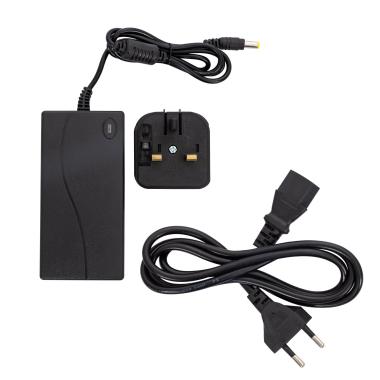
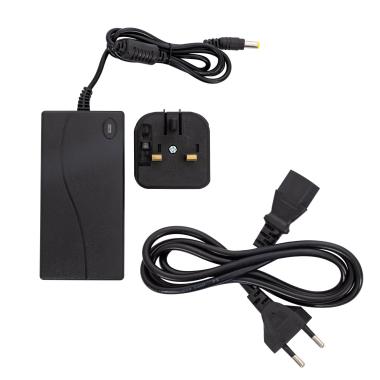
The power supply must provide 12V DC and have a higher capacity than the total consumption of the installed strip. As a guideline, it is recommended to add a 20% margin to ensure stable operation.
Can 12V LED strips be cut?
Yes, they include cutting points every few centimeters, allowing precise length adjustment without affecting the rest of the circuit.
Is 12V or 24V better?
12V is better suited for smaller installations with shorter runs and higher precision requirements. For longer runs or more demanding projects, 24V DC LED Strip Lights offer better performance in terms of voltage drop.
Are they safe for home use?
Yes, operating at low voltage, they provide a high level of safety, especially compared to higher voltage systems.
Can they be used outdoors?
Yes, as long as you choose a version with an appropriate IP rating (IP65 or higher) and use waterproof power supplies. Proper installation is essential to ensure durability.