
R7S LED bulbs
R7S LED bulbs make it possible to replace linear halogen lamps while keeping the same type of connection, with lower energy consumption and a considerably longer service life.
Our featured products from R7S LED bulbs
- -34%
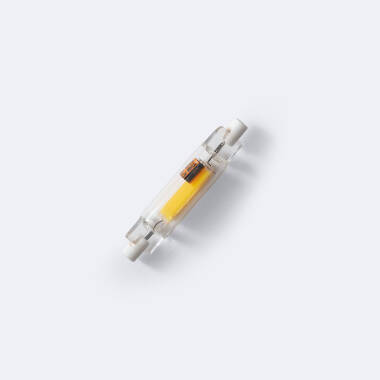
Essential
Before £6.49
£4.29
 (7)
(7)- Wattage 4 W
- Voltage Range 220-240V AC
- Lumen 400 lm
4 options - -45%
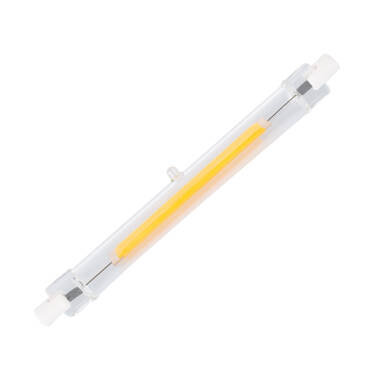
Essential
Before £9.79
£5.39
 (3)
(3)- Wattage 9 W
- Voltage Range 220-240V AC
- Lumen 900 lm
3 options 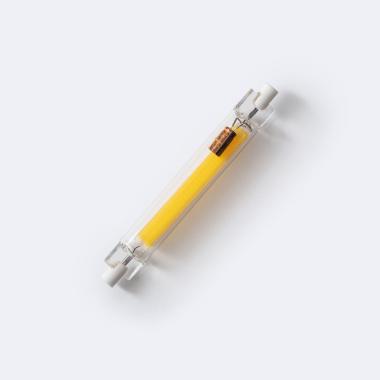
Essential
£7.19
(12)- Wattage 8 W
- Voltage Range 220-240V AC
- Lumen 800 lm
3 options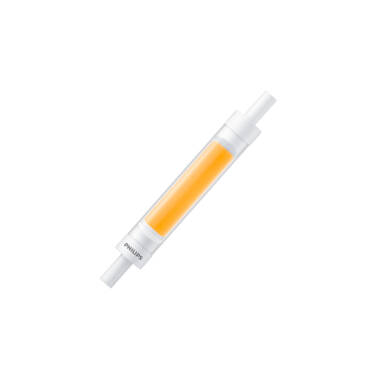
£12.99
- Wattage 7.2 W
- Voltage Range 220-240V AC
- Lumen 810 lm





Brands related to this category


About R7S LED bulbs
Within LED bulbs, the R7S format requires particular attention to length, available space and dimming, as an incorrect replacement may prevent installation or cause operating problems.
What is an R7S bulb and where is it used?
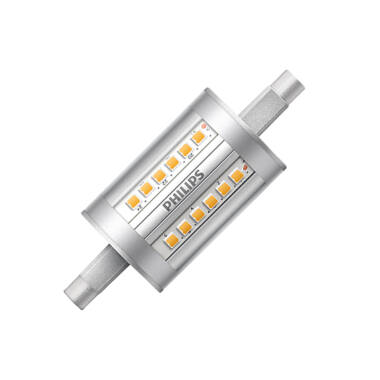
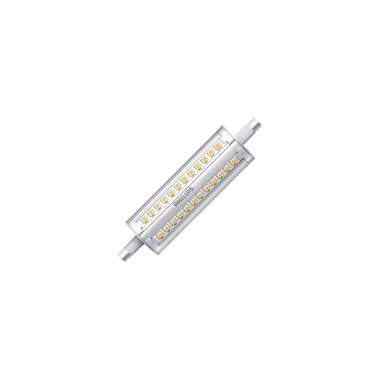
R7S bulbs are easy to recognise by their linear shape and the presence of an electrical contact at each end. Unlike screw-base bulbs or bulbs with pins grouped on one side, an R7S bulb is held horizontally or vertically between two opposing supports.
This format became popular with high-power linear halogen lamps. For many years, it was common to find R7S lamps rated at 100 W, 150 W, 300 W or even higher in light fittings that needed to produce a large amount of light from a relatively compact source.
Today, LED versions make it possible to upgrade many of these installations without necessarily replacing the entire light fitting. The aim is to retain the R7S lamp holder while achieving suitable luminous flux with significantly lower electrical power.
One of the best-known applications is in certain floor lamps, especially uplighter models that direct much of the light towards the ceiling. These fittings traditionally used high-power linear halogen lamps, so when switching to LED it is important to check both the luminous flux and the light distribution.
They are also common in floodlights, outdoor light fittings, wall lights, portable spotlights and other equipment originally designed around a linear halogen lamp. In these cases, the shape of the reflector can have a major influence on the result when replacing the light source.
An R7S LED bulb does not necessarily reproduce the light output of a halogen lamp in exactly the same way. A halogen lamp emitted light around almost the entire tube, whereas in an LED version the diodes may be positioned on one or more sides. It is therefore worth checking how the bulb is oriented inside the reflector and how much of the luminous flux is actually used by the light fitting.
Another important factor is the available space. Older R7S halogen lamps were very slim tubes, while LED alternatives need to house chips, electronics and heat-dissipation systems. As a result, an R7S LED bulb may be thicker than the original lamp even if it has exactly the same length.
How to choose your R7S LED bulb
Choosing an R7S bulb should begin with physical compatibility and then move on to lighting characteristics. With this format, simply looking for a bulb with the same type of base is not enough.
R7S bulbs are available in different lengths and wattages, and they can also vary in diameter, LED layout and dimming capability. To carry out a retrofit correctly, it is best to start with the installed lamp and check its characteristics before choosing a replacement.
Choosing the correct length
Length is the key factor in an R7S bulb because the contacts in the light fitting are positioned at a fixed distance and the bulb fits between them. If the measurement is incorrect, installation is not possible.
The most common lengths are 78 mm and 118 mm, although other variants exist depending on the application. They are not interchangeable: a 78 mm model cannot replace a 118 mm version and vice versa because they will not fit correctly in the lamp holders.
The most reliable way to identify the correct size is to check the reference of the original bulb or measure its total length from end to end, including the contacts. In some cases, the light fitting itself indicates the maximum permitted length.
In addition to length, it is essential to check the diameter of the R7S LED bulb, especially in narrow floodlights or reflectors. Even if the length matches, a thicker bulb may not fit into the housing.
This is because halogen lamps used very slim quartz tubes, whereas LED versions include a structure, electronics and thermal management components, which can increase their thickness. It is therefore important to make sure there is enough space and not to force the installation, as this could affect ventilation and correct operation.
Other features to consider
Once the length and dimensions have been confirmed, the next criterion is lumens. It is always better to compare luminous flux rather than watts, as two R7S LED bulbs with the same power consumption can produce different amounts of light depending on their efficiency.
Colour temperature affects the atmosphere: 2700–3000 K is close to the warm light of a halogen lamp, while 4000 K provides a more neutral tone that is suitable for functional or work areas.
In terms of emission angle, an R7S bulb usually operates inside a reflector, so light distribution is especially important. Halogen lamps emitted light in an almost omnidirectional pattern, while LED versions may emit over 180° or 300° depending on the design, which affects how effectively the reflector is used.
Finally, it is essential to check whether the bulb is dimmable, especially in floor lamps and other light fittings with a dimmer, where this function is common but compatibility is not always guaranteed.
R7S and dimmers: what to expect
Dimming is one of the most problematic aspects when replacing an R7S halogen lamp with LED, as it should not be assumed that the existing dimmer is compatible simply because the bulb fits.
Many R7S LED bulbs are not dimmable and, when connected to a dimmer, may produce flickering, unstable start-up, electrical noise or other operating faults. This problem is common in older floor lamps that used high-power halogen lamps of 150 W, 300 W or more with dimmers designed for high loads.
When switching to LED, the electrical load drops dramatically. Even if the bulb is dimmable, the dimmer may require a minimum load that is higher than the LED can provide, resulting in poor or no dimming.
For this reason, two conditions must be met in dimmable light fittings: the R7S bulb must be dimmable and the dimmer must be compatible with LED and low loads. If not, it may be necessary to replace or adapt the dimming system, always respecting the safety requirements of the installation.
A non-dimmable R7S can work perfectly with a conventional switch, but it does not allow the brightness to be adjusted. For new installations with lighting control, the most suitable option is to choose a dimmable R7S LED bulb together with a compatible dimmer.
Finally, the maximum wattage indicated on the light fitting should not be used as the reference for choosing the LED. The bulb should be selected according to lumens, dimensions, operating temperature and electrical compatibility, rather than by trying to match the wattage of the original halogen lamp.
Frequently asked questions
R7S bulbs have characteristics that do not appear with conventional bases: they use contacts at both ends, are available in several lengths and many original installations include dimmers designed for halogen lamps.
How do I know which R7S size I need?
The most reliable method is to check the reference of the old bulb or measure its total length from end to end. Sizes of approximately 78 mm and 118 mm are particularly common.
Can I use a 78 mm R7S instead of a 118 mm R7S?
No. Although both use the same type of connection, they have different lengths and are not interchangeable.
Why does an R7S LED bulb not fit if it has the same length as the halogen bulb?
The cause is usually the diameter. R7S halogen lamps used very slim quartz tubes, while LED versions need space for the diodes, electronics and heat dissipation. For this reason, in addition to checking the length in millimetres, it is advisable to check the maximum diameter allowed by the reflector or housing of the light fitting.
Do R7S LED bulbs operate directly at 230 V?
Most do, but before installing a new bulb you should always check the rated voltage stated in its specifications and compare it with the voltage of the light fitting.
Does an R7S LED bulb provide the same light as a halogen lamp?
It can provide an equivalent luminous flux, but the light distribution may be different. To find the closest replacement, both lumens and beam angle should be compared.
Can I use an R7S LED bulb in a dimmable floor lamp?
Only if the bulb is marked as dimmable and the dimmer in the lamp is compatible with LED. In older floor lamps, installing a low-wattage LED bulb may put the load below the dimmer’s minimum requirement and cause flickering or poor dimming.
Are all R7S LED bulbs dimmable?
No. A significant proportion of R7S LED bulbs only support on/off operation.
What colour temperature is closest to an R7S halogen lamp?
To maintain a warm appearance similar to halogen, around 2700 K or 3000 K is usually the best choice.