
 Wattage 150 W
 Voltage Range 220-240V AC
 Lumen 18000 lm
 Number of LEDs 192


Wattage
150 W
Voltage Range
220-240V AC
Lumen
18000 lm
Number of LEDs
192

Type Of Dimming
1-10 V

Power Factor
0.9

IP Rating
IP65

Battery Operated
No

Dimensions
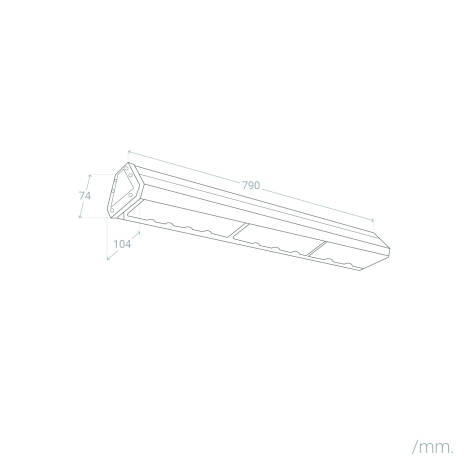
74 mm x 104 mm x 790 mm

Width
104 mm

Height
74 mm

IK Protection
IK08
150W 120 lm/W IP65 Linear Industrial High Bay LED Dimmable 1-10V HB1
Ref. Ledkia: 50232
 (2)
(2)5 out of 5 stars

Colour Temperature Cool White 4000K
Before £102.99
£67.99
VAT included
In Stock, delivery in 24/48h

Are you a lighting professional or a company?
- Great discounts off PVP
- Extended Warranty
- Exclusive Services
Buy now, pay later
Credit payment30 calendar days to return
You can renounce to this product during the first 30 calendar days from receipt, provided that the product remains in perfect condition for use.
Custom-made products and cut-to-size strips are excluded.
Full conditions here: After-Sales Service.
24h Delivery
If you place your order today before 2:30 pm, delivery within 24/48h (working days).
Shipping is free on purchases over £49.99 (incl. VAT).
Full conditions here: Shipping methods.
100% secure payments


At Ledkia we strive to protect your security and privacy. We use payment methods that guarantee your security. Both your personal and bank details are protected with all the security measures established in the current legislation.
More information: Payment methods.
Warranty up to 5 years
Our warranty service of up to 5 years guarantees the replacement, repair or refund of defective products.
You will find the exact product warranty in the technical details.
Full conditions here: After-Sales Service.
Dimensions
- Width104 mm
- Weight2.8 kg
- Height74 mm
- Depth790 mm
Downloads

PDF Datasheet 50232_99985 EN
DoC_50232_99985
Certificates and Stamps



Technical Specifications
Electrical Features
- Electrical Insulation ClassI
- Frequency50-60 Hz
- Light SourceSMD2835
- Type Of Dimming1-10 V
- Voltage Range220-240V ACVoltage level required for the product to function correctly.
- Wattage150 W
Mechanical Features
- Ambient Working Temperature-20 °C~+50 °CTemperature range in which the product can operate optimally, ensuring its performance without overheating or damage.
- IK ProtectionIK08Protection grade that the product offers against physical impacts. It is measured on a scale from IK00 to IK10, with IK10 being the highest level of resistance to impact and mechanical damage.
- InstallationSurface
- IP RatingIP65The IP protection indicates the level of resistance of a product to dust and water. The higher the number, the more protected it is.
- LocationOutdoor, Indoor
- Optic110ºx110ºType of lens that determines the distribution and quality of the light. It influences the illumination angle and light efficiency.
LED Features
- Colour Rendering Index80Measures how accurately a light source displays colours compared to natural light. A high CRI (close to 100) ensures accurate colour rendering.
- Colour Temperature4000KDefines the light tone, from warm white to cool white, measured in Kelvin (K).
- Hours60.000 hoursEstimated lifespan of the product before it loses performance. Based on optimal, non-continuous use, and measured in hours of operation under controlled conditions.
- LED Performance120 lm/WEfficiency of the LEDs, measured as the amount of light generated per unit of energy consumed (lumens per watt). High efficiency ensures energy savings without losing light quality.
- Light ColourCool White
- Lumen18000 lm
- Luminous Efficiency110 lm/WRatio between light output (lumens) and energy consumed (watts). A high value indicates better efficiency, ideal for saving energy without compromising lighting.
- Number of LEDs192
- Power Factor0.9
Materials and Finishes
- ColourBlack
- Fitting MaterialAluminium
Product Information
- CertificatesCE, RoHS, UKCA
- Guarantee3 years
Driver Information
- Driver Intensity162 mA-168 mA
- Driver Tension200 V-288 VVoltage level that the driver uses to power the LEDs or electrical components of the product, ensuring their proper functioning.
- WifiNo

Description
The 150W Elegance Linear LED High Bay 120 lm/W IP65 Dimmable 1-10V No Flicker is the ideal replacement for traditional high-pressure sodium or mercury vapour luminaires of up to 330W.
Features of the 150W Elegance Linear LED High Bay 120 lm/W IP65 Dimmable 1-10V No Flicker
This high bay features powerful Epistar SMD2835 LEDs and have a luminous output of 120 lm/W. It provides high-quality illumination with a beam angle of 90°.
Manufactured with high quality materials, this industrial LED high bay has a protection factor of IP65, so it can be used indoors or outdoors with an ambient temperature between -20 ºC and 40 ºC.
Industrial LED lighting is the most efficient and ecological alternative to traditional lighting technology. It saves a lot of energy and reduces maintenance costs. It is completely ecological as it avoids the use of highly contaminated elements such as mercury.
Applications of the 150W Elegance Linear LED High Bay 120 lm/W IP65 Dimmable 1-10V No Flicker
Its Slim design allows for the use of this luminaire in all types of industrial spaces, both indoors and outdoors, even in the most unfavourable conditions. It is used in all types of industrial or work areas, such as industrial warehouses, workshops, factories, storage facilities or car parks.
Industrial LED lighting is especially desired in the professional field because of the savings it provides in terms of consumption and maintenance. It also stands out for its immediate, flicker-free start, which allows activity to be restored immediately after a power failure, for example. It is also worth noting that this Driver is Free Flicker, preventing light flicker and therefore reducing eye fatigue.
You can find the 150W Elegance Linear LED High Bay 120 lm/W IP65 Dimmable 1-10V No Flicker at LEDKIA, our online lighting shop, with a five-year warranty and for the best price.
*The customer’s visual perception of sizes, colors, or textures may be affected by factors such as lighting, screen calibration, or the device used. For this reason, the images are merely illustrative and may not fully reflect the product’s actual characteristics. Please note that some of the ambient photographs shown on the website correspond to real environments, while others may have been generated or edited using artificial intelligence. In no case do they constitute an exact representation of the product or intend to mislead. To learn about the product’s real characteristics, please refer to the technical sheet and product description.