
G53 AR111 LED bulbs
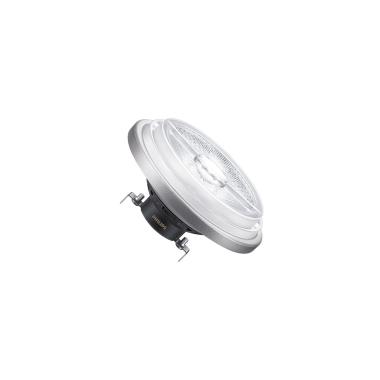
G53 AR111 LED bulbs are designed for large-format directional lighting, providing a controlled beam and high luminous intensity for commercial and architectural applications.
Our featured products from G53 AR111 LED bulbs
- -34%
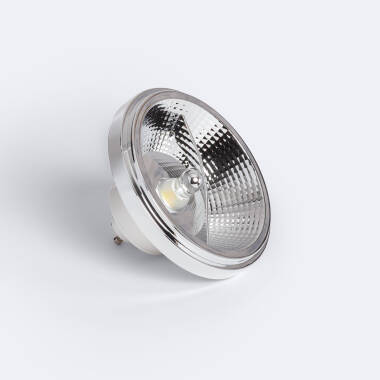
Essential
Before £12.49
£8.19
 (3)
(3)- Wattage 12 W
- Voltage Range 220-240V AC
- Lumen 800 lm
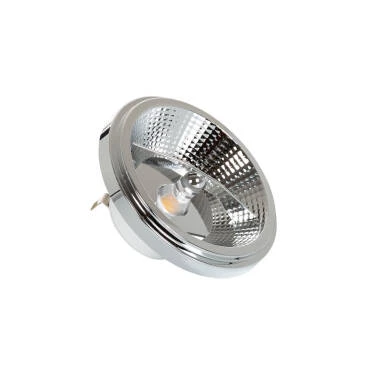
Advanced
£10.99
(12)- Wattage 12 W
- Voltage Range 220-240V AC
- Lumen 900 lm
3 options
£3.29
- Wattage 5 W
- Voltage Range 220-240V AC
- Lumen 450 lm
- -45%
Essential
Before £11.99
£6.59
 (1)
(1)- Wattage 7 W
- Voltage Range 220-240V AC
- Lumen 400 lm
2 options






Brands related to this category


About G53 AR111 LED bulbs
Among LED bulbs, AR111 models stand out for their diameter of approximately 111 mm and their common use of a G53 base, a combination particularly suited to recessed spotlights and adjustable light fittings.
What is an AR111 and what makes it different
AR111 identifies a large-diameter reflector bulb format. The designation AR refers to its reflector configuration, while the number 111 indicates the approximate outer diameter of the lamp, 111 mm.
One of its most distinctive features is precisely its size. Compared with compact reflector bulbs such as GU10 or MR16, an AR111 has a much larger optical surface. This makes it possible to control the beam accurately and produce powerful accent lighting, which is especially useful when the light fitting is installed at some distance from the object or surface.
The base most commonly associated with this format is G53, consisting of two contacts spaced approximately 53 mm apart. AR111 and G53 therefore do not mean exactly the same thing: AR111 mainly describes the format and diameter of the bulb, while G53 identifies its connection system.
LED versions replace older halogen AR111 lamps while significantly reducing the required power. They also make it possible to choose different colour temperatures, colour rendering levels and beam angles without losing the characteristic appearance of this reflector format.
12 V or 230 V G53: which one do you need
Before replacing an AR111, voltage is just as important as checking the base. The fact that two bulbs use a G53 connection does not automatically mean they can be powered in the same way.
The traditional G53 AR111 format is particularly associated with 12 V installations, where the bulb operates through a transformer or power supply. Many commercial light fittings originally installed with halogen AR111 lamps use this configuration.
When switching to LED, it is necessary to check that the new bulb supports the output voltage of the existing equipment. In addition, an older electronic transformer for halogen lamps may require a minimum load higher than the consumption of an AR111 LED bulb, causing flickering, start-up problems or unstable operation.
There are also AR111 solutions designed to operate at other voltages, including certain configurations connected directly to the mains. For this reason, it should not be assumed that every G53 bulb operates at 12 V, nor should a 12 V bulb ever be connected directly to 230 V.
The correct reference is always the voltage indicated on the bulb and the light fitting. When replacing the lamp, it is also advisable to check the transformer or driver to determine whether it can be retained or whether an LED-compatible unit needs to be installed.
Beam angle in AR111 bulbs
Beam angle is one of the most important criteria when choosing an AR111, as this format is mainly used to direct light precisely.
Narrow beams of around 8°–15° concentrate high intensity onto a small surface. They are useful for highlighting specific pieces, products, sculptures or architectural features from a certain distance.
At around 20°–30°, the result is broader accent lighting while still maintaining a clearly defined illuminated area. This is a common range for shop windows, retail spaces, exhibitions and areas where elements need to be highlighted without creating an excessively small light spot.
Beam angles close to 40°–60° distribute the luminous flux over a larger surface and allow the AR111 to be used for more open lighting. They can be suitable for commercial areas, restaurants or interiors where several spotlights need to work together to achieve a more uniform distribution.
The beam angle should be assessed together with lumens and distance. An AR111 with a narrow angle concentrates more intensity at the centre of the beam, while another bulb with the same lumens and a wider beam angle distributes that light over a larger surface.
Uses of G53 AR111 bulbs
AR111 bulbs are especially useful when directional lighting, intensity and optical control need to be combined. Their size allows clearly defined beams to be created even from heights where a smaller reflector bulb would have more difficulty producing the same effect.
In shops and commercial spaces, they are used to highlight products, display units, shop windows or specific areas. In these applications, a CRI above 80 is often particularly important and, when product colour is critical, values above 90 are preferable.
They are also commonly used in restaurants, hotels and exhibition spaces, where they make it possible to create different lighting levels between circulation areas and points that need to be emphasised. By using different optics, a lighting composition can be created with narrow beams over tables or objects and wider angles for general areas.
Installation in the light fitting and heat dissipation
Before installing a G53 AR111, the available diameter, the depth of the light fitting and the power supply system must be checked. Even if the base is compatible, the body of approximately 111 mm requires a housing specifically designed for this format.
In adjustable light fittings, there must also be enough space to move the bulb without the reflector hitting the trim of the light fitting, the ceiling or other components. Dimensions may vary slightly between LED models due to the electronics and heat-dissipation system.
Thermal management is particularly important in AR111 LED bulbs. Relatively high power concentrated in a compact body generates heat in the chips and driver. To maintain luminous flux and service life, this heat must be able to dissipate into the surrounding environment.
For this reason, an AR111 LED bulb should not be installed in a fully enclosed housing unless the bulb or light fitting is designed for those conditions. Heat build-up can accelerate the degradation of electronic components and reduce actual operating life.
When carrying out a retrofit from halogen, the transformer should also be checked. An AR111 LED bulb may consume only a fraction of the power of the previous source, which means the old 12 V equipment could fall below its minimum operating range.
Frequently asked questions
The most common questions about G53 AR111 bulbs relate to their size, voltage, base and the replacement of older halogen lamps.
What does AR111 mean?
AR111 identifies a reflector format with an outer diameter of approximately 111 mm. On its own, it does not indicate the voltage or all the electrical characteristics of the bulb.
Are AR111 and G53 the same thing?
Not exactly. AR111 refers to the lamp format, while G53 identifies the base with two contacts spaced approximately 53 mm apart.
Do all G53 AR111 bulbs operate at 12 V?
This should not be assumed. The traditional format is strongly associated with 12 V, but the voltage indicated on the bulb should always be checked before connection.
Can I replace a halogen AR111 with an LED version?
Yes, provided the base, dimensions and supply voltage match. The compatibility of the existing transformer should also be checked if the installation operates at low voltage.
Which AR111 beam angle should I choose to highlight a product?
For precise accent lighting, beams of approximately 8° to 24° can be used depending on the distance and size of the object. For larger surfaces, angles of 30°–60° may be more suitable, as they distribute the luminous flux over a wider area.
Are AR111 LED bulbs dimmable?
Not all of them. If the installation includes dimming, the bulb must be explicitly marked as dimmable and the control system must be compatible with LED. In 12 V installations, the combined operation of the dimmer and the transformer or driver must also be checked.
Why can an AR111 LED bulb flicker after replacing a halogen lamp?
A common cause is incompatibility with the old transformer. Because the LED consumes much less power, it may fall below the minimum load required for the equipment to operate correctly.