
E27 Philips LED bulbs
Philips E27 LED bulbs combine the most common screw base with different wattages and colour temperatures for domestic and professional lighting.
Our featured products from E27 Philips LED bulbs
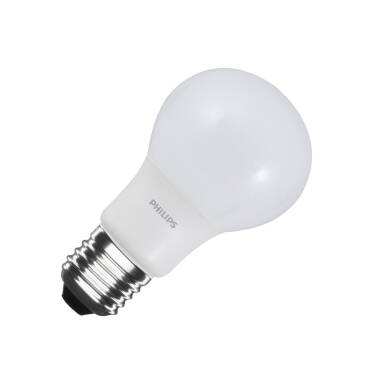
£3.99
- Wattage 7.5 W
- Voltage Range 220-240V AC
- Lumen 800 lm
£4.49
 (4)
(4)- Wattage 13 W
- Voltage Range 220-240V AC
- Lumen 1525 lm
3 options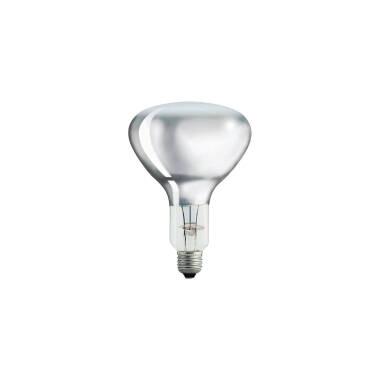
£22.19
- Wattage 375 W
- Voltage Range 220-240V AC
- Cap Code E27
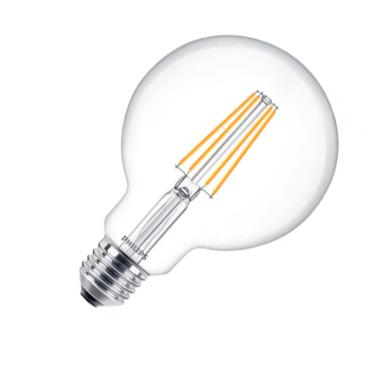
£6.49
PhilipsRef 98197
E27 Filament LED Bulb PHILIPS CorePro CLA 7W G93 806 lm
In Stock, delivery in 15-20 days
- Wattage 7 W
- Voltage Range 220-240V AC
- Lumen 806 lm





You may also be interested in
Brands related to this category


About E27 Philips LED bulbs
LED bulbs with an E27 screw base can replace numerous incandescent, halogen and energy-saving lamps without modifying the lampholder. To achieve the right result, checking the base alone is not enough: it is also important to consider lumens, colour temperature and other parameters.
Philips E27 LED bulbs with a standard screw base
Philips E27 LED bulbs are part of the range of Philips LED bulbs designed to meet different general, ambient and decorative lighting needs. Their main characteristic is the E27 base, a 27 mm diameter screw fitting widely used in ceiling lights, flush ceiling lights and other fittings.
This format offers solutions with different levels of luminous flux, from bulbs intended for ambient lighting to options capable of providing a high amount of light in larger spaces. When selecting a bulb, it is advisable to compare its performance in lumens rather than using watts as the only reference, as wattage in LED technology mainly indicates electrical consumption.
What characterises Philips E27 bulbs?
The E27 base has become one of the most common formats due to its ease of installation and the wide variety of designs that can use this connection. However, sharing the same base does not mean that all bulbs are interchangeable in every light fitting.
Characteristics of the E27 base
The E27 designation refers to an Edison screw base with a diameter of approximately 27 mm. The bulb is secured to the lampholder by twisting it into place and establishes electrical contact once it is correctly screwed in.
In European domestic installations, E27 bulbs are commonly designed to operate directly at mains voltage, so they do not normally require an external transformer. This makes replacing older bulbs easier, provided that the lampholder, voltage and dimensions are compatible.
The E27 screw base can be found on bulbs with very different shapes. For this reason, correctly identifying the base only solves one part of the selection process.
How to identify an E27 screw base
The easiest way to identify it is to check the reference printed on the bulb itself. When the E27 marking appears, the number corresponds to the approximate diameter of the screw thread in millimetres.
It can also be identified visually because it is considerably wider than an E14. If the marking has worn away, the outer diameter of the threaded base can be measured. A measurement close to 27 mm allows the format to be identified with a high degree of accuracy.
Before handling a bulb, it is advisable to switch off the power supply and wait for it to cool down if it has recently been switched on.
Available shapes of Philips E27 bulbs
The E27 base is available with different geometries and sizes. Choosing the right shape affects both the appearance of the light fitting and the distribution of light, as well as the available space inside a lampshade or diffuser.
Standard bulbs
The standard shape has the classic silhouette of a conventional bulb and is generally used for general lighting. Its light distribution is suitable for ceiling, floor or table lamps where a relatively even illumination of an area is required.
Depending on the model, these bulbs can provide anything from moderate luminous flux to levels above 1,500 lumens. Before installing them in enclosed fittings, it is advisable to check their dimensions and the specified ventilation requirements to prevent excessive heat build-up.
Globe bulbs
Globe bulbs have a larger diameter and a more visible light-emitting surface. They are commonly used in open lamps, pendant lights and decorative fittings where the bulb itself forms part of the design.
Their larger size makes it necessary to check the physical space available. A bulb may use an E27 screw base and still not fit correctly inside a narrow shade or may end up too close to other components of the fitting.
Decorative bulbs
Decorative formats include designs with clear glass, amber finishes or visible LED filaments. They are mainly used when the light source remains exposed and the bulb is intended to form part of the overall appearance of the space.
In these cases, appearance should not be the only selection criterion. Lumens, colour temperature and light distribution remain essential for achieving the required lighting level.
How to choose a Philips E27 bulb
The right choice should be made by considering several parameters together. Keeping the same base ensures mechanical compatibility, but it does not guarantee that the new bulb will provide the same amount or quality of light as the previous one.
Wattage and luminous flux
Electrical power is expressed in watts and represents the bulb’s energy consumption. Luminous flux is measured in lumens and quantifies the total amount of light emitted.
Two LED bulbs with the same wattage can produce different numbers of lumens if their efficiency differs. For this reason, luminous flux is more useful when comparing lighting levels.
Equivalent traditional bulbs
Equivalences provide an initial reference when replacing older lighting technologies. A 40 W incandescent bulb typically produces around 470 lumens, while a 60 W bulb provides approximately 800 lumens and a 75 W bulb can reach around 1,050 lumens.
These figures serve as a guide, but the way light is distributed must also be considered in fittings with reflectors. A bulb with the same total luminous flux can produce a different effect if it concentrates or spreads the beam differently.
Colour temperature
Colour temperature is expressed in kelvins. A bulb of approximately 2700 K provides warm light similar to that of traditional incandescent bulbs. A value of 4000 K corresponds to neutral light, while values close to 6000 or 6500 K produce a cooler tone.
Warm tones are commonly used in living rooms, bedrooms and relaxation areas. In kitchens, work areas and certain commercial spaces, neutral light may be more suitable.
Shape and dimensions
Although two bulbs may both use an E27 base, they can differ considerably in height and diameter. This is particularly important in lamps with narrow shades or fittings where the bulb sits very close to a diffuser.
Before purchasing a replacement bulb, it is advisable to measure the available space and compare the dimensions with those of the existing bulb. With globe or decorative formats, just a few centimetres can determine whether installation is possible.
What light output should you choose for a Philips E27 bulb?
The amount of light required depends on the size of the space, the function of the light fitting and the number of installed light points. To make an appropriate choice, it is useful to relate the lumens of each bulb to the desired illuminance, which is expressed in lux.
One lux is equivalent to one lumen distributed over one square metre. It should be taken into account that, in many installations, distributing the luminous flux across several light points is preferable in order to reduce shadows and achieve more even lighting.
Differences between Philips E27 bulbs and other screw bases
The E27 format used in these bulbs is the same mechanical standard used by any compatible E27 LED bulb. The main difference compared with other screw bases lies in the diameter of the base and, consequently, the type of lampholder with which it can be used.
Philips E27 vs E14
E27 and E14 use the same screw connection principle, but they are not directly interchangeable. E27 measures approximately 27 mm in diameter, while E14 measures around 14 mm.
E14 bulbs are generally installed in compact fittings, candle lamps, small wall lights and similar applications. E27 bases can accommodate larger bulbs and are frequently found in fittings designed to provide general lighting.
When to choose each format
The choice should not be based on wattage or appearance, but on the installed lampholder. If a light fitting has an E27 base, an E27 bulb should be used unless a suitable adapter is fitted, although this is not always recommended due to space or thermal conditions.
In new fittings, size can also influence the choice. E14 is useful when a compact light source is required, while E27 provides access to a wider range of shapes, luminous flux levels and designs.
Replacing a traditional E27 bulb with a Philips LED bulb
Replacement is usually straightforward if both bulbs use the same E27 screw base and the installation operates at a compatible voltage. Before making the change, the light fitting should be disconnected from the power supply and it should be checked that the previous bulb is no longer hot.
Next, it is advisable to determine how many lumens the old bulb provided or which traditional wattage needs to be replaced. The size, colour temperature and dimming capability should also be checked. If the fitting has a dimmer, the new bulb must be dimmable. In enclosed fittings, it is advisable to check that the bulb is suitable for this type of installation, as heat dissipation directly affects the lifespan of the electronic components.
Frequently asked questions about Philips E27 LED bulbs
What wattage Philips E27 LED bulb do I need?
Wattage should not be chosen by trying to match the watts of an incandescent bulb. Lumens should be used as the reference instead. Approximately 470 lumens correspond to the typical light level of a 40 W incandescent bulb, 800 lumens to a 60 W bulb and around 1,050 lumens to a 75 W bulb.
Are all E27 bulbs the same size?
No. E27 only identifies the type and approximate diameter of the base. The glass or plastic section can have a standard, globe, tubular or decorative shape, with very different heights and diameters. For this reason, an E27 bulb may be electrically compatible with a light fitting but still not physically fit inside its shade or diffuser.
What is the difference between E27 and E14?
The main difference is the diameter of the screw thread. E27 uses a base of around 27 mm, while E14 uses one of approximately 14 mm. Each requires the corresponding lampholder. E14 is commonly used in more compact fittings, while E27 is frequently found in general lighting applications and is available in a very wide range of shapes and luminous flux levels.
How can I tell if a Philips E27 bulb is dimmable?
The bulb’s technical information should be checked for a specific indication that it supports dimming. Using a non-dimmable LED bulb with a dimmer can cause flickering, irregular operation or prevent the bulb from reaching the expected light level. The dimmer must also be compatible with LED technology, and its minimum load range must be suitable for the total wattage of the connected bulbs.