
MR11 LED Bulbs
MR11 LED bulbs are compact light sources designed for focused lighting, ideal for small spotlights, display cases, furniture and spaces where light needs to be directed precisely.
Our featured products from MR11 LED Bulbs
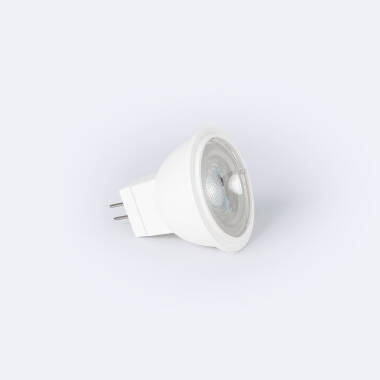
Essential
£2.29
 (3)
(3)- Wattage 1 W
- Voltage Range 12V AC, 12V DC
- Lumen 120 lm
2 options




You may also be interested in
About MR11 LED Bulbs
LED bulbs make it possible to adapt lighting to the needs of each space, combining energy efficiency, different light intensities and multiple installation options.
MR11 LED bulbs for focused lighting
MR11 LED bulbs are designed for compact light fittings that need to concentrate light on specific areas. Their small diameter allows them to be installed in small spotlights and lighting elements where a larger reflector bulb would not have enough space.
The MR format is characterised by a reflective surface that helps direct the luminous flux. In LED versions, this function is combined with specific optics capable of producing wider or more concentrated beams depending on the application. This means an MR11 can be used both to highlight an object and to provide supplementary lighting over a limited surface.
Their compact size makes them particularly useful in installations where the light fitting needs to remain visually discreet. They can also replace older MR11 halogen lamps while retaining the original spotlight in many cases, although the electrical characteristics of the installation must always be checked beforehand.
What is an MR11 bulb?
MR11 identifies a compact reflector bulb format rather than a specific type of base. The designation mainly refers to the approximate diameter of the lamp, while the electrical connection may vary depending on the model.
Size and characteristics of the MR11 format
The initials MR come from “multifaceted reflector”, a design originally developed to control and direct light through a reflective surface. The number 11 indicates the diameter of the bulb expressed in eighths of an inch. An MR11 therefore measures approximately 11/8 inches, equivalent to around 35 mm in diameter.
This size is one of its main distinguishing features. An MR11 is considerably smaller than an MR16, which means it can be integrated into narrow light fittings, display cases or small recessed spotlights.
With LED technology, the front optic is responsible for defining much of the light distribution. Depending on the design, the beam can be concentrated on a small area or widened to cover a larger surface. For this reason, two MR11 bulbs with a similar luminous flux can produce very different visual effects.
Common bases used with MR11 bulbs
One of the most common bases used with MR11 bulbs is GU4, characterised by two pins spaced approximately 4 mm apart. This combination is frequently found in low-voltage installations, especially in light fittings that originally used halogen lamps.
However, MR11 describes the bulb format and does not in itself guarantee a particular base. Before replacing an existing light source, both the connection and the operating voltage must be checked.
The bulb can be identified by checking the reference marked on the previous bulb or by measuring the distance between the contacts. Forcing an apparently similar base into place can damage the lamp holder or result in an unsuitable electrical connection.
What are MR11 LED bulbs used for?
Their small size and ability to control the beam make MR11 bulbs particularly suitable for focused, decorative and display lighting. Their usual purpose is not to illuminate large areas independently, but to provide light precisely where it is needed.
Recessed spotlights and display cases
Small recessed spotlights are one of their most common applications. An MR11 can direct light towards a side table, architectural feature or specific area without requiring a large-diameter light fitting.
In retail display cases or display units, the compact format makes it easier to conceal the light source and direct the beam towards the objects on display. In these applications, choosing the correct beam angle is important to avoid illuminating unnecessary areas or creating excessively intense spots.
The distance between the bulb and the object should also be considered. A narrow beam installed very close to an object creates a small, concentrated circle of light, while the same optic positioned further away covers a larger surface.
Decorative and accent lighting
MR11 LED bulbs can be used to highlight pictures, decorative features or architectural details. Accent lighting is intended to create contrast with the general lighting, so the direction and angle of the beam are more important than wattage alone.
A warm colour temperature of approximately 2,700 to 3,000 K can enhance materials such as wood, fabrics or warm decorative finishes. Around 4,000 K, on the other hand, provides a more neutral appearance that may be suitable for display cases, contemporary furniture or commercial spaces.
Furniture and confined spaces
The approximately 35 mm size makes it possible to integrate an MR11 into shelving, display furniture, cabinets and other structures where available space is limited.
In these locations, particular attention should be paid to ventilation. Although an LED bulb consumes considerably less energy than an equivalent halogen lamp, its electronics still need to dissipate heat to maintain stable operation and extend its service life.
It is also important to check that the body of the bulb does not interfere with the structure of the spotlight. Two MR11 models may share the same front diameter but have different lengths due to the design of the heat sink or internal electronics.
How to choose an MR11 LED bulb
Choosing the right MR11 involves more than checking that it is the same size as the previous bulb. Voltage, lumens, optics, colour temperature and possible dimming capability all have a direct impact on final performance.
Operating voltage
Many MR11 bulbs operate at low voltage, commonly around 12 V, although the exact specification of both the light source and the light fitting should always be checked.
Installing a bulb designed for a different voltage may prevent it from working or damage its electronics. In older installations, it is also necessary to determine whether the power supply comes from a conventional transformer or an electronic transformer.
The voltage is usually indicated on the previous bulb, on the light fitting or on the power supply equipment. This should be checked before purchasing a replacement.
Wattage and lumens
Wattage indicates electrical consumption, while lumens indicate the amount of light emitted. For this reason, when replacing a halogen lamp with LED, it is more useful to compare luminous flux.
Accent lighting does not always require a high luminous flux. A moderate number of lumens may be sufficient if the beam is correctly directed towards a small surface.
It should also be considered that a narrow optic concentrates the light and produces greater intensity in the illuminated area, while a wider beam distributes the same number of lumens over a larger surface.
Beam angle
The beam angle determines how widely the light spreads from the bulb. Narrow values, for example around 20° or 30°, produce concentrated beams suitable for accent lighting.
Angles of around 40° or more cover a larger area and provide a smoother transition between the illuminated zone and its surroundings.
The choice should take into account both the size of the object and the installation distance. A narrow beam may be useful for highlighting a small object from a short distance, while illuminating a complete shelf usually requires a wider light distribution.
Colour temperature
Colour temperature is expressed in kelvin. Between 2,700 and 3,000 K, the light has a warm appearance suitable for residential spaces, relaxation areas and decorative compositions.
At around 4,000 K, the light has a neutral tone that provides a more balanced perception of colours and can be used in shops, display cases or functional furniture.
Higher colour temperatures produce a cooler appearance. The chosen colour temperature should remain consistent with the rest of the installation, especially when several MR11 bulbs illuminate the same surface.
Compatibility of MR11 LED bulbs with transformers
Transformer compatibility is one of the most important aspects when replacing older MR11 halogen lamps with LED versions. Low-voltage installations usually include equipment that reduces the mains voltage to the level required by the bulb.
Electronic transformers designed for halogen lamps may require a minimum load to operate correctly. When low-wattage LED bulbs are installed, the total consumption may fall below this minimum.
MR11 vs MR16: main differences
MR11 and MR16 are both reflector bulb formats, but they differ in size. An MR11 is approximately 35 mm in diameter, while an MR16 measures around 50 mm.
This difference affects the size of the light fitting. An MR16 cannot be used as a direct replacement for an MR11 if the spotlight is designed to accommodate a smaller-diameter light source.
They may also use different bases. GU4 is common with MR11 bulbs, while low-voltage MR16 bulbs frequently use connections such as GU5.3. Compatibility should therefore not be assumed simply because both have two pins.
MR16 bulbs can generally provide higher luminous flux levels due to their larger size, while MR11 bulbs stand out for their ability to fit into confined spaces.
Frequently asked questions about MR11 LED bulbs
What base does an MR11 bulb use?
The GU4 base is one of the most common for MR11 bulbs. It has two pins spaced approximately 4 mm apart and is frequently used in low-voltage installations. However, MR11 mainly defines the format and diameter of the bulb. It is therefore always advisable to check the specific connection indicated on the light source or light fitting before replacing it.
Can I replace an MR11 halogen bulb directly with LED?
In many cases, the same lamp holder can be retained, but the replacement is not always completely direct. The base, operating voltage, dimensions and transformer compatibility must all be checked. If the existing transformer requires a minimum load higher than the consumption of the new LED bulbs, flickering or start-up problems may occur. In that case, it may also be necessary to replace the power supply equipment.
How do I know what voltage my MR11 needs?
The voltage should be checked on the bulb being replaced, on the light fitting itself or on the installed transformer. Many MR11 bulbs operate at 12 V, but this should not be assumed without verification. It is also important to distinguish between the different types of power supply supported by each model. Using a voltage other than the specified one may cause incorrect operation or damage the bulb.