
G9 LED bulbs
G9 LED bulbs are a compact solution for light fittings with limited internal space and are especially common in wall lights, decorative lamps, ceiling lights and small points of light.
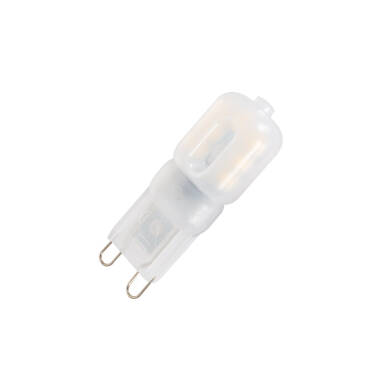
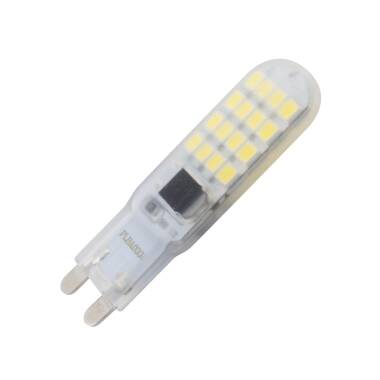
Our featured products from G9 LED bulbs
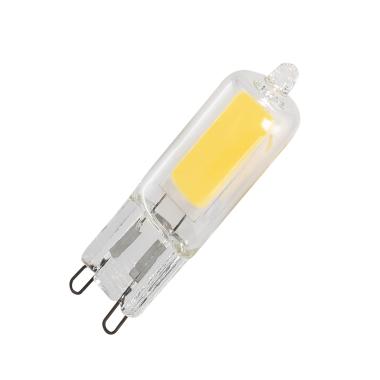
£3.79
 (1)
(1)- Wattage 2 W
- Voltage Range 220-240V AC
- Lumen 220 lm
2 options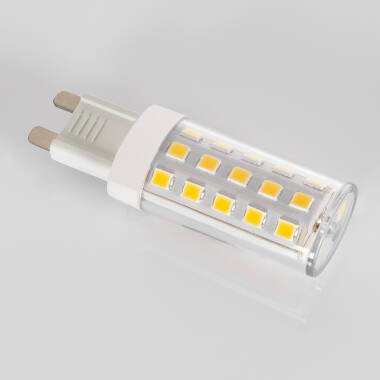
Essential
£3.19
(30)- Wattage 4 W
- Voltage Range 220-240V AC
- Lumen 470 lm
2 options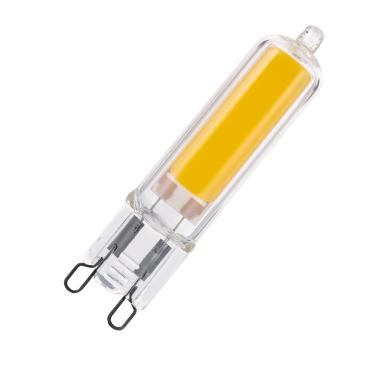
£5.29
 (5)
(5)- Wattage 4 W
- Voltage Range 220-240V AC
- Lumen 460 lm
3 options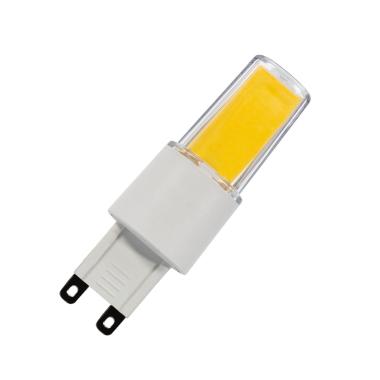
£3.29
(6)- Wattage 3.8 W
- Voltage Range 220-240V AC
- Lumen 470 lm





Brands related to this category


About G9 LED bulbs
Among LED bulbs, the G9 format makes it possible to replace many halogen capsule bulbs while keeping the existing lamp holder, although it is important to check dimensions, heat dissipation and compatibility with dimming.
What is a G9 base
The G9 base is identified by its two loop-shaped metal contacts, spaced approximately 9 mm apart. Unlike screw bases such as E14 or E27, the bulb is not twisted into place: it pushes directly into the lamp holder.
Its compact design led to widespread use in small halogen capsule bulbs, especially in light fittings where a conventional bulb would take up too much space. For this reason, it is commonly found in multi-light ceiling fittings, wall lights, table lamps, decorative ceiling lights, glass light fittings and other relatively compact designs.
In Spain, traditional G9 bulbs and many of their LED replacements are designed to operate directly at 220–240 V, without the need for the 12 V transformer associated with other capsule formats, such as certain G4 bulbs. Even so, the voltage should always be checked in the bulb specifications before installation.
The physical difference from a G4 is also easy to recognise. A G4 uses two straight, thin pins spaced 4 mm apart, while a G9 has more robust loop-shaped contacts. Although both can have a capsule-shaped body, their lamp holders and electrical requirements are different.
When replacing an old G9 halogen bulb with LED, energy consumption can be reduced considerably. However, to achieve a similar light level, it is not advisable to compare watts alone. It is better to use lumens and also check how the new light source distributes light within the fitting.
Dimensions of G9 LED bulbs
Dimensions are critical when choosing a G9 LED bulb because, although the base is standardised, the body can vary in length and diameter, which may create compatibility issues in small light fittings.
Unlike halogen bulbs, G9 LED bulbs incorporate chips and control electronics, which usually increases their size, especially in higher-output models. This can mean that the bulb fits into the lamp holder but prevents the glass shade or diffuser from closing.
It is therefore important to check the maximum available dimensions inside the light fitting and, if possible, use the old bulb as a reference. Size also tends to increase with output, as higher luminous flux requires a larger emitting surface and better heat dissipation.
The arrangement of the LEDs affects the light distribution: some models emit over 300°–360° to make better use of open fittings, while others are more directional. In addition, many installations use several G9 bulbs together, so the combined lumen output is often sufficient for general lighting without the need for high individual wattages.
Heat and enclosed light fittings
Operating temperature is an important factor with G9 bulbs because they are often installed in compact light fittings with limited ventilation.
Although G9 LED bulbs consume less energy and generate less heat than halogen bulbs, their chips and electronics still produce heat that must be dissipated correctly. In open fittings this is generally not a problem, but heat can build up inside closed glass shades or diffusers without ventilation.
This excess heat reduces the service life of the LED and its components, so a bulb may degrade sooner than expected if it operates under unsuitable conditions. For this reason, choosing the most powerful G9 available is not always the best option: in enclosed spaces, it is preferable to choose efficient models or distribute the light across several points.
When several G9 bulbs are used together, the heat accumulates within the same volume, raising the temperature even further. It is also important to avoid placing the bulb too close to glass or other elements that could restrict heat dissipation.
When replacing halogen bulbs with LED, the lower heat output is an advantage, but the installation should always provide adequate ventilation to ensure performance and durability.
G9 bulbs and dimmers
G9 halogen bulbs were easy to dim, so many light fittings include dimmers. When replacing them with LED, it is essential to check system compatibility.
Not all G9 LED bulbs are dimmable, so dimmable models must be chosen if brightness adjustment is required. Otherwise, flickering, cut-outs or unstable dimming may occur.
Even with dimmable bulbs, the problem may lie with the dimmer itself, as many older dimmers are not designed for LED loads. The reduction in power can be very significant — for example, from 200 W of halogen to 20 W of LED — which may cause issues such as flickering, a limited dimming range or irregular switching.
For this reason, it is necessary to check that the dimmer is LED-compatible and to consider the total load of the installation. It should also be noted that the dimming curve of a G9 LED bulb does not always reach the same minimum light levels as a halogen bulb, depending on the model and the dimmer.
If dimming is not required, a non-dimmable G9 LED bulb will work without problems with a standard switch, provided the installation is compatible.
In any case, before replacing a bulb in a dimmable light fitting, it is advisable to check the bulb, dimmer and total load together to ensure correct operation.
Frequently asked questions
What is the difference between a G9 LED bulb and a G9 halogen bulb?
The main difference is energy consumption. A G9 LED bulb uses much less power to produce a similar amount of light and generates less heat, although it may differ in size and requires compatibility with dimmers if dimming is needed.
Do all G9 bulbs operate at 230 V?
Most current G9 LED bulbs are designed for 220–240 V, but the manufacturer’s label should always be checked. Not all G9 technologies share exactly the same electrical requirements.
Can I replace any G9 halogen bulb with an LED version?
In most cases, yes, but dimensions, available space in the light fitting, ventilation and whether the system is dimmable all need to be checked. Very enclosed fittings may have thermal limitations.
Why does my G9 LED bulb flicker?
It may be caused by incompatibility with the dimmer, a dimmer that is not designed for LED, or minimum-load issues when several halogen bulbs are replaced with very low-consumption LEDs.
Do G9 LED bulbs provide the same light as halogen bulbs?
They can provide equivalent or greater light output with lower energy consumption, but the perceived result depends on lumens, beam angle and the quality of the bulb’s optics.
Can G9 LED bulbs be used in enclosed light fittings?
Yes, but with care. There should be some ventilation or enough space for heat to dissipate, as excessive temperature can reduce the service life of the LED.