
Industrial LED High Bays
Industrial LED high bays are designed to illuminate large spaces with high ceilings, offering high luminous performance, energy efficiency, and uniform lighting in demanding environments.


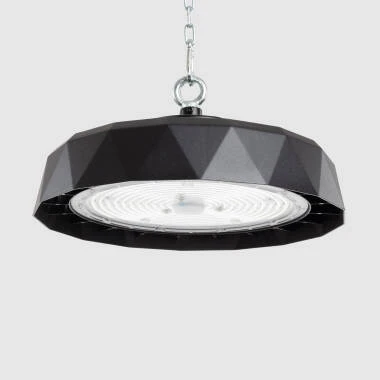
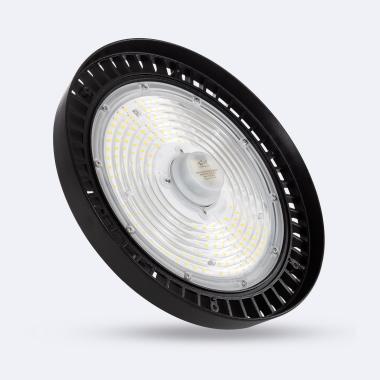
Our featured products from Industrial LED High Bays
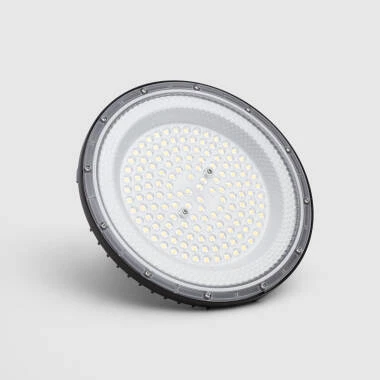
Essential
17,39 €
- Wattage 100 W
- Voltage Range 220-240V AC
- Lumen 12000 lm
3 options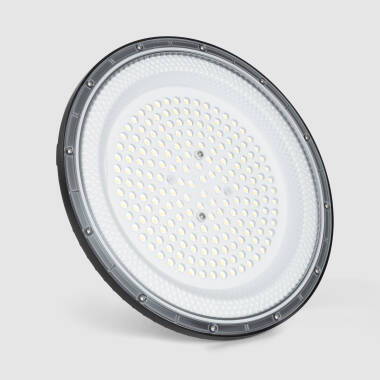
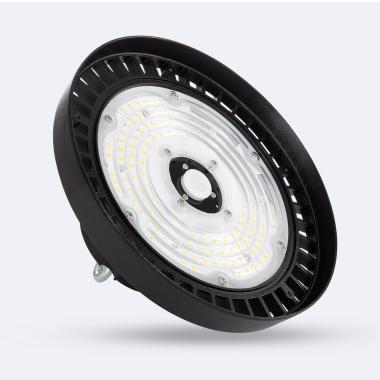
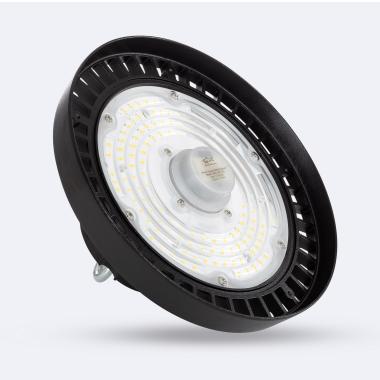
Essential
23,59 €
- Wattage 150 W
- Voltage Range 220-240V AC
- Lumen 18000 lm
3 options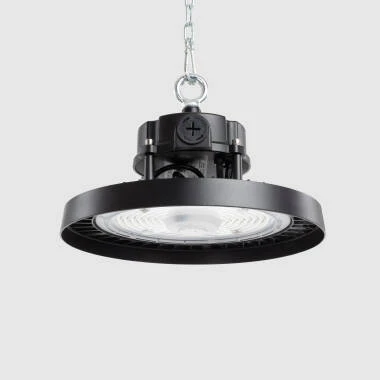
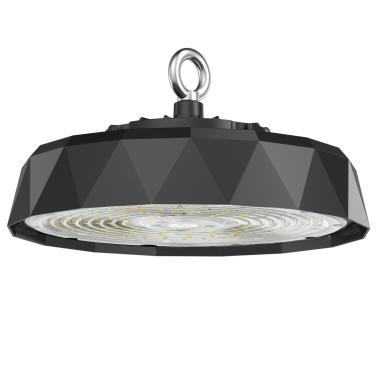
Advanced
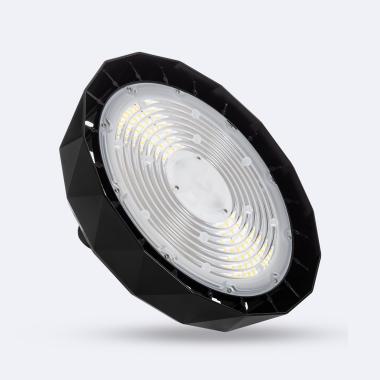
37,19 €
Ref 177512
UFO LED 0-10V Dimmable High Bay HBD Evo LUMILEDS 170lm/W LIFUD
In Stock, delivery in 16-21 days
- Wattage 100 W
- Voltage Range 220-240V AC
- Lumen 17000 lm
18 options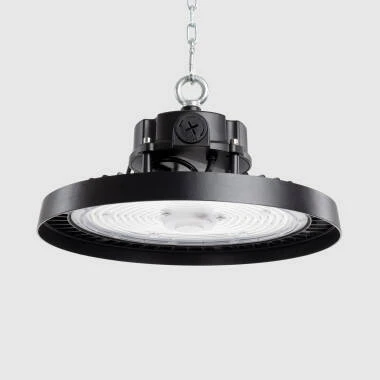
Advanced
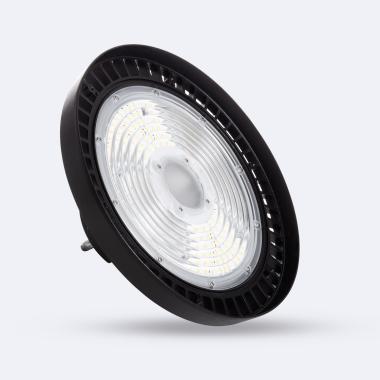
54,12 €
Ref 177512
UFO LED 0-10V Dimmable High Bay HBD Evo LUMILEDS 170lm/W LIFUD
In Stock, delivery in 16-21 days
- Wattage 200 W
- Voltage Range 220-240V AC
- Lumen 34000 lm
18 options





Brands related to this category


About Industrial LED High Bays
In spaces with high ceilings, constant activity, and demanding conditions, it is fundamental to guarantee adequate levels of visibility, uniformity, and energy efficiency. Within Industrial LED Lighting, LED high bays have established themselves as a reliable technical solution to cover large surfaces with fewer light points, reducing both consumption and maintenance.
What are industrial LED high bays
Industrial LED high bays are luminaires specifically designed to be installed at a certain height, usually between 4 and 15 meters, with the aim of providing direct, powerful, and homogeneous lighting over wide areas.
Unlike other solutions, their optical design allows for the control of the light beam distribution to adapt to different space configurations. This translates into better uniformity, less loss of luminous flux, and a significant reduction in shadow zones, especially in industrial units, warehouses, or logistics areas.
Furthermore, LED technology allows for efficiencies exceeding 130–160 lm/W in many models, which means obtaining more light with lower electrical consumption. Added to this is a typical lifespan of 50,000 hours or more, reducing maintenance interventions in installations where access is usually complex.
Types of industrial LED high bays
There are different configurations of LED high bays depending on the design, light distribution, and type of installation. Choosing the right format directly influences the quality of the lighting.
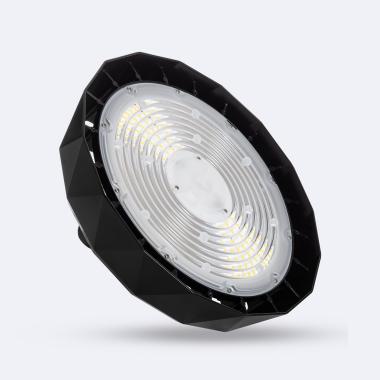
UFO High Bays
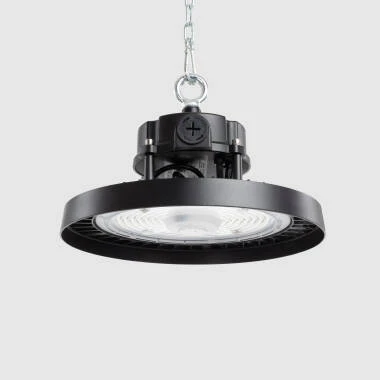
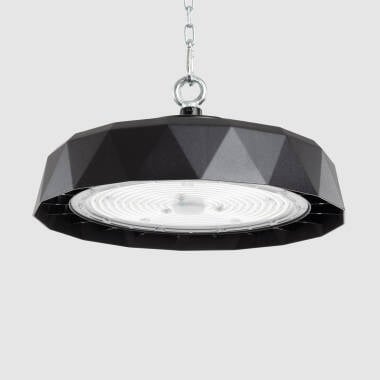
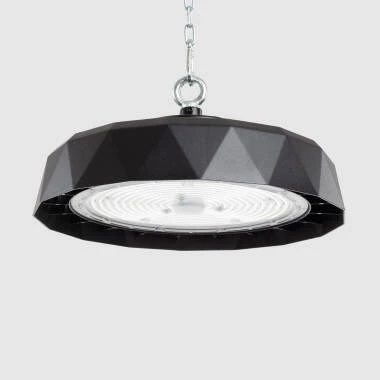
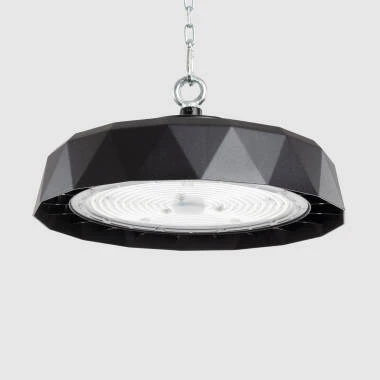
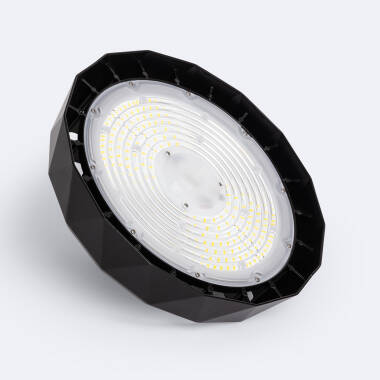
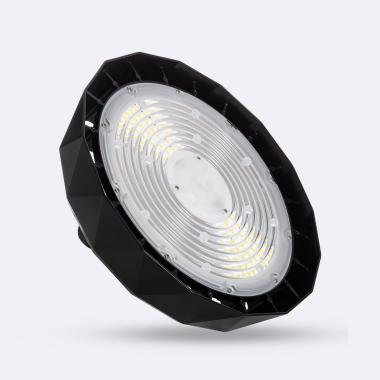
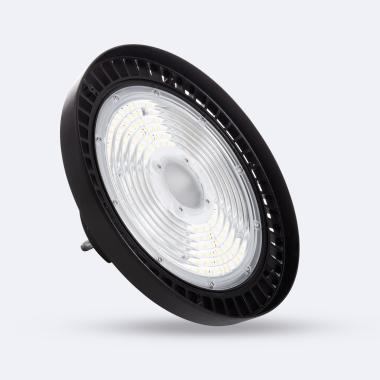
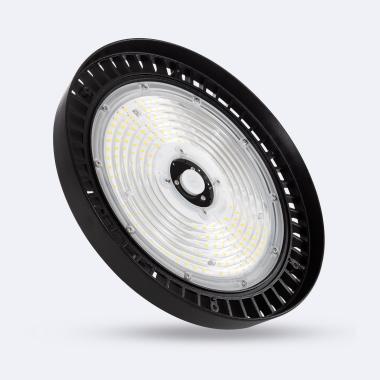
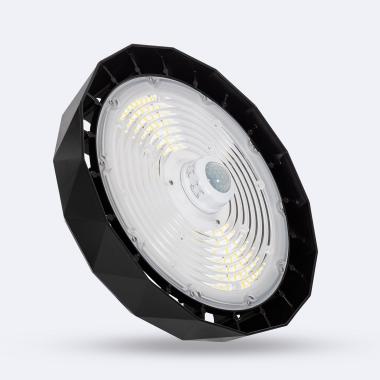
UFO High Bays are characterized by their compact and circular design, with a robust body that facilitates thermal dissipation. This format is particularly common in industrial installations due to its balance between power, durability, and ease of assembly.
Thanks to their optics, they allow for beam angles that typically range between 60° and 120°, adapting to both medium and high mounting heights. They are a common solution in warehouses, workshops, production zones, or logistics pavilions where powerful and uniform lighting is sought.
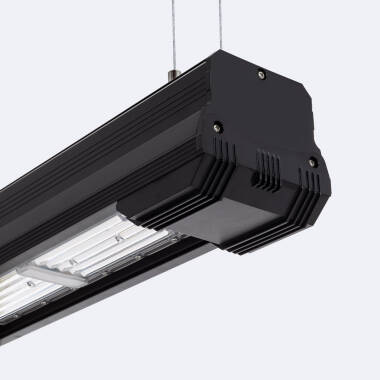
Linear LED High Bays
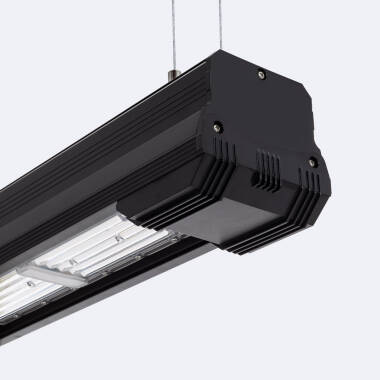
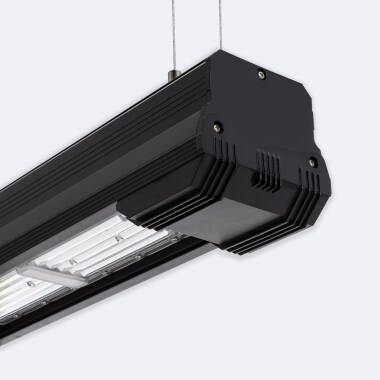
Linear LED High Bays feature an elongated design that favors a more longitudinal distribution of light. This type of luminaire is especially useful in aisles, production lines, or high shelving, where it is necessary to follow the geometry of the space.
Their main advantage is the improvement of uniformity in long and narrow zones, reducing shadows between shelves or machinery. Additionally, they allow for the optimization of luminaire layout, avoiding over-lighting in specific areas.
Control and regulation systems in industrial high bays
Industrial LED high bays can integrate different control systems that allow the lighting to be adjusted based on the actual use of the space, improving energy efficiency and visual comfort.
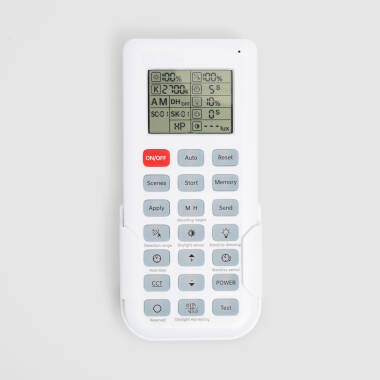
Among the most common solutions are analog regulation (1-10V), digital protocols, and integration with sensors. Each system responds to different needs depending on the size of the installation, the level of automation required, and the type of activity.
In this context, DALI Industrial LED High Bays represent an option within digital systems, allowing for precise regulation, the creation of scenes, and management by zones. However, in many installations, simpler solutions like 1-10V are also used, especially in projects where advanced centralized control is not required.
Presence sensors allow for the reduction of intensity or the turning off of lighting in areas without activity, while natural light sensors automatically adjust the luminous flux to maintain constant levels between 300 and 500 lux on the work plane. This approach, known as "daylight harvesting," can generate additional savings of 20% to 40% in installations with natural light intake.
In large-scale industrial installations, the combination of regulation, sectorization, and sensors allows the lighting to be adapted to schedules, shifts, or specific zones, avoiding over-lighting and optimizing energy consumption without compromising safety or visibility.
How to choose industrial LED high bays
Correctly selecting an LED high bay involves analyzing the space, the activity, and the required lighting levels. An appropriate choice directly impacts efficiency, safety, and visual comfort.
Installation height and light distribution
The mounting height conditions both the necessary power and the type of optics. At greater heights, a higher luminous flux is required and, in many cases, more controlled beam angles to avoid light loss.
In installations between 4 and 6 meters, it is common to work with moderate powers and wide angles. From 8–10 meters upwards, luminaires with higher intensity and narrower optics are required to ensure the light correctly reaches the work plane.
Required lighting level (lux)
The lighting level is measured in lux and depends on the type of activity. In low-rotation warehouses, values around 100–200 lux may be sufficient, while in production or handling areas, levels between 300 and 500 lux are recommended.
For precision tasks or quality control, requirements may exceed 500 lux, necessitating a more detailed lighting design that takes uniformity and glare into account.
Efficiency and energy consumption
One of the main benefits of LED high bays is their high performance. Compared to traditional technologies like metal halides, it is possible to reduce energy consumption by between 40% and 70% while maintaining or even improving lighting levels.
Furthermore, the stability of the luminous flux over time prevents performance drops, which is common in conventional technologies.
Color temperature and visual comfort
Color temperature directly influences the perception of the space and visibility. In industrial environments, the most common range is between 4000K and 5000K, providing a neutral or slightly cool light that improves concentration and the perception of details.
A correct choice also helps reduce visual fatigue, especially during long working days.
Protection ratings and durability
In industrial environments, it is common to find dust, moisture, or vibrations. Therefore, it is important to select luminaires with appropriate protection ratings, such as IP65 or higher, and sufficient mechanical resistance (IK).
This guarantees stable operation and reduces the risk of premature failure, especially in demanding installations.
Applications of industrial LED high bays
LED high bays are used in a wide variety of industrial and logistics environments, where lighting plays a key role in daily operations.
Industrial units and production zones
In production spaces, lighting levels usually sit between 300 and 500 lux on the work plane, potentially reaching 750 lux for more demanding tasks. The key is not just power, but uniformity, with typical ratios of 0.6–0.7 to avoid contrasts.
In these types of environments, it is common to work with heights between 6 and 12 meters, using UFO-type high bays with 90° or 120° optics depending on the density of the luminaires. Correct distribution allows for a reduction in light points without generating shadows on machinery or production lines, improving operational efficiency.
Warehouses and logistics
In warehouses, especially those with shelving higher than 8 meters, the goal is to guarantee between 150 and 300 lux in circulation and picking zones. Here, light distribution takes on special importance, as poor orientation generates shadows on lower levels.
Linear LED high bays allow for the following of long, narrow aisles, while UFO high bays work better in open areas. In advanced logistics installations, asymmetrical optics or combinations of angles are used to improve light penetration between shelves.
Sports centers and large surfaces
In high-ceiling commercial spaces, typical levels are between 300 and 500 lux, seeking uniform lighting that avoids dark zones and improves the perception of the space.
In sports halls, LED high bays can be used in recreational or low-level facilities, with values between 200 and 500 lux. However, when there are more demanding technical requirements, such as television broadcasts or strict control of glare and light distribution, specialized solutions like stadium floodlights are used, designed to offer greater optical precision and uniformity.
Workshops and technical spaces
In workshops, lighting levels are usually between 500 and 750 lux, especially in assembly, repair, or inspection zones. For precision tasks, these values can be increased to improve the visibility of details.
In this context, it is important to work with color temperatures around 4000K–5000K and a good color rendering index (CRI >80), which allows for the identification of materials, colors, and finishes with greater precision. Well-dimensioned lighting reduces errors, improves productivity, and increases safety in the work environment.
Advantages of industrial LED high bays
LED high bays stand out for offering a combination of efficiency, durability, and light quality that is difficult to match with other technologies.
In terms of consumption, they allow for a significant reduction in the energy required to illuminate large spaces. This improvement translates into lower operating costs, especially in installations with many hours of daily use.
From a maintenance point of view, their long useful life reduces the need for replacements, which is particularly relevant in high-altitude installations where access is complex.
At a lighting level, they provide instant start-up, an absence of flickering, and more stable light, which improves visual comfort and safety in the work environment.
Frequently asked questions about industrial LED high bays
What is the difference between an LED high bay and a conventional luminaire?
An industrial LED high bay typically offers real efficiencies of 130–160 lm/W, compared to the 70–100 lm/W common in metal halides. This translates into consumption reductions of 40% to 60% for the same lux level. Additionally, while a traditional lamp may require replacement every 10,000–15,000 hours, an LED high bay maintains more than 80% of its luminous flux for 50,000 hours (L80), drastically reducing maintenance and installation downtime.
How many lumens do I need for an industrial unit?
The calculation starts from the required lux level. For example, for a 1,000 m² unit with a target of 300 lux, approximately 300,000 useful lumens are needed on the work plane. Taking into account losses due to height, reflectance, and uniformity (maintenance and utilization factor between 0.5 and 0.7), the actual installation usually requires between 430,000 and 600,000 total installed lumens. This is equivalent, for example, to 10–15 high bays of 40,000 lm depending on the distribution.
What height is suitable for installing LED high bays?
LED high bays are normally used between 4 and 15 meters, but the selection should be adjusted more precisely:
- Between 4 and 6 m: 100–150W high bays with 90°–120° optics.
- Between 6 and 10 m: 150–200W powers with 90° angles.
- More than 10 m: 200–300W high bays or higher, with 60°–90° optics to concentrate the flux.
A poor combination of height and optics can cause losses of up to 30% of the useful flux or generate areas with insufficient lighting.
Is it recommended to use regulation in industrial environments?
Yes, especially in installations with more than 3,000–4,000 hours of annual use. Systems like DALI or 1-10V allow for additional consumption reductions of 20% to 40% when combined with presence or natural light sensors. In units with skylights, the use of light sensors can maintain constant levels of 300–500 lux by automatically reducing power during daylight hours, optimizing consumption without affecting visibility.
What is the useful life of an industrial LED high bay?
Most industrial LED high bays are designed for 50,000–100,000 hours (L80–L70), depending on the quality of the driver and the thermal dissipation. In a typical use of 10–12 hours daily, this equates to between 10 and 20 years of operation. In comparison, traditional technologies require several replacements during that same period, increasing maintenance and labor costs.