
Square LED downlights
Square LED downlights provide clean, precise recessed lighting, ideal for modern ceilings where uniformity, efficiency and a more architectural aesthetic are required.
Our featured products from Square LED downlights
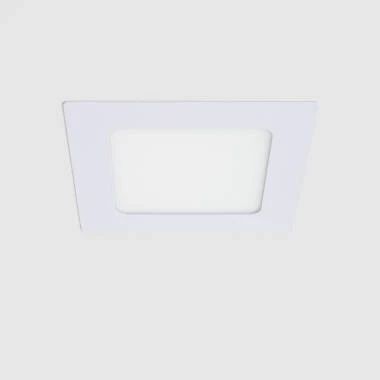
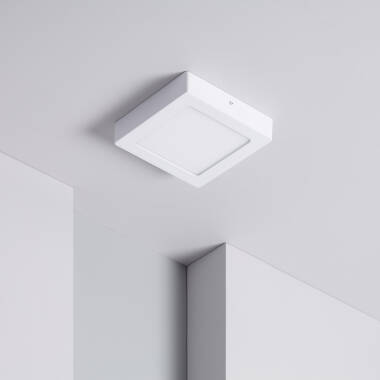
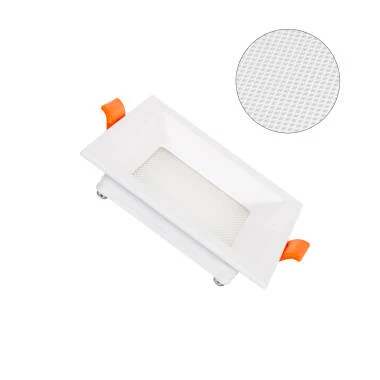
Essential
2,79 €
- Wattage 6 W
- Voltage Range 220-240V AC
- Lumen 600 lm
4 options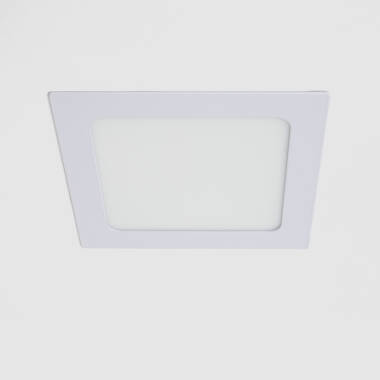
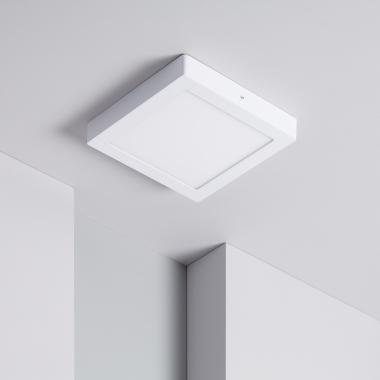
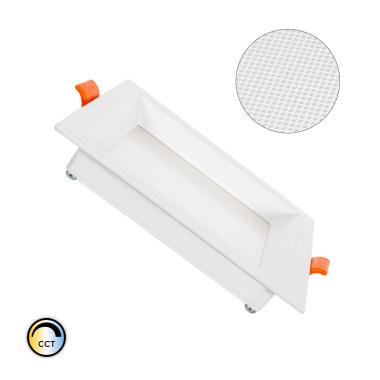
Essential
3,89 €
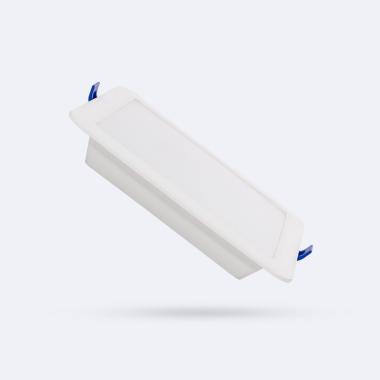
- Wattage 9 W
- Voltage Range 220-240V AC
- Lumen 900 lm
4 options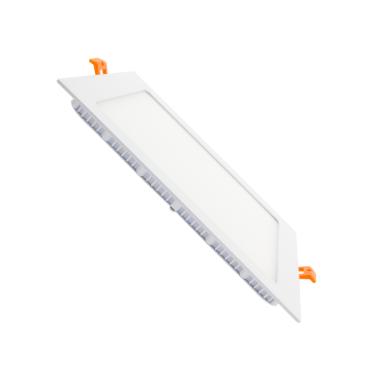
Essential
5,39 €
 (15)
(15)Ref 222
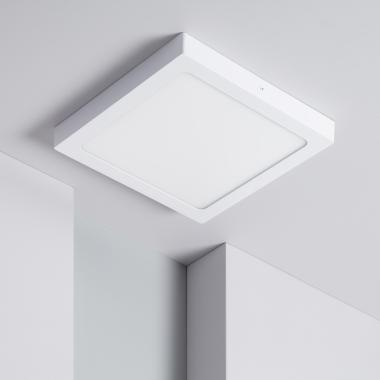
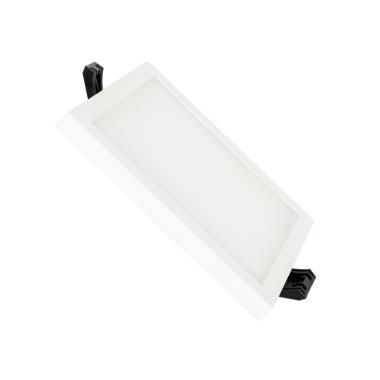
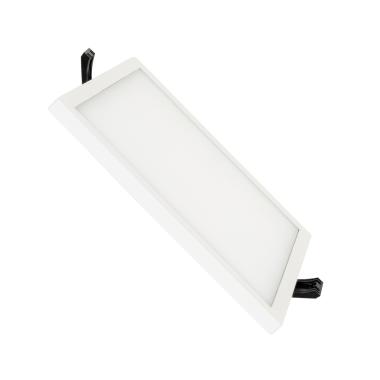
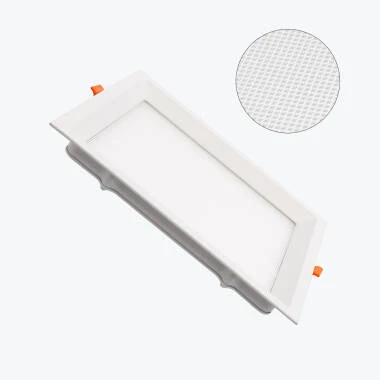
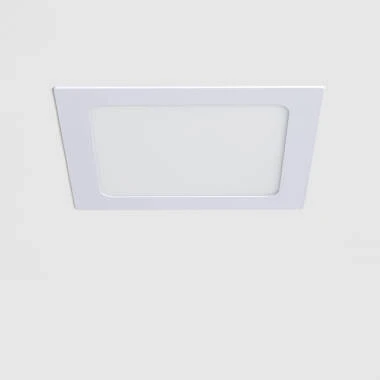
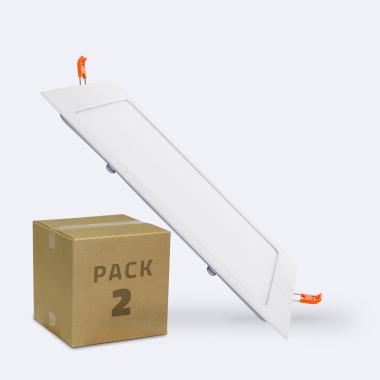
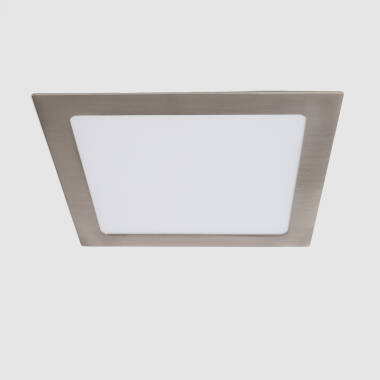
AluminiumSquare SuperSlim 18W LED Downlight 205x205mm Cut Out
In Stock, delivery in 15-20 days
- Wattage 18 W
- Voltage Range 220-240V AC
- Cut Out Dimensions 205 mm x 205 mm
4 options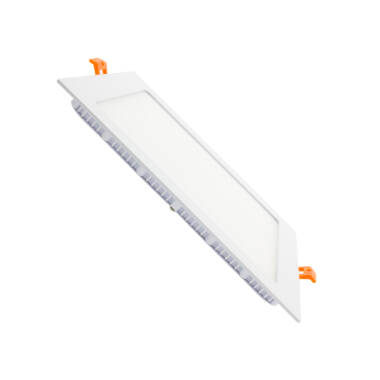
Essential
9,99 €
Ref 401
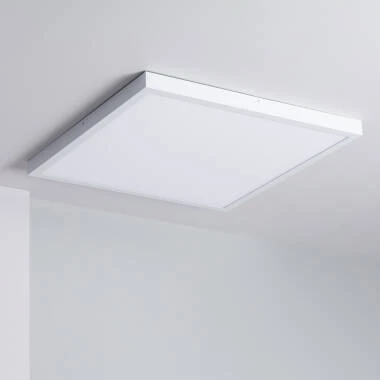
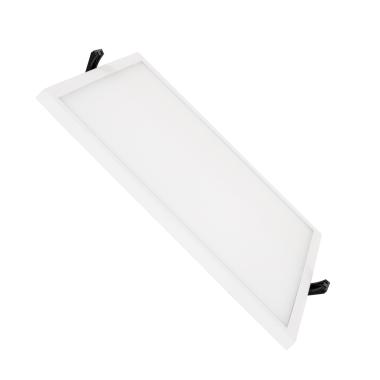
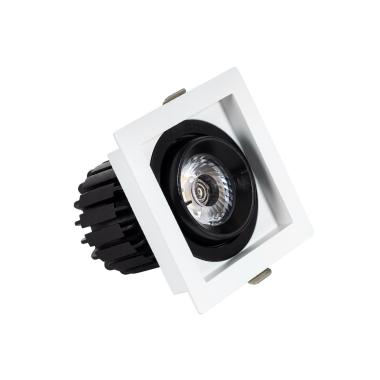
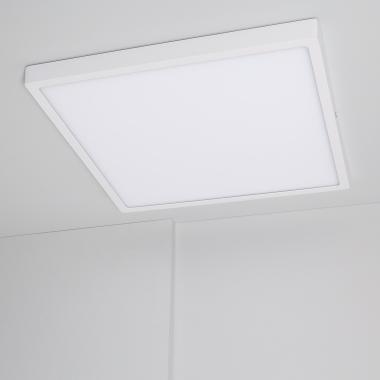
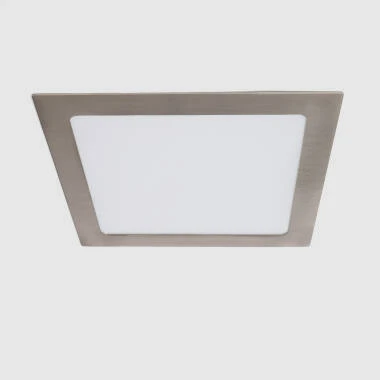
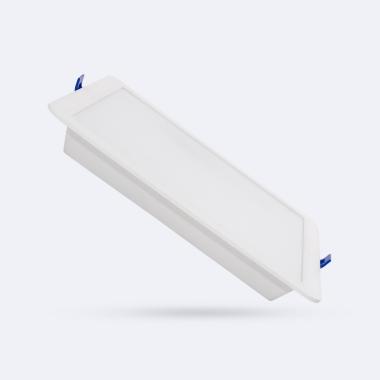
AluminiumSquare SuperSlim 20W LED Downlight 215x215mm Cut Out
In Stock, delivery in 15-20 days
- Wattage 20 W
- Voltage Range 220-240V AC
- Cut Out Dimensions 215 mm x 215 mm
4 options





You may also be interested in
Brands related to this category


About Square LED downlights
Square downlights are a widely used alternative in projects where lighting needs to be integrated into the ceiling without losing visual presence. Their straight-edged format works especially well in kitchens, living rooms, corridors, offices, shops and contemporary design spaces, where the lines of the furniture, finishes or ceiling layout play an important role.
From a technical point of view, they work according to the same principles as other recessed downlights: they project light downwards, can offer different beam angles, wattages, colour temperatures and protection levels, and can be used for both general lighting and accent lighting. The difference lies in how they integrate visually and how they help organise the ceiling composition.
Characteristics of square downlights
Square downlights combine LED efficiency, recessed installation and a geometric design that provides a more technical aesthetic aligned with modern spaces.
Within the general range of LED downlights, square models stand out for their ability to create very orderly layouts. Because of their straight shape, they are especially suitable when installed along clear axes: above a worktop, along a corridor, parallel to a kitchen island, in a dining area or forming grids in offices and shops.
Their main visual advantage is their integration with straight-line architecture. In plasterboard ceilings, suspended grid ceilings or modern renovations, a square downlight can reinforce the sense of continuity with doors, wardrobes, kitchen units, tiles or decorative profiles.
From a lighting perspective, the external shape alone does not determine light quality. The key factors are luminous flux, beam angle, diffuser type, colour rendering, colour temperature and the efficiency of the LED-driver set. A square downlight can provide broad, diffused light for general lighting, or a more concentrated beam if it incorporates a specific optic.
In residential settings, wattages between 6W and 18W are commonly used, with approximate outputs from 500 to 1,800 lumens depending on the model. In professional or commercial spaces, higher-output versions can be used to achieve higher lighting levels, especially when the ceiling is high or the activity requires greater visibility.
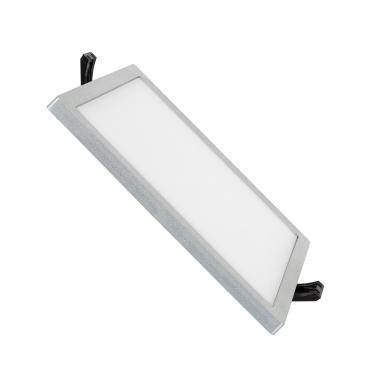
Another important feature is the finish. White models integrate easily into light-coloured ceilings and are more discreet. Black, aluminium or chrome finishes provide greater contrast and can be used when the light fitting forms part of the space’s design. In projects where a minimalist aesthetic is desired, a slim bezel and homogeneous diffuser help reduce the visual presence of the light point.
Fixed and adjustable square downlights
Fixed square downlights are the most common option for general lighting. They project light downwards in a stable way and make it possible to create an even distribution across entire rooms. They are suitable for kitchens, living rooms, corridors, bathrooms, offices and areas where regular light is required without highlighting a specific point.
In this type of fitting, the beam angle is a key specification. Models with wide beam angles, between 90° and 120°, spread light over a larger surface and reduce contrast. They are suitable for residential ceilings of 2.4 to 2.7 metres, where the space needs to be well covered without creating overly marked pools of light.
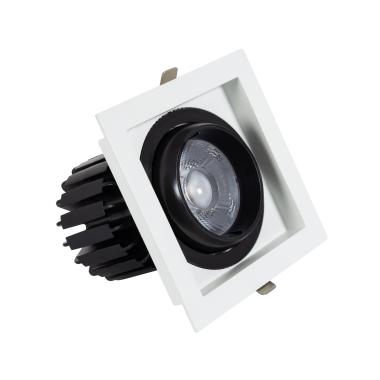
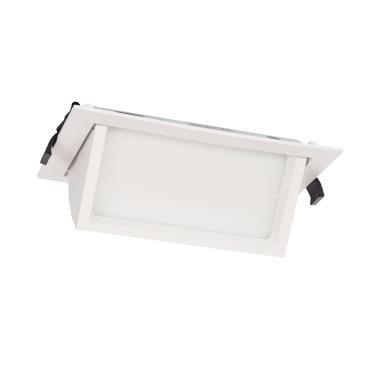
Adjustable square downlights allow the light beam to be tilted towards a specific area. They are useful when you want to illuminate a wall, shelf, worktop, picture, reading area or product on display. They are also practical in renovations where the existing light point is not exactly above the area to be illuminated.
In living rooms and shops, adjustable models help create more dynamic lighting. For example, fixed downlights for general light can be combined with adjustable ones directed towards a decorative wall or product area. In kitchens, they can be used to reinforce work areas if the furniture layout does not allow the light point to be placed in the ideal position.
Adjustment should be carried out carefully to avoid glare. If the beam is directed towards a passage area or towards the user’s usual line of sight, it can become uncomfortable. In spaces used for long periods, it is advisable to prioritise models with controlled optics, quality diffusers or designs that reduce direct glare.
Sizes and cut-out dimensions
Although they are referred to as square downlights, installation still depends on the recessed opening and the actual dimensions of the product. In many models, the cut-out is also square, while others may have a square front and a circular installation body. For this reason, it is important to always check the technical data sheet before replacing or installing a fitting.
In small models, the cut-out may be around 65 x 65 mm, 75 x 75 mm or 90 x 90 mm, common sizes for support lighting points, corridors or decorative lighting. Medium formats may require cut-outs of 120 x 120 mm, 150 x 150 mm or similar dimensions, widely used in homes for general lighting. Large models may exceed 200 mm and are used when more luminous flux is needed or when replacing older larger fittings.
The external size also matters. A downlight may require a 150 mm cut-out but have a visible frame of 170 or 180 mm. This difference allows it to cover the opening and hide small irregularities in the ceiling. In renovations, measuring only the old front is not enough: the actual opening, available depth and fixing system must be checked.
Recessed depth is another key factor. Some extra-flat square downlights require only a few centimetres of height, making them easier to install in shallow suspended ceilings. Other models, especially adjustable or higher-power versions, require more space to house the body, heat sink and driver.
It is also advisable to leave room for ventilation. Although LED technology generates less heat than older halogen lamps, it still needs to dissipate temperature correctly. An installation that is too enclosed or has insulation in direct contact with the fitting can reduce the service life of the LED and the driver.
Where to install square downlights
Square downlights work especially well in spaces where the ceiling and furniture layout follows straight lines.
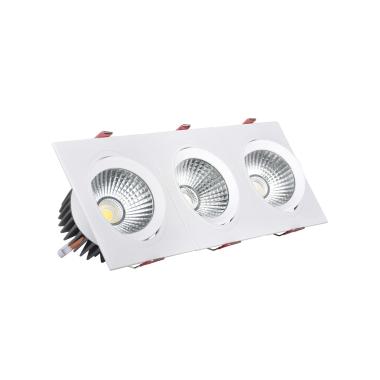
Their format makes it possible to create very orderly compositions, both in residential and professional environments. They can be installed in a line, in a grid, in symmetrical pairs or combined with other lighting systems, such as LED strips, decorative lamps or wall lights.
Kitchens
A square kitchen LED downlight is a very practical option when functional lighting aligned with cabinets, an island or a worktop is required. The kitchen needs enough light to prepare food, clean, cook and handle utensils safely. For this reason, it is advisable to work with approximate levels of 300 to 500 lux in the main use areas.
In this space, the most common colour temperature is 4000K, because it provides neutral light that improves the perception of cleanliness and makes it easier to distinguish food, surfaces and utensils. If the kitchen is open to the living room, 3000K can be chosen to maintain a warmer atmosphere, or separate circuits can be combined if greater flexibility is desired.
Positioning is especially important. If the downlights are placed too far behind the person, they can cast shadows over the worktop. Ideally, the light points should be planned so that they illuminate the work areas directly, keeping an appropriate distance from wall units and avoiding annoying reflections on glossy surfaces.
Living rooms
A square LED downlight for the living room provides a clean, contemporary aesthetic. It can be used as general lighting, but also as part of a zoned composition: sofa area, dining area, bookcase, decorative wall or passage area. In this case, the colour temperature is usually between 2700K and 3000K to create a more comfortable atmosphere.
In large living rooms, it is advisable to avoid a single uniform grid if the space has several uses. A zoned layout makes it possible to switch on only the light needed at each moment. Dimmable downlights or fittings combined with different circuits help adapt the lighting for watching TV, reading, receiving guests or creating a more ambient light.
Other rooms and uses
They are also very useful in corridors and hallways. Their geometric design allows clean alignments along the circulation axis. In these areas, it is not usually necessary to achieve high levels: between 100 and 150 lux can be enough to ensure safe and comfortable circulation.
In offices, studies and meeting rooms, square downlights can be integrated into modular or plasterboard ceilings, creating a professional and orderly appearance. In these spaces, glare should be carefully controlled, especially if there are screens, work desks or users seated for many hours. Neutral 4000K light, a minimum CRI of 80 and a homogeneous distribution help improve visual comfort.
In shops, they can be used for general lighting or to reinforce specific zones. Adjustable models allow light to be directed towards displays, walls or products, while fixed models help maintain an even base light. In this type of application, a high CRI can make a difference in the perception of colours, textiles, food or finishes.
How to choose your square downlight
To select the ideal square downlight, it is essential to assess several technical and decorative aspects that ensure perfect integration: from the function of the space and recessed dimensions to light performance and frame aesthetics.
Looking at the lighting plan, models offering between 700 and 1,200 lumens comfortably cover the needs of a standard home, while professional environments or high ceilings will require higher outputs. Beyond wattage, the key lies in efficiency, with standards typically ranging between 80 and 120 lm/W. Similarly, the beam must respond to the project objective: generous 90° to 120° openings for uniform base light, or concentrated 24° to 60° optics if the aim is to accentuate architectural or decorative details.
Colour temperature defines the atmosphere of the room: warm tones from 2700K to 3000K are the natural choice for relaxation areas, neutral white at 4000K supports concentration in work areas, and 5000K provides maximum technical clarity. In projects where faithful colour reproduction is critical, such as dressing rooms or galleries, it is advisable to prioritise a CRI of 90 over the standard value of 80.
Finally, installation feasibility depends on a rigorous technical check: it is essential to compare the cut-out with the technical data sheet, select the appropriate IP rating according to exposure to humidity, from IP20 in dry rooms to IP65 in water-prone areas, and ensure that the driver is compatible if dimming is required. A construction that favours thermal dissipation and a quality electronic component are the best safeguards for achieving the expected service life without performance loss.
Frequently asked questions
What is the difference between a square downlight and a round one?
The main difference is aesthetic and relates to integration into the ceiling. A square downlight fits better in spaces with straight lines, modern kitchens, offices, shops or projects where a more architectural composition is desired. A round downlight is more neutral and more common in general installations.
In terms of light, both can offer similar performance if they have the same wattage, luminous flux, optic, colour temperature and driver quality. The external shape alone does not determine lighting performance.
Do square downlights provide less light than round ones?
Not necessarily. A square downlight can provide the same amount of light or more than a round one if it offers the same luminous flux in lumens. The important thing is to check the technical data, not the shape.
A 12W model can provide 900, 1,000 or 1,200 lumens depending on its efficiency. That is why it is advisable to compare lumens, beam angle and performance, not just design or wattage.
What size square downlight do I need?
It depends on the available opening and the required light level. In a new build, the size can be chosen according to the ceiling design. In renovations, the first step is to measure the existing cut-out and check that the new model fits correctly.
The external size must also be checked, because it needs to cover the opening without being too tight. If the cut-out is irregular or too large, it may be necessary to use an adapter ring or choose a larger-format fitting.
What colour temperature should I choose for square downlights?
For living rooms, bedrooms and relaxation areas, 2700K or 3000K is usually chosen. For kitchens, bathrooms and work areas, 4000K usually offers better visibility. In garages, storage rooms or technical spaces, 5000K can be used if a cooler light is desired.
It is advisable to maintain consistency within the same room. Mixing colour temperatures without planning can create a visually uneven effect.
Can I install square downlights in a bathroom?
Yes, provided the model has the appropriate IP rating for the area where it is installed. In areas away from splashes, IP44 may be sufficient, while near a shower or bath, greater protection such as IP65 is usually required, in accordance with the applicable electrical regulations.
In addition to IP rating, it is advisable to choose an appropriate colour temperature and good colour rendering if the bathroom is used for make-up, shaving or personal care.
Are adjustable square downlights recommended?
Yes, when you want to direct the light towards a specific area. They are useful for illuminating walls, pictures, shelves, worktops, shop windows or reading areas.
For general lighting, fixed models are usually simpler and more uniform. In many projects, it works well to combine fixed downlights for base lighting with adjustable ones for specific accents.
How many square downlights do I need in a living room?
It depends on the square metres, the output of each fitting and the desired light level. As a reference, a living room can work with 150–250 lux for general lighting. A 20 m² living room with a target of 200 lux would need around 4,000 useful lumens.
If each downlight provides 800 lumens, around five points could be installed, adjusting the layout by zones and preventing the light from being concentrated only in the centre.
Can square downlights be dimmed?
Yes, provided the model is dimmable and the dimmer is compatible with LED. If the driver is not designed for dimming, flickering, buzzing or switch-on failures may occur.
In living rooms, bedrooms, restaurants and meeting rooms, dimming is especially useful because it allows the intensity to be adapted to different moments and uses.
What beam angle is best for square downlights?
For general lighting, angles between 90° and 120° usually provide broad and comfortable light. To highlight specific elements, narrower angles between 24° and 60° are preferable.
In low ceilings, an angle that is too narrow can create pools of light. In higher ceilings, it may be necessary to narrow the beam slightly so that the light reaches the working plane with sufficient intensity.
How long does a square LED downlight last?
The usual service life is between 25,000 and 50,000 hours, depending on the quality of the LED, driver and thermal dissipation. In a home with 4 hours of daily use, 25,000 hours is equivalent to more than 17 years of theoretical operation.
In installations with many hours of use, such as shops or offices, it is advisable to prioritise models with good thermal management and a reliable driver, as these components directly influence real durability.