
GU10 Philips LED bulbs
Philips GU10 LED bulbs are designed for directional lighting, with different beam angles and light intensities for recessed and adjustable spotlights.
Our featured products from GU10 Philips LED bulbs
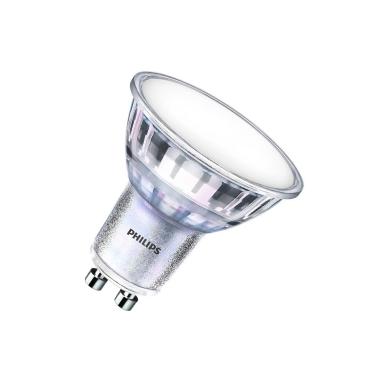
3,39 €
 (11)Philips
Ref 4518
GU10 PAR16 LED Bulb PHILIPS CorePro spotMV 5W 120º 550 lm
In Stock, delivery in 15-20 days
- Wattage 5 W
- Voltage Range 220-240V AC
- Lumen 550 lm
3 options
3,39 €
PhilipsRef 95137
GU10 PAR16 LED Bulb PHILIPS CorePro 4.9W 120º 550 lm
In Stock, delivery in 15-20 days
- Wattage 4.9 W
- Voltage Range 220-240V AC
- Lumen 550 lm




You may also be interested in
Brands related to this category


About GU10 Philips LED bulbs
GU10 bulbs are mainly used when the aim is to direct light towards a specific area. Their compact format and two-pin twist-lock connection make them common in ceiling spotlights, track lighting and adjustable fittings.
Philips GU10 LED bulbs for directional lighting
Philips GU10 LED bulbs are part of the range of Philips LED bulbs designed for applications where light needs to be projected in a controlled way. Unlike a standard bulb, which distributes luminous flux in several directions, a GU10 uses front optics that concentrate the light output within a specific angle.
This makes them suitable both for general lighting using several spotlights and for highlighting shop windows, products, pictures, circulation areas or work surfaces. The right choice depends on the distance between the bulb and the surface, the number of installed light points and the beam angle.
What characterises a Philips GU10 bulb?
The GU10 format combines a specific base with a shape designed to work as a spotlight. Installation is straightforward, but it is important to distinguish it from other visually similar formats before replacing a bulb.
Characteristics of the GU10 base
The GU10 base has two short pins with wider ends that are inserted into the lampholder and locked in place with a slight twist. The distance between the two connections is approximately 10 mm, which is where the GU10 designation comes from.
In standard installations in Spain, these spotlights usually operate directly at mains voltage, so they do not require a specific external transformer. This distinguishes them from other low-voltage formats used in spotlights with a similar appearance.
The front diameter of many GU10 bulbs is around 50 mm, although the total length may vary depending on the design and integrated electronics.
How to identify a GU10 bulb
The most reliable way to identify one is to look at the base. A GU10 has two short connections with wider ends that allow it to lock into place by twisting. It should not be confused with bases that use two thin, straight pins.
The GU10 reference is also usually printed on the body of the bulb. Before replacing a spotlight, it is advisable to disconnect the power supply and remove the bulb using the lampholder’s twist-lock system to check both the base and the dimensions.
Types of Philips GU10 LED bulbs
Although they share the same base, GU10 bulbs can behave very differently depending on their optics. The beam angle determines the area covered and the intensity achieved at the centre of the illuminated zone.
GU10 bulbs with a narrow beam
Spotlights with a narrow beam angle concentrate most of the light within a small area. Angles of around 25° or 36° are common and are particularly useful when highlighting an object, a table, a wall texture or a product.
By concentrating the lumens over a smaller surface, they can produce high illuminance at the centre of the beam even with a moderate luminous flux.
This type of optic is useful for adjustable track lighting, shop windows and accent lighting systems.
GU10 bulbs with a wide beam angle
GU10 bulbs with beam angles of 60° or more distribute light over a larger surface. They are usually used when several spotlights need to work together to achieve more uniform lighting.
A wide beam angle reduces the difference between the centre of the beam and the surrounding areas, although it also lowers the maximum intensity reaching a specific surface.
For this reason, they are a common choice in kitchens, corridors, circulation areas or rooms where general lighting is provided by recessed spotlights.
Dimmable GU10 bulbs
Dimmable GU10 bulbs allow the light level to be adjusted using a compatible dimmer. This function is useful when the same spotlights need to provide bright lighting during an activity and a lower level at other times.
Not all GU10 LED bulbs support dimming. This feature must be clearly stated, and the dimmer must also be compatible with LED loads.
How to choose a Philips GU10 bulb
The choice should take into account both the amount of light and the way that light reaches the surface. With a directional spotlight, two bulbs with the same number of lumens can produce very different results if they use different beam angles.
Wattage and luminous flux
Wattage indicates electrical consumption, while lumens represent the total luminous flux. With LED technology, it is more useful to compare bulbs by lumens than by watts.
A GU10 LED bulb can provide several hundred lumens while consuming much less energy than a halogen spotlight. However, total luminous flux alone does not explain how much light will reach a worktop, display or floor.
In directional lighting, luminous flux should be considered together with the beam angle and the distance to the surface.
Beam angle
The beam angle indicates the width of the cone of light produced by the spotlight. The smaller the angle, the more concentrated the beam will be.
A 25° spotlight may be suitable for highlighting a limited area, while a 60° model covers a considerably larger surface from the same distance.
Installation height also has an effect. The further the spotlight is from the surface, the larger the diameter of the illuminated area and the lower the intensity received at each point.
Colour temperature
GU10 bulbs are available in different colour temperatures. Around 2700 K provides warm light, suitable for residential environments or areas where a cosy atmosphere is desired.
4000 K produces neutral light, commonly used in kitchens, shops and workspaces. Cooler tones close to 6000 K provide a whiter appearance with a stronger bluish component.
When several spotlights illuminate the same area, it is advisable to use the same colour temperature to avoid visible differences between the beams.
Light intensity and distribution
The intensity of light on a surface is expressed in lux. A GU10 spotlight can provide a high number of lux at the centre of the beam if it concentrates its lumens within a narrow angle.
For example, two spotlights producing 400 lumens can provide very different illuminance levels at a distance of one metre if one has a 25° beam angle and the other a 60° beam angle.
The spacing between spotlights should also be considered. If they are too far apart, dark areas may appear between the beams; if they are too close together, some areas may receive excessive light.
Differences between Philips GU10 and other LED spotlights
Philips GU10 bulbs share the same format and connection system as any compatible GU10 LED bulbs. The main difference compared with other spotlights of a similar appearance lies in the base, operating voltage and electrical system of the fitting.
GU10 vs MR16
GU10 and MR16 bulbs may have a similar front diameter, so they can easily be confused when viewed from the front. However, the MR16 designation mainly refers to the reflector format, while its usual connection may use a two-pin base such as GU5.3.
GU10 bulbs have two pins with a twist-lock connection and usually operate directly at mains voltage. MR16 spotlights with a GU5.3 base use two thin pins and are generally used in low-voltage installations.
For this reason, they should not be substituted for one another simply because their external dimensions look similar.
Differences in connection and power supply
A GU10 connects using two contacts with a twist-lock fitting. By contrast, a GU5.3 spotlight is inserted using two straight pins and normally requires a low-voltage power supply, often 12 V.
The electrical difference is essential. Installing a bulb designed for low voltage in a mains-voltage installation, or doing the reverse, can damage the bulb or prevent it from working.
Replacing GU10 halogen spotlights with Philips LED models
Replacing a GU10 halogen spotlight with an LED model is usually straightforward when both use the same base and operate at the same voltage. The first step is to disconnect the power supply and wait for the halogen bulb to cool down, as these lamps can reach high temperatures.
To maintain a similar lighting level, it is advisable to compare lumens rather than trying to match the wattage. The beam angle should also be compared. A new GU10 with a high lumen output but a much wider beam angle may produce less intensity at the centre than the previous spotlight.
If a dimmer is installed, it is necessary to check that the new bulb is dimmable and that the dimmer supports LED loads. Finally, the dimensions should be checked if the spotlight is installed inside a recessed ring or a fitting with limited space.
Frequently asked questions about Philips GU10 LED bulbs
What LED wattage replaces a halogen GU10?
There is no exact equivalence based on wattage alone. It is advisable to compare luminous flux and beam angle. As a reference, a 35 W GU10 halogen spotlight may provide around 300 to 400 lumens, while a 50 W model may reach approximately 400 to 500 lumens. An LED bulb can achieve these levels with much lower energy consumption.
What beam angle do I need?
To highlight an object or a small surface, beam angles of approximately 20° to 36° are commonly used. For general lighting with several spotlights, angles of 60° or more are more suitable. Installation height and the distance between the spotlights should also be taken into account, as they affect the size and overlap of the beams.
What is the difference between GU10 and MR16?
GU10 identifies a base with two twist-lock contacts that usually operates directly at mains voltage. Spotlights described as MR16 commonly use a GU5.3 base with two straight pins and operate at low voltage. Although both formats may look similar from the front, they are not directly interchangeable.
How can I tell if a Philips GU10 is dimmable?
Dimming capability must be clearly stated in the bulb specifications. If this feature is not indicated, it should not be assumed that the GU10 can be used with a dimmer. In addition, the dimmer must be compatible with LED technology and with the total load of the circuit.