
E14 Philips LED bulbs
Philips E14 LED bulbs are designed for compact light fittings that require a 14 mm screw base, from decorative lamps to wall lights and auxiliary lighting points.
Our featured products from E14 Philips LED bulbs
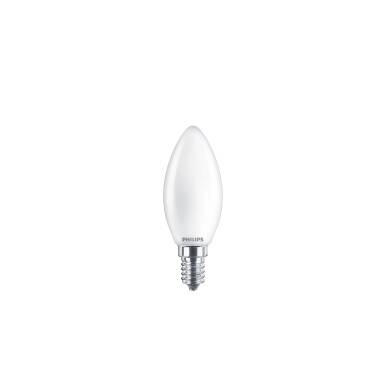

4,29 €
PhilipsRef 126626
E14 Filament LED Bulb PHILIPS Candle 4.3W BA38 470lm
In Stock, delivery in 16-21 days
- Wattage 4.3 W
- Voltage Range 220-240V AC
- Lumen 470 lm
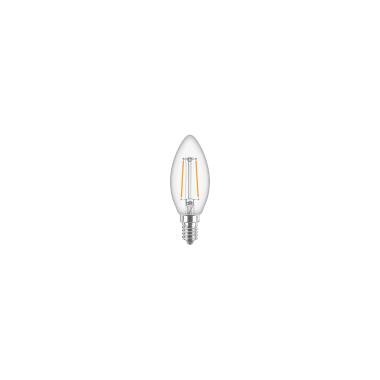
4,29 €
PhilipsRef 95167
E14 Filament LED Bulb PHILIPS CandleND 2W B35 36º 250 lm
In Stock, delivery in 15-20 days
- Wattage 2 W
- Voltage Range 220-240V AC
- Lumen 250 lm




You may also be interested in
Brands related to this category


About E14 Philips LED bulbs
The E14 base is one of the most widely used screw formats in compact light fittings. Its small diameter makes it possible to install LED bulbs in table lamps, wall lights and decorative lamps where the available space is limited. To choose the right bulb, it is important to consider not only the base, but also the lumens, dimensions, colour temperature and whether dimming is supported.
Philips E14 LED bulbs with a slim screw base
Philips E14 LED bulbs are part of the range of Philips LED bulbs designed to meet different domestic and professional lighting needs. They feature a slim 14 mm screw base, which is considerably narrower than the one used by E27 bulbs.
This format is practical in small light fittings where a larger standard bulb would not fit correctly. Different shapes are available with the same E14 base, from candle-style models to spherical bulbs and compact designs, making it possible to adapt both the appearance and the distribution of light to each fitting.
What is a Philips E14 bulb?
An E14 bulb is a light source that uses a 14 mm threaded base. The letter E refers to the Edison screw system, while the number indicates the approximate outer width of the base in millimetres.
Characteristics of the E14 base
The E14 uses a narrow metal thread that is secured to the lampholder by twisting it into place. In standard installations in Spain and other European countries, these bulbs are normally designed to operate directly at mains voltage.
Its small diameter allows it to be used in fittings with limited internal space. For this reason, it is commonly found in table lamps, wall lights, chandeliers and certain decorative fittings.
Sharing the same base does not mean that all E14 bulbs have the same dimensions. The length, diameter of the light-emitting section and overall shape can vary considerably.
How to identify an E14 bulb
The most reliable way to identify an E14 bulb is to check the reference printed on its body or base. If the marking E14 appears, it means that the bulb uses a screw thread of approximately 14 mm.
It can also be recognised visually because it is noticeably narrower than an E27. If the marking is no longer visible, the outer diameter of the base can be measured. A measurement close to 14 mm confirms the format.
Philips E14 LED bulb shapes
The E14 screw base is combined with different shapes to suit compact and decorative light fittings. Choosing the right shape is important both to ensure that the bulb fits inside the fitting and to achieve suitable light distribution.
Candle bulbs
Candle bulbs have a narrow, elongated body that resembles the shape of a flame. They are commonly used in chandeliers, decorative wall lights and multi-arm fittings where the bulb remains fully or partially visible.
Their design helps maintain a slender appearance without taking up too much lateral space. They are available with clear, frosted or visible LED filament finishes, depending on the desired aesthetic effect.
In open fittings, it is also advisable to consider glare, especially when the bulb is directly within the field of vision.
Spherical bulbs
E14 spherical bulbs have a rounded, compact shape. They are commonly used in table lamps, mirrors, wall lights and small fittings where a relatively wide light distribution is required.
Their diameter is usually smaller than that of a standard E27 bulb, although it can vary between models. For this reason, it is advisable to check the available space inside the lampshade or diffuser.
How to choose a Philips E14 LED bulb
The base is the first compatibility criterion, but it should not be the only one. An E14 bulb may fit physically into the lampholder while still providing too much or too little light, protruding from the shade or being incompatible with an existing dimmer.
Wattage and lumens
Wattage is expressed in watts and reflects electrical consumption. Lumens indicate the total amount of light emitted, making them a more useful reference when comparing an LED bulb with an older incandescent or halogen bulb.
E14 bulbs are frequently used in multi-light fittings. In these cases, it is advisable to calculate the total luminous flux by adding together the lumens of all installed light sources.
Colour temperature
Colour temperature determines the visual appearance of the light and is expressed in kelvins. Values close to 2700 K provide a warm tone similar to that of incandescent bulbs. Around 4000 K provides neutral light, while higher values produce an increasingly cooler appearance.
Warm tones are commonly used in bedroom lamps or relaxation areas. In mirrors, work areas or certain commercial installations, neutral light may be more suitable.
When a fitting uses several visible E14 bulbs, it is advisable to keep the same colour temperature across all of them to avoid noticeable differences between light points.
Size and shape
The E14 base only defines the base of the bulb. The light-emitting part may be candle-shaped, spherical, tubular or compact, and each format has different dimensions.
Before replacing a bulb, it is useful to measure the available height from the lampholder to the edge of the shade and also check the maximum permitted diameter.
This precaution is especially important in decorative lamps, where an oversized bulb can alter the proportions of the fitting or remain excessively exposed.
Dimmable E14 bulbs
Dimmable bulbs allow the light intensity to be adjusted using a compatible dimmer. Not all E14 LED bulbs support this function, so it must be clearly stated in their specifications.
It is also necessary to check the existing dimmer. Some dimmers originally designed for incandescent bulbs operate with minimum loads that are higher than those provided by several low-wattage LED bulbs.
When the load is not compatible, flickering, buzzing, sudden changes in brightness or difficulty reaching low dimming levels may occur.
Differences between Philips E14 and E27 bulbs
E14 and E27 use the same Edison screw connection principle, but they are designed for lampholders with different diameters. This difference influences the type of light fitting and the usual size of the available bulbs.
Differences in diameter and size
E14 has an approximate diameter of 14 mm, while E27 measures around 27 mm. The difference is clearly visible when comparing the two bases.
E14 bulbs are generally associated with smaller formats, such as candle bulbs and compact spherical bulbs. E27 bulbs are more commonly found in standard shapes and models capable of providing higher levels of luminous flux.
However, the external size is not determined solely by the base. There are relatively long E14 bulbs and compact E27 models, so it is always advisable to check the actual dimensions.
Compatibility with lampholders
An E14 bulb cannot be screwed directly into an E27 lampholder because the diameters are different. Likewise, an E27 bulb cannot be installed directly into an E14 base.
Adapters between the two formats are available, but using one increases the overall length and may alter the position of the bulb inside the fitting. Whenever possible, the simplest option is to use a bulb with the base that matches the original lampholder.
Replacing traditional E14 bulbs with Philips LED bulbs
When a fitting already uses an E14 LED bulb or a traditional lamp with the same screw base, replacing it with LED technology can usually be done without modifying the lampholder. The first step is to check that both use the same base and that the new bulb is suitable for the installation voltage.
Equivalence should be determined by lumens rather than by trying to maintain the same electrical wattage. An older 25 W E14 incandescent bulb can produce approximately 200 to 250 lumens, while a 40 W bulb usually provides around 470 lumens. An LED bulb can achieve similar values with considerably lower energy consumption.
It is also advisable to compare shape and dimensions. A traditional candle bulb may have a different length from its LED equivalent, which is relevant in fittings with narrow shades or decorative arms.
If the installation includes dimming, the new bulb must be specifically designed to work with a dimmer, and the dimmer must be compatible with LED loads. In enclosed fittings, it is also advisable to check the permitted ventilation conditions.
Frequently asked questions about Philips E14 LED bulbs
What size is an E14 base?
The E14 base has an approximate outer diameter of 14 mm. This measurement refers only to the metal screw thread and not to the total diameter of the bulb. The length and width of the body can vary depending on whether it is a candle, spherical or compact bulb, so the overall dimensions should be checked separately.
Can an E14 bulb be used in an E27 lampholder?
Not directly. An E14 bulb has a screw thread of around 14 mm, while an E27 lampholder is designed for a thread of approximately 27 mm. Certain adapters can be used, but they alter the total length of the assembly and may limit the available space inside the fitting. For a straightforward replacement, it is preferable to use the corresponding base.
What LED wattage should I choose?
With LED technology, it is advisable to choose based on lumens. To replace an incandescent bulb of approximately 25 W, a luminous flux close to 250 lumens can be used as a reference. To replace one of around 40 W, approximately 470 lumens is a common reference point. The LED wattage required to reach these levels can vary depending on the efficiency of each model, so two bulbs with different wattages may provide a similar amount of light.