
Garden Spot Lights
LED garden spot lights make it possible to illuminate plants, paths and green areas with precision, low consumption and an installation that can be adapted to different outdoor spaces.
Our featured products from Garden Spot Lights
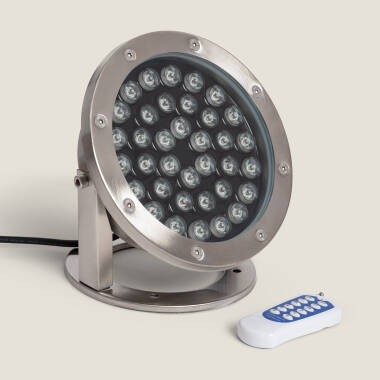
Expert
153,99 €
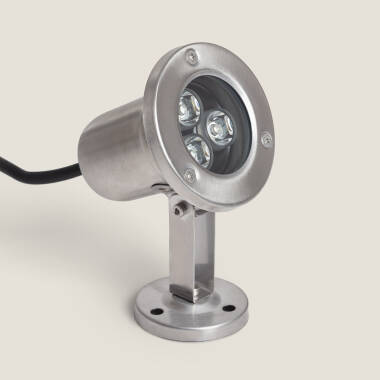
Advanced
36,89 €
Ref 3481
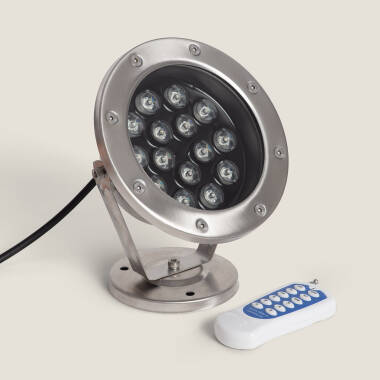
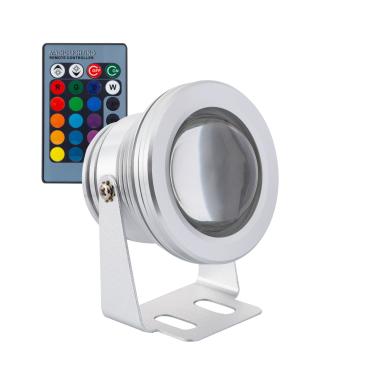
12V DC 3W RGB Stainless Steel Submersible Surface Mounted XtraPool LED Spotlight
RGB
In Stock, delivery in 15-20 days
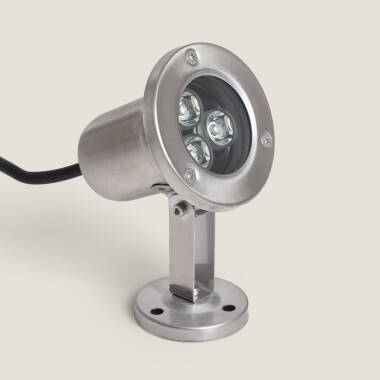
Advanced
33,79 €
Ref 632
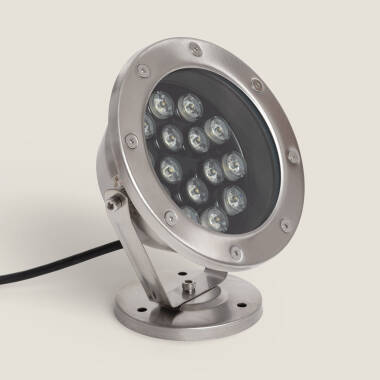
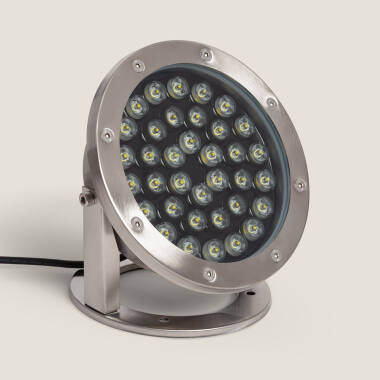
12V DC 3W Surface Mounted Stainless Steel XtraPool LED Spotlight IP68
Warm White 3000K
In Stock, delivery in 15-20 days






Brands related to this category


About Garden Spot Lights
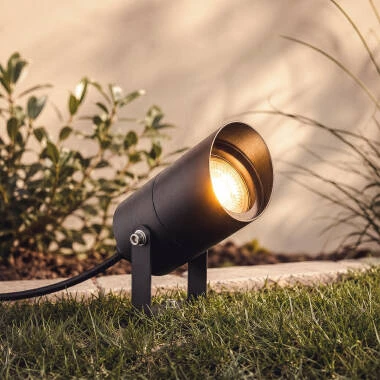
Garden spot lights are a very versatile solution within LED Path lights, especially when the aim is to direct light towards specific outdoor elements. Unlike general lighting, they make it possible to highlight trees, low walls, paths or decorative areas.
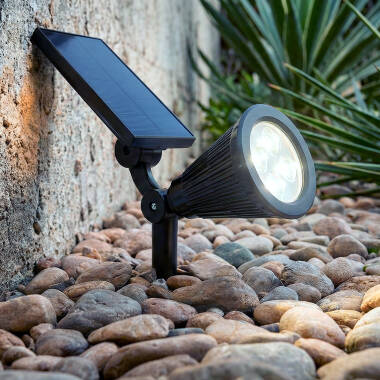
In addition to traditional mains-powered models, there are now solar garden spotlights and path lights with increasingly advanced technologies. Some models work using solar energy thanks to a photovoltaic panel and rechargeable battery, and there are also smart solutions capable of synchronising automatically via a remote control. This variety makes it possible to adapt lighting to different needs.
What are garden spot lights used for?
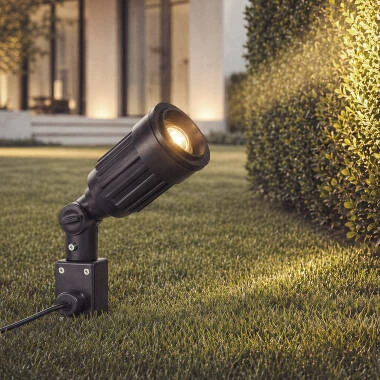
Garden spot lights are used to illuminate green areas in a focused, directed and decorative way. Their main function is to direct the beam towards plants, walls or specific elements in order to improve visibility and create depth at night.
This type of luminaire is used when precise control is needed over which part of the garden receives light. It can be placed next to a tree to highlight the trunk or at the edge of a path to reinforce orientation. Thanks to its flexible installation, it allows the lighting to adapt to the garden design and to the evolution of the vegetation.
Decorative lighting for green areas
LED garden step lights make it possible to work with soft contrasts, highlight plant volumes and create points of visual interest that are not perceived during the day. At night, a tree or hedge can stand out thanks to the lighting.
In residential gardens, moderate wattages are usually used to avoid harsh lighting. A spotlight from 3 W to 10 W may be sufficient for shrubs, low plants or nearby elements. For taller trees, dense plant masses or to highlight larger structural elements, it may be necessary to use models from 10 W to 40 W, always adjusting the beam angle and the distance from the illuminated element.
Beam direction is key. If the spotlight is placed too close, it can create an intense patch of light at the base of the plant and leave the rest in shadow. If it is placed too far away, it can lose definition and scatter light into unwanted areas. For low vegetation, medium or wide beams help distribute the light; for trunks or palm trees, a narrower beam creates a more pronounced upward effect.
It is also worth taking into account the texture and colour of the vegetation. Light-coloured leaves reflect more light, while darker leaves absorb part of the flux. For this reason, not all plants need the same intensity. Well-adjusted lighting respects the natural appearance of the garden and avoids excessive contrasts.
Focused light to highlight garden elements
Garden spot lights are especially useful for creating focused light on specific elements. They can be used to highlight a sculpture, a fountain, a low wall, etc. This precision makes it possible to build richer lighting than that obtained with uniform general light.
When the aim is to mark a route more visibly, LED Bollard Lights can complement garden step lights. The bollard provides a stable reference to guide movement, while the spotlight directs light towards plants or specific details. This combination helps separate functional lighting from decorative lighting.
Focused light also helps create visual hierarchy. Not every element in the garden should be illuminated with the same intensity. If everything is lit in the same way, the result can look flat. Instead, selecting a few main points and leaving other areas with less light creates a more natural and pleasant composition.
In small spaces, one or two well-positioned spotlights can completely change the perception of the garden. In larger outdoor spaces, it is advisable to distribute light points by zones, avoiding concentrating all the lighting in a single point.
More pleasant outdoor atmospheres at night
LED garden spot lights help create more pleasant atmospheres at night because they make it possible to work with indirect light and controlled shadow areas. Instead of illuminating the whole space with intense light, the lighting can be directed towards vegetation, walls or decorative elements to create a more comfortable atmosphere.
This way of lighting is especially useful on landscaped terraces, patios, pool areas, etc. A garden does not need very high light levels to be usable; in many cases, it is enough to mark routes, highlight some elements and avoid completely dark areas at passage points.
Recessed deck lighting can be combined with garden step lights when a more architectural type of lighting or lighting integrated into paving is desired. While garden step lights with a spike or support make it easier to adjust the direction, recessed ground lights offer a more discreet presence and can be used on terraces, paths or façades. Together, they make it possible to create layers of light from different positions.
For comfortable night-time atmospheres, colour temperature is very important. Warm light from 2700 K to 3000 K is usually the most suitable in residential gardens because it provides a welcoming feel and respects natural materials such as stone, wood, gravel or earth better. Neutral light can be used when a sharper reading of the vegetation is desired, but excessive intensity should be avoided.
Key features of LED garden spot lights
LED garden spot lights should combine different features such as precise direction, outdoor resistance and ease of installation. As they are in contact with soil, moisture, irrigation, vegetation and temperature changes, they need suitable materials and protection to function correctly over long periods.
Adjustable spotlights to direct light precisely
Direction is one of the most important features of garden spot lights. Unlike a fixed path light, the spotlight makes it possible to direct the beam exactly towards the element to be illuminated. This makes it easier to highlight walls or landscape details with greater control.
Adjustable models allow the tilt to be changed and, in some cases, the lateral rotation as well. This flexibility is very useful because the garden changes over time. A shrub may gain volume or a passage area may be modified with outdoor furniture. Being able to readjust the spotlight makes it possible to maintain the lighting effect without replacing the luminaire.
The beam angle should be chosen according to the desired result. A narrow beam, between 15 and 30 degrees, is suitable for accentuating vertical elements such as trunks, palm trees or columns. A wide beam, of 60 degrees or more, helps illuminate plant masses or more open areas softly.
The distance from the illuminated element also has an influence. For a small plant, a very powerful spotlight placed too close can create harsh shadows; for a tall tree, a beam that is too wide may fall short. Adjusting direction, distance and beam angle makes it possible to achieve more precise lighting without unnecessarily increasing consumption.
IP protection to withstand rain
IP protection indicates the level of resistance to dust and water. For garden spot lights, this information is essential because the luminaire is usually exposed to rain, ground moisture, dust and temperature changes. For outdoor use, it is advisable to choose models with at least IP65.
A spotlight with IP65 offers protection against dust and water jets, making it suitable for gardens exposed to rain or irrigation. In areas with intense humidity, frequent splashes or possible temporary water accumulation, it may be advisable to choose higher protection levels. In any case, IP protection should be accompanied by correct installation and connections prepared for outdoor use.
Spotlights installed with a spike usually have a lower risk of water accumulation than recessed models, but they still need good sealing. The most vulnerable point is usually the connections, not the luminaire housing. For this reason, joints, transformers and junction boxes should be protected, especially if they are close to the ground or in irrigation areas.
In addition to water protection, it is important to assess the quality of the manufacturing materials. A robust body, usually made of stainless steel, helps withstand corrosion and moisture better. A suitable material helps maintain the performance and appearance of the luminaire for longer.
Ground installation
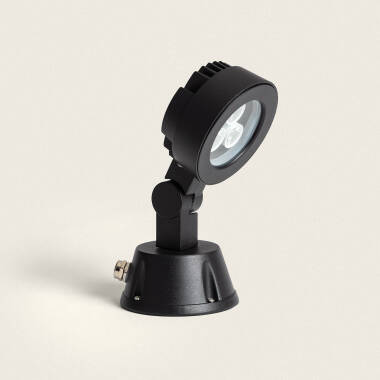
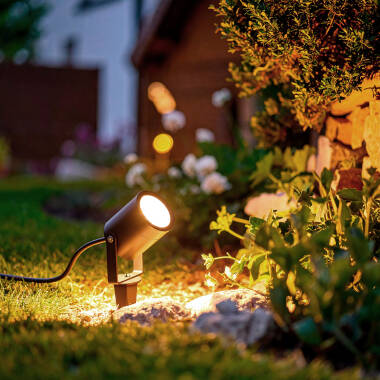
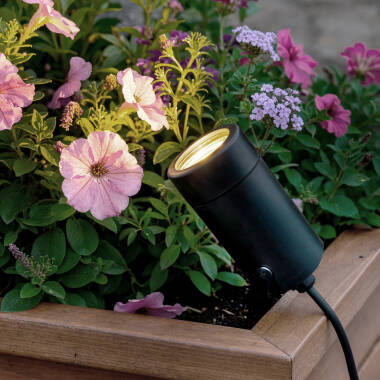
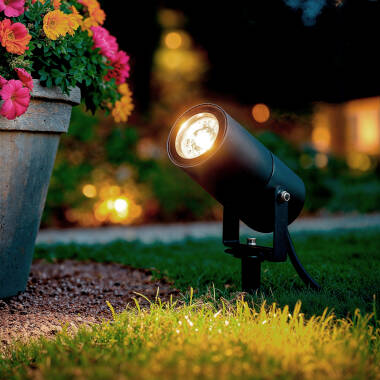
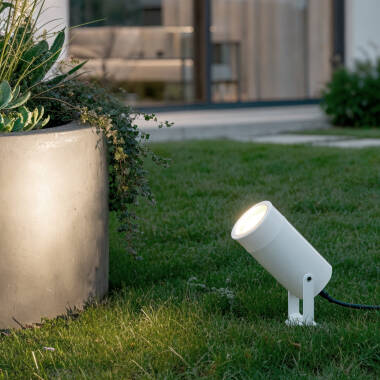
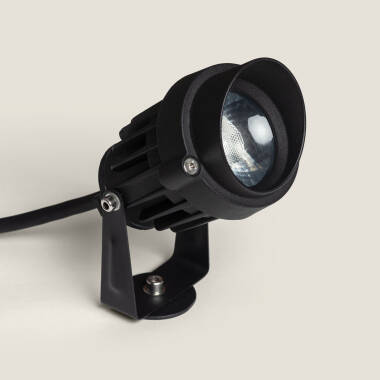
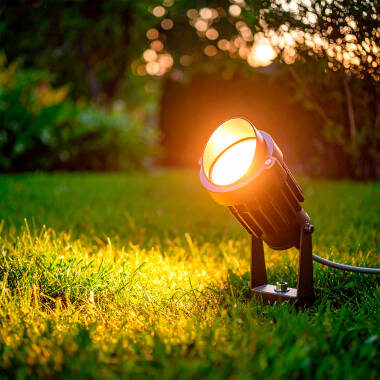
Many models include a spike or support to be fixed directly into grass, soil or gravel, making it possible to place them without building work and adjust their position easily. This flexibility is especially useful in gardens where vegetation changes over time.
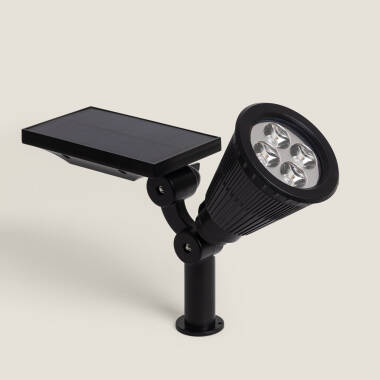
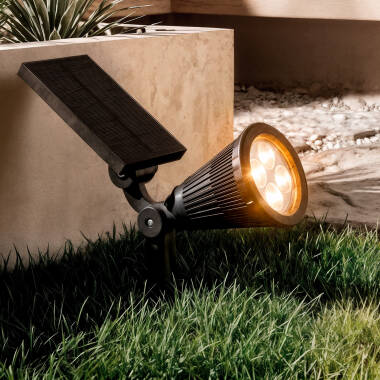
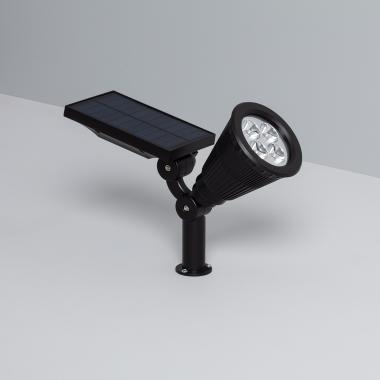
In addition to models connected to the mains, there are solar spotlights and path lights that incorporate a solar panel and integrated rechargeable battery. During the day they store solar energy and at night they switch on automatically, eliminating the need for wiring. They are a practical solution for gardens where there is no nearby electrical installation or when quick placement is desired.
There are also certain garden step lights designed to synchronise automatically via a remote control. This type of system makes it possible to control and modify operating modes without having to carry out complex configurations.
Before installation, it is worth checking the stability of the ground. If the soil is too loose, the luminaire may tilt or move with irrigation, wind or garden maintenance. In compact soil, the spike offers better support. In gravel or decorative areas, it may be necessary to reinforce the base or choose a more stable support.
The direction should be adjusted at night or in conditions similar to real use. At first glance during the day, the spotlight may seem well positioned, but when switched on it may create glare, harsh shadows or poorly lit areas. Adjusting the beam with the light on makes it possible to correct the direction and achieve a more precise effect.
Cable routing should also be planned. In outdoor installations, the cable must be suitable for weather exposure and protected against moisture, gardening tools or footsteps.
How to choose garden spot lights according to the light
The choice of garden spot lights depends largely on the type of light desired. Colour temperature, intensity, beam angle and glare control determine how the space is perceived.
Not all gardens need the same light; below are the different types:
Warm light for welcoming gardens
Warm light, between 2700 K and 3000 K, is the most commonly used option in residential gardens and outdoor seating areas. It provides a pleasant feel, softens contrasts and combines well with natural materials.
On terraces and in gardens, this colour temperature helps create a relaxed atmosphere at night. It is also suitable for illuminating plants near dining areas, pools or porches, as it avoids lighting that feels too white or technical.
Warm light works especially well on trunks, stone walls and plants with deep green tones. However, it should not be confused with weak light. A warm spotlight can offer good visibility if it has the right flux and angle. The important thing is that the intensity is adjusted to the size of the illuminated element.
To avoid a flat scene, it is advisable to use different intensities within the same warm tone. Some spotlights can highlight main elements and others can provide softer light in secondary areas; this helps create a garden with depth.
Neutral light to highlight vegetation
Neutral light, around 4000 K, makes it possible to perceive vegetation more clearly and can be suitable when the aim is to highlight colour and shapes. It provides a clearer reading than warm light, although it may feel less welcoming if used generally throughout the garden.
In gardens and professional spaces, neutral light can work well to reinforce visibility and give a cleaner appearance. It can also be useful in areas where paths, edges or landscape elements need to be clearly identified.
When neutral light is used on vegetation, wattage should be controlled. Too many lumens can make leaves appear too bright or artificial. Moderate neutral light, however, can provide definition without losing naturalness. For plants with light-coloured leaves or reflective surfaces, it may be necessary to reduce the intensity or increase the distance from the spotlight.
If the garden combines garden spot lights with other luminaires, it is advisable to maintain a consistent colour temperature. Mixing 3000 K and 4000 K can work if they are separated by zones, but doing so without a clear plan can create irregular lighting.
Frequently asked questions about LED garden spot lights
What IP rating should they have?
For a garden step light exposed to rain or irrigation, it is advisable to choose at least IP65. This rating offers protection against dust and water jets. In areas with intense humidity or possible temporary accumulation, it may be advisable to choose a higher level such as IP67 or IP68. In addition to the IP rating, it is important to protect connections, transformers and joints.
What wattage is suitable for illuminating plants?
For low plants, shrubs or small flower beds, wattages between 3 W and 10 W are usually sufficient. For medium-sized trees, walls or denser plant masses, spotlights from 10 W to 15 W can be used. For tall trees or large-volume elements, more flux may be necessary, always controlling the beam angle to avoid glare.
Is warm or neutral light better for a garden?
Warm light from 2700 K to 3000 K is the most recommended for residential gardens because it creates a welcoming atmosphere and respects natural materials well. Neutral light at 4000 K can be useful for highlighting vegetation with more definition or in professional spaces. Ideally, colour consistency should be maintained within each garden zone.
Can they be installed directly in the ground?
Yes, many garden spot lights include a spike or support for direct installation in soil, grass or gravel. It is important that the ground is stable and that the wiring is protected against moisture and footsteps. In very loose soil, it may be necessary to reinforce the fixing.
How should a garden step light be directed to avoid glare?
The spotlight should be directed towards the element to be highlighted, not towards paths, windows or seating areas. For trees and shrubs, it is advisable to direct the beam towards the trunk, crown or plant mass. On paths, it is usually better to illuminate the sides rather than point directly towards the route.
Can garden step lights be used to illuminate paths?
Yes, they can help illuminate paths if they are placed at the sides and correctly directed. However, if continuous and visible route marking is needed, it may be advisable to combine them with bollards. Spotlights provide flexibility and accent; path lights offer a more stable reference.
Can they be combined with other outdoor luminaires?
Yes, this is a highly recommended combination. Garden step lights can highlight vegetation or decorative elements, while bollards, Step lights or Recessed deck lighting can take care of paths, entrances or façades. Maintaining a consistent colour temperature and avoiding overlapping light helps achieve a balanced result.