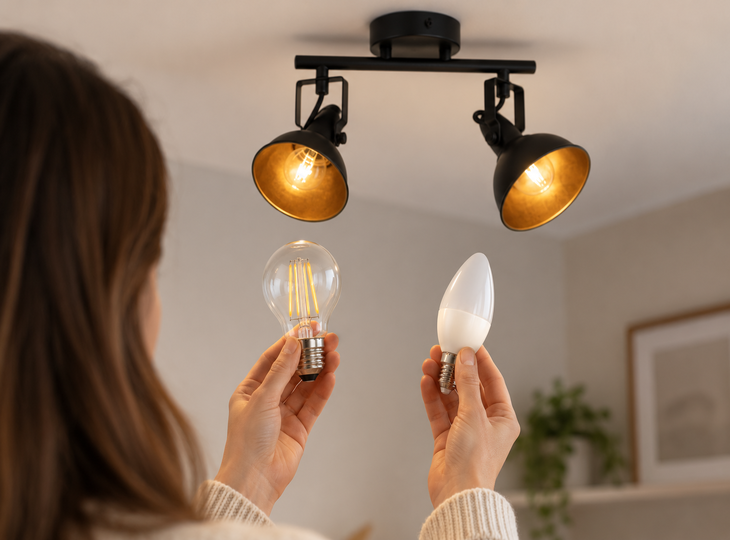
Which LED bulb should you choose for a ceiling light, and what wattage do you need?
Choosing the right LED bulb for a ceiling light is essential for achieving adequate lighting, improving visual comfort and optimising energy consumption in any room. Although it may seem like a simple decision at first glance, there are various factors to bear in mind before buying a bulb: wattage, luminous flux, the type of socket, colour temperature and the characteristics of the light fitting itself.
In this guide, we explain which LED bulb to choose for a ceiling light, what wattage is recommended depending on the space, and which technical specifications you should check to ensure efficient lighting tailored to your needs.
Which LED bulb should you choose for a ceiling light?
To choose a suitable LED bulb for a ceiling light, the first step is to check the light fitting’s specifications and determine what type of lighting you need.
The design of the light fitting, the number of light sources and the purpose of the room will all influence your choice. These are the main factors you should bear in mind.
Type of bulb base
The bulb base is one of the first things you should check, as it determines the physical and electrical compatibility between the bulb and the light fitting.
The most common types for ceiling lights are:
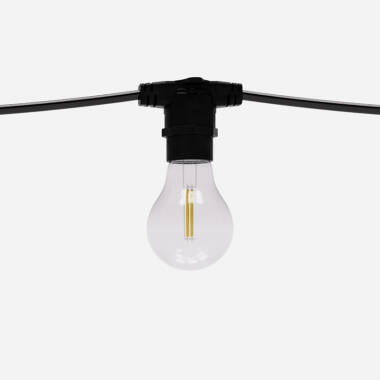
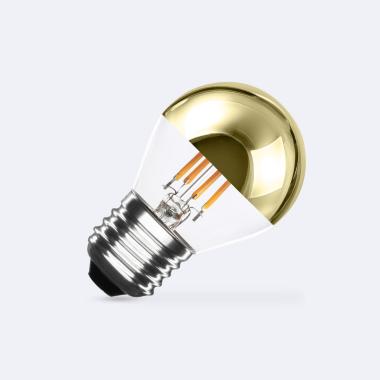
E27: this is one of the most widely used screw-in sockets. It is found in pendant lights, ceiling lights and numerous decorative light fittings.
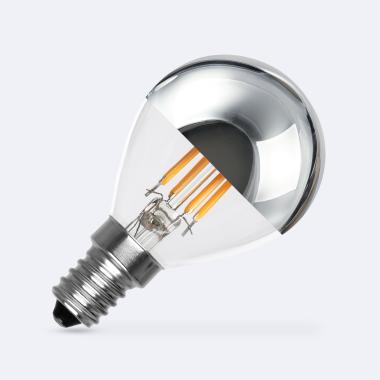
E14: this has a smaller thread and is usually used in chandeliers, decorative light fittings and multi-arm models.
GU10: this is common in ceiling spotlights and adjustable light fittings. It usually operates on a 230 V mains supply.
G9: used in certain compact and decorative lamps, particularly where space for the bulb is limited.
GU5.3: is common in some low-voltage spotlights, usually 12 V, which require a compatible power supply.
If you’d like to find out about other available options and their features, you can consult our guide to types of light bulbs.
Before replacing a bulb, check the socket type and operating voltage. It is also important to check the dimensions of the new bulb. Some LED models have a bulkier body than their traditional equivalents and may not fit properly in lamps with narrow shades or confined spaces.
One of the most common mistakes when choosing an LED bulb is to focus solely on its wattage (W). However, the amount of light emitted by a bulb is measured in lumens (lm).
Watts indicate the amount of electrical energy consumed, whilst lumens express its luminous flux. Therefore, two LED bulbs with the same wattage may provide different amounts of light.
As a rough guide:
Luminous flux
Typical use
250–470 lumens
Ambient or decorative lighting
470–806 lumens
Auxiliary light fittings and multi-bulb lamps
806–1,055 lumens
Moderate-intensity general lighting
1,055–1,521 lumens
General lighting of higher intensity
More than 1,521 lumens
Spaces requiring high luminous flux
These figures should be interpreted taking into account the number of bulbs fitted and how the luminaire distributes the light.
Colour temperature of the LED bulb
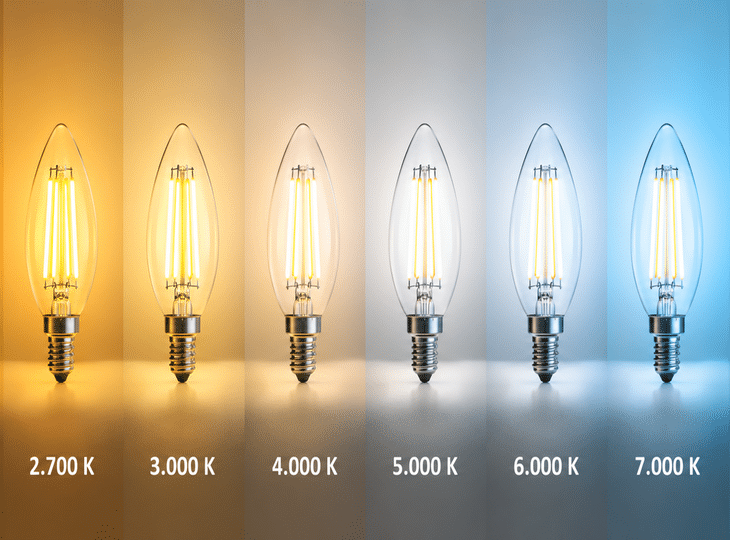
Colour temperature determines the hue of the light emitted and is expressed in kelvin (K). The choice of colour temperature directly influences the atmosphere of the room and the visual perception of the space.
The most common options are:
Warm light (2,700–3,000 K): provides cosy and relaxing lighting. It is suitable for bedrooms, living rooms and dining rooms.
Neutral light (3,500–4,000 K): offers a more balanced appearance and is suitable for kitchens and workspaces.
Cool light (5,000–6,500 K): has a whiter or bluish tone and can be used in spaces where a cooler-looking light is desired.
ⓘ Illustrative contextual content generated or edited using AI (Art. 50 AI Act).
Beam angle and light distribution
The beam angle indicates how the light from a bulb is distributed. This is an important consideration for ceiling lights, as it determines whether the light is concentrated on a single surface or spread over a wider area.
Bulbs with narrow beam angles are suitable for focused lighting, whilst models with wide beam angles are better suited to general lighting.
For example, a GU10 spotlight with a 36° beam angle can be used to highlight a specific area, whilst a wide-beam LED bulb fitted to a pendant light can help to illuminate a room more evenly.
Colour rendering index
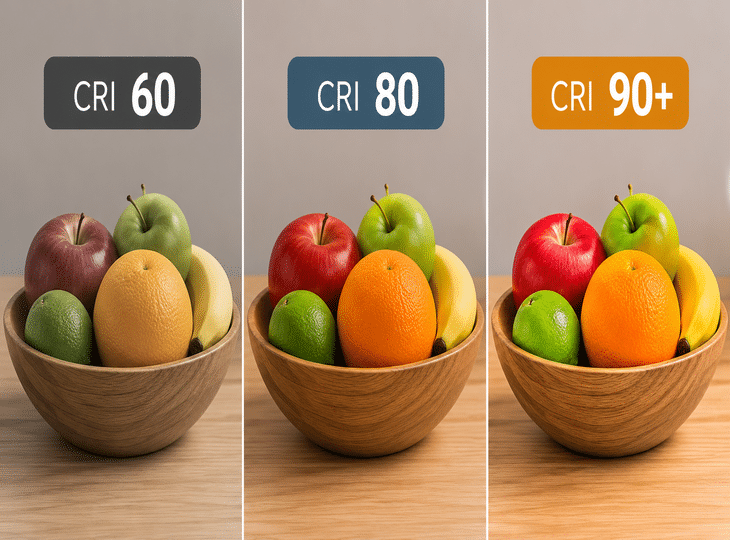
The colour rendering index, known as CRI, indicates a light source’s ability to render the colours of objects in comparison with a reference source.
For most domestic applications, it is advisable to choose LED bulbs with a CRI of at least 80.
In spaces where colour perception is particularly important, such as dressing rooms or certain work areas, bulbs with a CRI of 90 or higher may be worth considering.
Good colour rendering allows you to appreciate the colours of furniture, textiles, food and decorative items more accurately.
ⓘ Illustrative contextual content generated or edited using AI (Art. 50 AI Act).
What wattage should a light bulb have for a ceiling light?
The correct wattage for an LED bulb depends on the amount of light required in the room and the efficiency of the bulb itself.
LED technology allows for high levels of light output with considerably lower electricity consumption. For this reason, it is not advisable to choose the wattage of an LED bulb solely based on the wattage of the old bulb. It is best to use lumens as the main reference.
The relationship between watts and lumens
The luminous efficacy of a bulb is expressed in lumens per watt (lm/W) and indicates how much light it produces for every watt of electrical energy consumed.
For example, an 8 W LED bulb that produces 960 lumens has a luminous efficacy of 120 lm/W. Another 8 W bulb with an efficiency of 90 lm/W would emit 720 lumens. Although both consume the same amount of electrical power, their luminous flux is different.
Recommended wattage based on room size
To estimate the amount of light required in a room, you can use its floor area and the desired illuminance level, expressed in lux (lx), as a guide. Lux indicates the amount of light reaching a surface, whilst lumens represent the total light emitted by a light source.
As a general guide for homes:
Room
Recommended illuminance
Living room
100–200 lux
Bedroom
100–150 lux
Dining room
150–200 lux
Kitchen
200–400 lux for general lighting
Bathroom
200–300 lux general lighting
Corridors
100–150 lux
These figures are guidelines and should be adapted to the actual use of the space. Work surfaces, such as kitchen worktops or desks, may require higher levels of lighting through the use of additional light fittings.
To estimate the initial amount of light required, the following formula can be used:
Lumens = area (m²) × desired illuminance (lux)
For example, in a 12 m² bedroom where an average illuminance of 150 lux is required:
12 m² × 150 lux = 1,800 lumens.
This result represents an estimate of the useful luminous flux required over the area in question, not necessarily the number of lumens that the light bulbs must emit.
Which LED bulb should you use depending on the type of ceiling light?
As well as wattage and luminous flux, the choice depends on the characteristics of the ceiling lamps in which the bulb is to be fitted. Each type of light fitting has different lighting requirements, so it is important to understand the different types of ceiling lights and their applications before selecting the most suitable bulb.
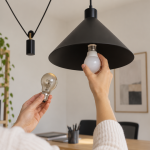
LED bulbs for pendant lights
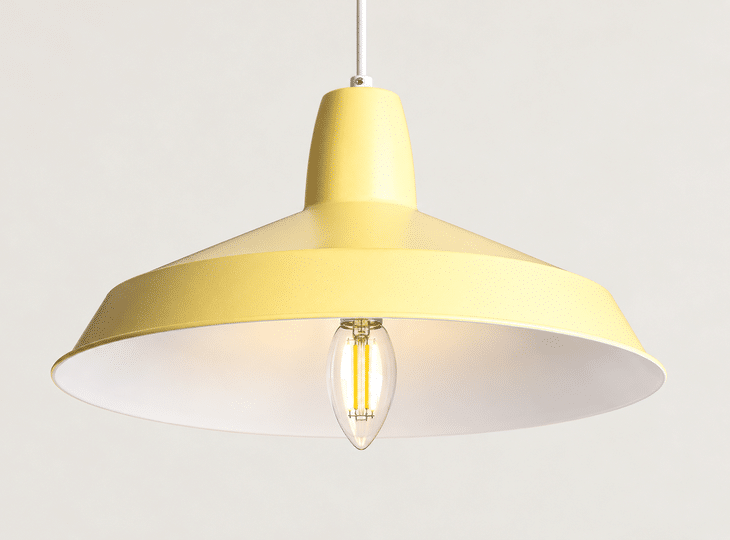
Pendant lights are typically used above dining tables, kitchen islands or in areas requiring decorative lighting.
In these cases, it is important to consider both the amount of light and its distribution. When the bulb is visible, its shape and finish also become important factors.
E14 filament LED bulbs can be an attractive option for open-style lamps or those with transparent shades, as they combine decorative appeal with low energy consumption.
To create a cosy atmosphere in living rooms and dining rooms, a colour temperature of between 2,700 and 3,000 K is usually suitable.
If the light fitting contains several bulbs, the total luminous flux should be taken into account to avoid excessive or insufficient lighting.
ⓘ Illustrative contextual content generated or edited using AI (Art. 50 AI Act).
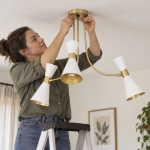
LED bulbs for ceiling lights
Design Flush Ceiling Lights are usually fitted close to the ceiling and are commonly used to provide general lighting.
When they feature sockets for replaceable bulbs, it is advisable to choose models with a sufficiently wide light distribution to ensure uniformity; the most common options are E27 and GU10 bulbs.
Attention should also be paid to the available internal space, particularly in enclosed ceiling lights.
Not all LED bulbs are designed to operate inside fully enclosed luminaires. Heat build-up can affect their performance and reduce their lifespan.
You should therefore check that the manufacturer expressly authorises this type of installation.
In ceiling lights with integrated LED technology, the light source forms part of the fixture itself and cannot be replaced with a conventional bulb.
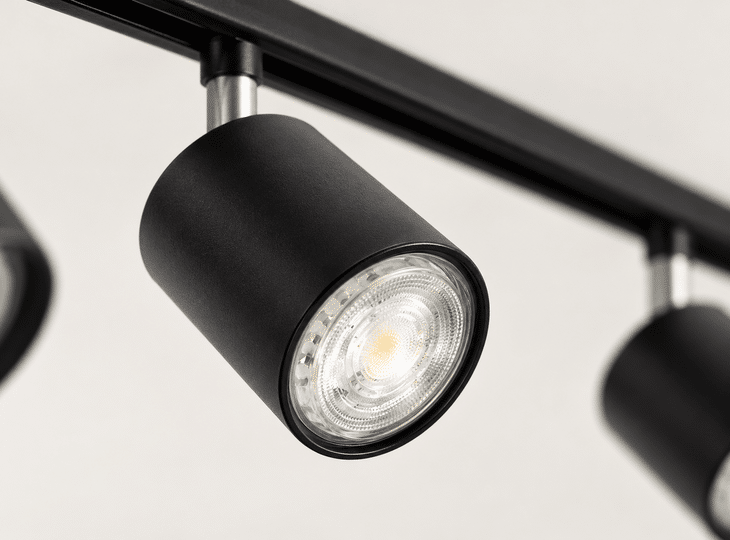
In these light fittings, the beam angle is particularly important.
A narrow beam allows the light to be concentrated on a specific feature, whilst a wider beam makes it easier to illuminate larger areas.
To achieve uniform general lighting using several spotlights, it is necessary to consider their layout and spacing, avoiding areas that are excessively bright and areas with pronounced shadows.
It is also advisable to choose models with adequate glare control, particularly when the spotlights are within the normal field of view.
ⓘ Illustrative contextual content generated or edited using AI (Art. 50 AI Act).
LED bulbs for ceiling spotlights
When choosing the right LED bulb for ceiling lights, it is important to consider the design of the spotlight, the type of socket and the direction in which the light is projected. In models with open shades, bulbs with a wide beam angle can help to provide a more even distribution of light.
Conversely, when the fitting is designed to direct light towards a specific area, it is advisable to choose a bulb that makes the most of that direction without causing glare.
Finally, it is essential to check the bulb’s dimensions and its compatibility with the wall light, particularly in compact or enclosed models, where available space and heat dissipation may influence the choice.
Common mistakes when choosing an LED bulb for a ceiling light
Choosing the wrong bulb can result in insufficient lighting, unnecessary energy consumption or compatibility issues.
Among the most common mistakes are:
Choosing based solely on wattage. Wattage indicates electricity consumption, but does not on its own determine how much light a bulb provides.
Failing to check the base. Before buying a bulb, it is essential to check that the base fits the light fitting.
Ignoring the dimensions. A bulb may have the correct base and still be too large for the shade or housing.
Choosing an unsuitable colour temperature. Light that is too cool or too warm for its intended use can affect visual comfort.
Failing to consider the number of bulbs. For lamps with multiple light sources, the combined illumination must be calculated.
Failing to check ventilation conditions. Enclosed light fittings can restrict heat dissipation and affect certain LED bulbs.
Avoiding these mistakes improves both the quality of the lighting and the performance of the installation. Once you have chosen the right bulb, it is important to fit it correctly. If you need to replace your current one, we explain how to change the bulb in a ceiling light, step by step.
How to choose the right LED bulb
To choose the right LED bulb for a ceiling light, it is important to consider the compatibility with the light fitting, the lumens, the wattage, the colour temperature and the light distribution.
By taking these criteria into account, you can achieve efficient, comfortable and suitable lighting for every space, whilst making the most of the benefits of LED technology without compromising on light quality.