Choosing the perfect ceiling fan for your home doesn’t have to be complicated. Below we will analyze in depth the differences between ceiling fans with and without light, their characteristics and the advantages of each option. This will help you make the right choice for every room in your home.

One of the first aspects to consider when choosing your model is whether it should include light or not, since each option has different benefits depending on your needs and the use you are going to give.
Table of Contents
- With or without light? The key decision when choosing a ceiling fan
- When to choose a ceiling fan with light
- When to choose a ceiling fan without light
- Which option is best for your situation
- Ceiling fan with light vs. without light: common mistakes when choosing one
- Can light be added to a ceiling fan without light (and vice versa)?
- Find the perfect ceiling fan for your home
With or without light? The key decision when choosing a ceiling fan
What really changes between the two options
A ceiling fan with Light integrates lighting and ventilation into a single unit, simplifying installation by combining two essential functions in a single point on the ceiling. These types of units often include remote control options or dimmers for everyday convenience.
On the other hand, a ceiling fan without light is designed exclusively to maximize air circulation. By dispensing with the lighting module, it usually allows for longer blades and features an aerodynamic design. It also offers greater flexibility in the placement of room lighting, allowing the main light to be planned without interfering with ventilation. This separation of functions is especially valuable in offices or rooms with already optimized lighting.
Why this choice affects more than meets the eye
The choice between a lighted or unlighted ceiling fan impacts multiple aspects:
- Airflow and performance: Ceiling fans that integrate lighting tend to have a more compact central module, which can slightly limit blade length, while models designed solely for ventilation in some cases can achieve more powerful and efficient performance.
- Light distribution and planning: Incorporating lighting in the fan centralizes light to a single point, providing convenience and avoiding additional installations.
- Energy consumption: Ceiling fans with LED lighting offer low energy consumption, while those without lighting depend on other external luminaires, which can increase the total electrical cost of the room.
- Aesthetics and visual harmony: The integration of light makes the fan a functional centerpiece that complements the décor.
- Flexibility and future adaptations: Ceiling fans with LED light allow for intensity and color regulation, adapting to changes in use or decoration without replacing the equipment, while those that do not include lighting offer total freedom to add external lights, although this may require additional installations and extra expense.
- Convenience and control: The combination of ventilation and lighting in a single unit usually includes remote control or Wi-Fi connectivity, allowing independent control of light and air.

When to choose a ceiling fan with light
In certain situations, integrating lighting into the fan itself can bring different advantages. Below, we see in which cases this option is more convenient:
Rooms without main lighting
In rooms without a central light source, the installation of a ceiling fan with light is the most interesting and efficient option. This type of fan avoids the need to add additional lamps or modify the existing electrical installation. As mentioned above, modern models include dimmer or remote control options, allowing both fan speed and light intensity to be adjusted independently, offering complete control without hassle. This model is very useful in bedrooms.
Recommended products
In Stock, delivery in 24/48h
65.99 £
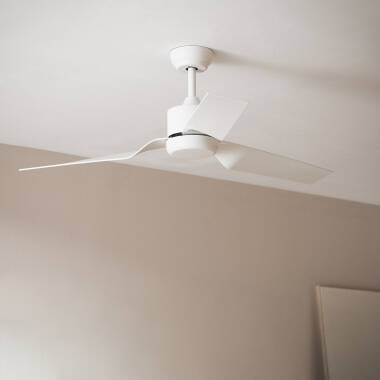
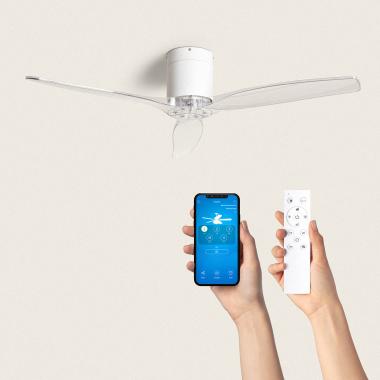
Minimal Silent Ceiling Fan with DC Motor White 132cm
View product
In Stock, delivery in 24/48h
88.99 £
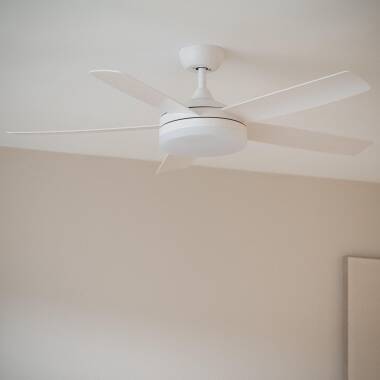
Angistri Silent Ceiling Fan with DC Motor White 132cm
View product
In Stock, delivery in 24/48h
103.99 £
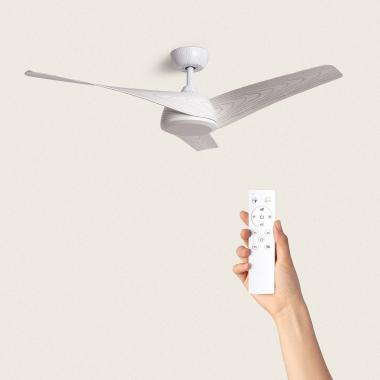
Patroclo Silent Ceiling Fan with DC Motor White 132cm
View product
In Stock, delivery in 24/48h
76.99 £
Eubea Silent Ceiling Fan with DC Motor 132cm
View product
Small rooms or rooms with limited space
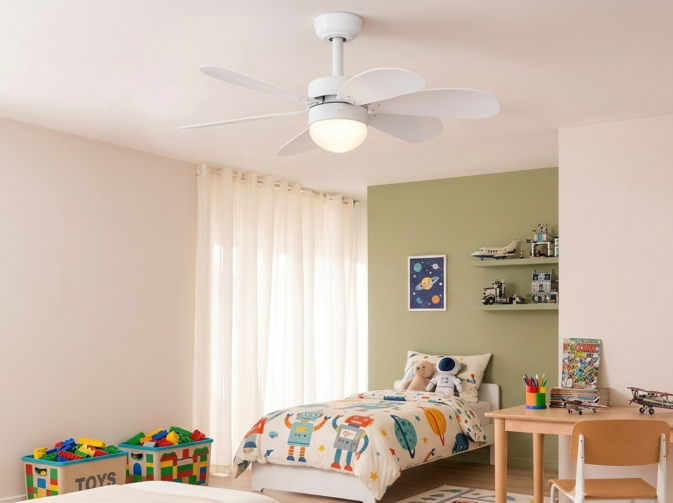
In small spaces, spaciousness is a priority. Integrating lighting and ventilation in a single device allows to optimize the useful surface of the room, avoiding the accumulation of table lamps or independent ceiling fans that visually saturate the environment. A well-dimensioned fan with light generates a feeling of spaciousness and avoids visual obstacles.
Dwellings with few ceiling light points
In older homes or homes with limited structural design, it is common to find only one or two light points per room. A ceiling fan with light ensures that each room has sufficient lighting without the need for electrical modifications. In addition, centralizing both functions in a single point minimizes the risk of excessive wiring and facilitates future maintenance of the equipment.
Cases in which you are looking for a practical and functional solution
For those who prioritize installation efficiency, a ceiling fan with light is a solution that integrates both options. Combining ventilation and lighting in a single unit reduces installation costs, simplifies room control and avoids having multiple independent devices.
When to choose a ceiling fan without light
In other contexts, it may be more interesting to opt for a ceiling fan without lighting such as:
Spaces with well-planned lighting
In rooms that already have a designed lighting scheme, adding light to the ceiling fan may generate unwanted shadows or reflections. An unlit fan avoids light interference, allowing each light source to fulfill its specific function. This option is recommended for offices, studios or rooms with good lighting.
Decorative projects where light is the protagonist
When lighting is part of the design, a ceiling fan with light can be visually distracting and break the decorative coherence. Choosing a ceiling fan without light allows the focus to remain on the main lighting and decorative elements, integrating discreetly into the environment. This is very useful in interior design projects or high-end design spaces.
Living rooms or rooms with several light sources
In large spaces, such as living or dining rooms, efficient air circulation is essential to maintain a comfortable temperature. In addition, by not adding light to the ceiling fan, it avoids competing with lamps already installed.

Which option is best for your situation
There is no one size fits all answer. The choice will depend mainly on the layout of the room and how the lighting is planned.
Here are some examples to help you decide:
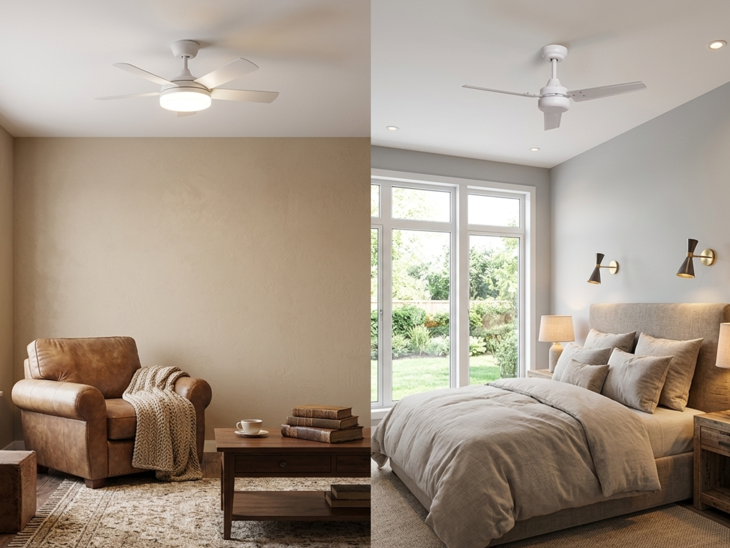
- If you only have one light point on the ceiling: A ceiling fan with light is the best option as it guarantees ventilation and lighting from the same point, simplifying the installation and avoiding additional costs.
- If you already have sufficient lighting with several light points: In this case, a ceiling fan without light allows you to concentrate on air performance and design, without duplicating the lighting function or affecting the distribution of existing lighting.
Ceiling fan with light vs. without light: common mistakes when choosing one
When making this decision it is common to make certain mistakes, identifying them will help you avoid problems in the future.
- Choosing with light “just in case”: Opting for a model with light without real need can generate excess lighting and unnecessary consumption.
- Doing without light without analyzing the actual lighting: Giving up light thinking only about design can leave rooms dark and force the installation of additional lamps.
- Not thinking about long-term use: Considering only the present without anticipating future needs can result in an inadequate ceiling fan, affecting comfort and functionality for years.
Can light be added to a ceiling fan without light (and vice versa)?
The flexibility of a ceiling fan can be an important factor if you anticipate changes in room usage over time. However, not all options are equally viable and, in practice, it all depends on the particular model:
- Adding light to a ceiling fan without light: In those models that are available in both lighted and unlit versions, it is usually possible to add lighting at a later date. This option allows you to adapt the fan to your needs, as long as the manufacturer provides for this compatibility. It is essential to check that the model allows this and to follow the technical instructions to ensure safe operation.
- Dispensing the light in a ceiling fan with light: In most ceiling fans that have a light as standard, it is not possible to physically remove the lighting module. In these cases, the alternative is simply not to use the light.
In any case, it is important to keep in mind that such modifications or manipulations depend entirely on the fan design and manufacturer’s specifications. Furthermore, making changes that are not officially contemplated may invalidate the product warranty, so it is always advisable to consult the technical documentation beforehand.
Find the perfect ceiling fan for your home
Once the differences and uses of each type are clear, we show you the options that stand out the most for their functionality:
Best-selling ceiling fans with light
The most demanded models currently combine both energy efficiency and remote control or Wi-Fi connection, adapting to the specific needs of each room. Among the most prominent are:
- Silent: DC silent ceiling fans are designed for bedrooms or study rooms, offering an efficient air flow without generating annoying noises.
- With retractable blades: Ceiling fans with retractable blades allow for a more compact design when not in operation and a clean aesthetic, ideal for living rooms and bedrooms.
- Models with remote control or Wi-Fi control: Ceiling fans with WiFi make it easy to manage speed and light without the need for physical switches, integrating seamlessly with smart home systems.
- Outdoor: Outdoor ceiling fans are made of moisture and weather resistant materials, perfect for terraces, porches or pool areas.

Recommended ceiling fans without light
The most recommended options prioritize airflow and quiet operation, they are usually installed in large rooms or offices that already have lighting. Featured models include:
- Silent ceiling fans: designed to provide optimal thermal comfort without generating annoying noises.
- Models with remote control or Wi-Fi connection: allow speed and programming to be controlled remotely, but without integrated lighting.
Which fan do you really need
When choosing the right ceiling fan you need to consider the size and height of the room to ensure efficient air circulation, as well as the lighting planning to properly integrate light and ventilation. It is also important to evaluate the noise level, available technology and consistency with the decorative style of the space. Considering these points ensures that the fan will perform its function efficiently and in the long term.