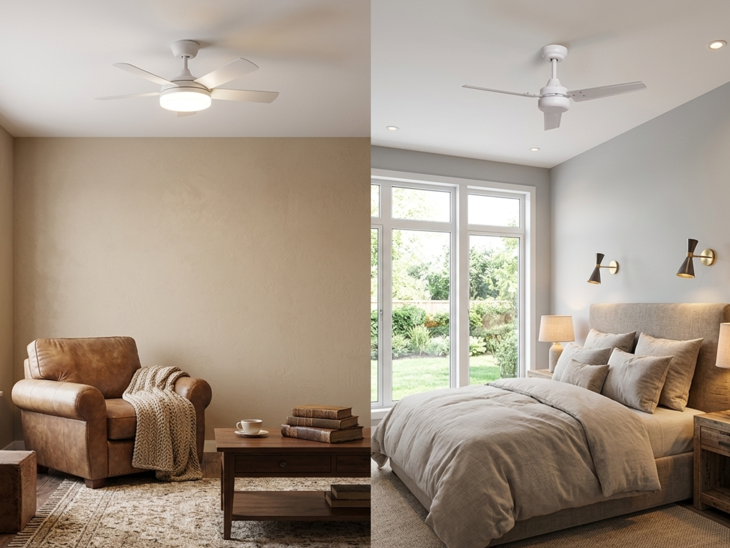
Selecting a suitable ceiling fan requires more than just choosing a visually appealing model. Technical aspects such as the overall diameter of the blades, air flow, ceiling height, motor type, etc., need to be assessed for the equipment to work properly.

Table of Contents
Basic principles of airflow in ceiling fans
The operation of a ceiling fan is based on the movement of its blades. As the blades rotate, they generate a pressure difference that displaces the air downward. This movement creates a current that improves the thermal sensation, although it does not cool the air as an air conditioning system does.
The cooling sensation is produced because the moving air facilitates the evaporation of sweat and reduces the perception of heat. Therefore, a ceiling fan can make a room more comfortable without the need to lower the air conditioning temperature as much.
To compare the actual performance of a ceiling fan, it is useful to look at the air flow rate, i.e. the amount of air that the device is able to move in a given time, provided that this data is available. This data is usually expressed in CFM (cubic feet per minute) or in m³/h (cubic meters per hour), standard units that allow comparing different models regardless of their size, design or number of blades.
However, moving more air doesn’t just depend on increasing the rotational speed. A small ceiling fan running at too high a speed can generate noise and turbulence without providing truly efficient ventilation.
In contrast, a larger diameter ceiling fan can move more air volume at a lower speed, with a more uniform and quieter flow.
The key to performance is diameter, blade pitch, motor and speed, all of which must work in balance.
Recommended products
In Stock, delivery in 24/48h
76.99 £
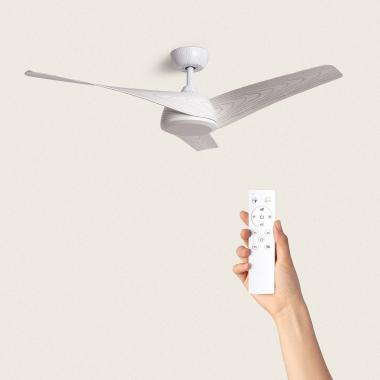
Eubea Silent Ceiling Fan with DC Motor 132cm
View product
In Stock, delivery in 24/48h
90.99 £
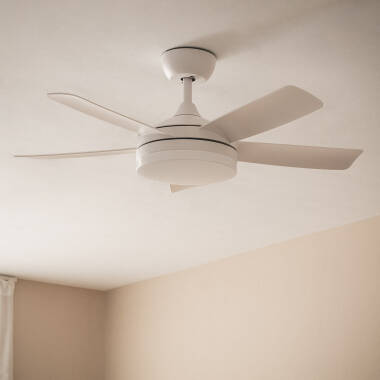
Patroclo Silent Ceiling Fan with DC Motor White 106cm
View product
In Stock, delivery in 24/48h
96.99 £
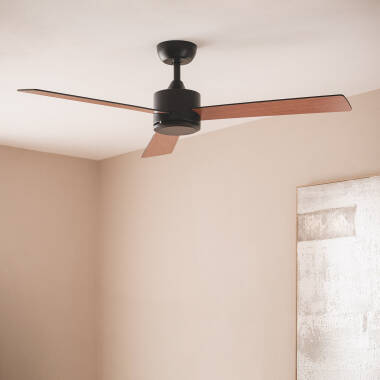
Fleves Silent Ceiling Fan with DC Motor 132cm
View product
In Stock, delivery in 24/48h
102.99 £
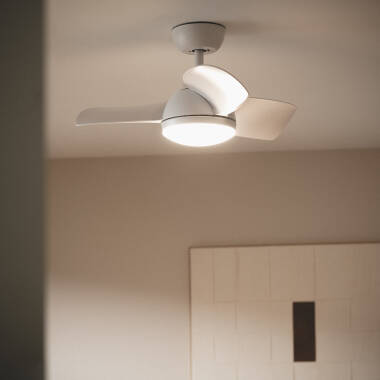
Poros Silent Ceiling Fan with DC Motor 76cm
View product
Proper diameter of ceiling fan blades.
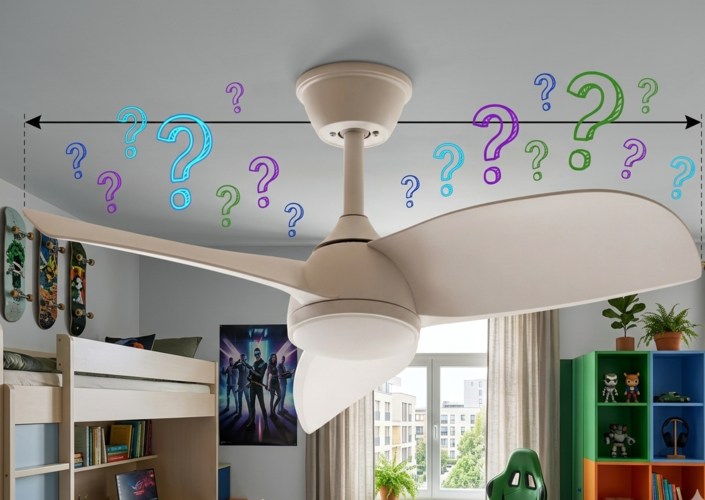
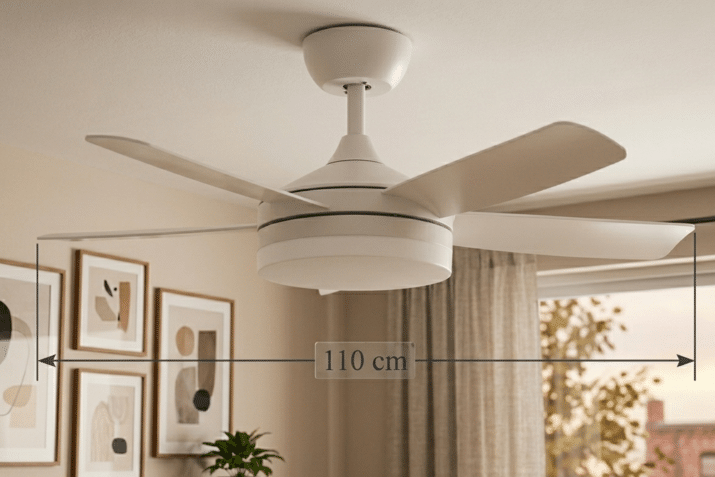
The diameter of the ceiling fan is measured from blade tip to blade tip, i.e., the total width the fan occupies when rotating. It should not be confused with the individual length of each blade.
The volume of the room, the height of the ceiling, the shape of the room and the presence of furniture or obstacles must also be taken into account.
For example, a 20 m² room with a 2.4 meter ceiling does not require the same performance as a 20 m² room with a 3 meter ceiling. In the second case there is more air volume, so the ceiling fan will have to move a greater amount of air to achieve a similar sensation.
The distribution of the space also has an influence. A square room allows a better distribution of air from a central point. On the other hand, an elongated room, a living room with several areas or a space with tall furniture may need two medium-sized ceiling fans or one large one.
| Area of the room | Approximate diameter |
| Up to 10 m² | 50-101 cm |
| 10-20 m² | 70-110 cm |
| More than 20 m² | 132-165 cm |
How long are the blades of a ceiling fan and why does it matter?
The length of the blades directly influences the fan’s ability to move air. The longer the blades, the more area the ceiling fan can cover during rotation.
A small increase in blade length can result in a significant improvement in the amount of air displaced. Therefore, two ceiling fans with a seemingly small difference in diameter may offer different performances.
In domestic ceiling fans, the length of each blade is usually between 30 and 70 cm, depending on the overall size of the equipment and the model.
Small ceiling fans are suitable for bedrooms, offices or smaller rooms. Medium models work well in living rooms or medium-sized rooms. Large models, on the other hand, are intended for large spaces or open areas.
How many blades should a ceiling fan have?
The choice of the number of blades is often associated with aesthetics, but it also has technical implications. Each blade adds thrust surface, but also increases the resistance to rotation. Therefore, more blades does not always mean more ventilation.
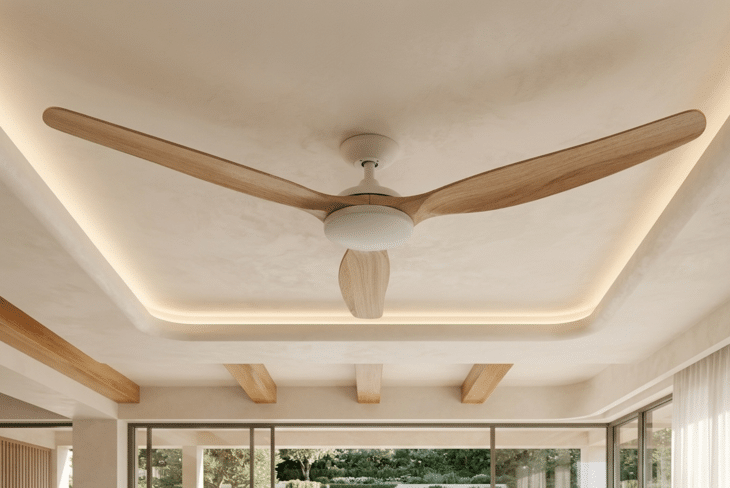
Three-bladed ceiling fans generally offer good aerodynamic efficiency. Because they have less drag, they can achieve higher speeds with low power consumption. They are common in modern designs and in spaces where a more direct airflow is desired.
Four-blade ceiling fans tend to move air smoothly and steadily. They are a popular choice in homes because they provide good ventilation and a moderate sound level.
On the other hand, ceiling fans with five or more blades usually generate a smooth flow and are quieter. They can be suitable for bedrooms or areas where greater acoustic comfort is required.
Influence of blade angle and design on efficiency.
One of the most important factors in the performance of a ceiling fan is the blade pitch. This angle determines the amount of air that is pushed through each revolution.
If the angle is too low, the ceiling fan may spin fast but move little air. If the angle is too high, the motor needs more force to move the blades, which can increase power consumption and wear.
In many efficient ceiling fans, the angle is usually between 12 and 15 degrees. This range allows a good balance between airflow, power consumption and sound level.
Blade geometry also plays a role. Straight, curved or airfoil blades do not behave in the same way. Curved designs reduce turbulence and improve flow at medium speeds.
Material is also important. Wooden or composite blades can provide quiet and stable operation. Metal blades, on the other hand, are more likely to be used in industrial or commercial environments where resistance and increased air movement are important.
Height and positioning for proper installation
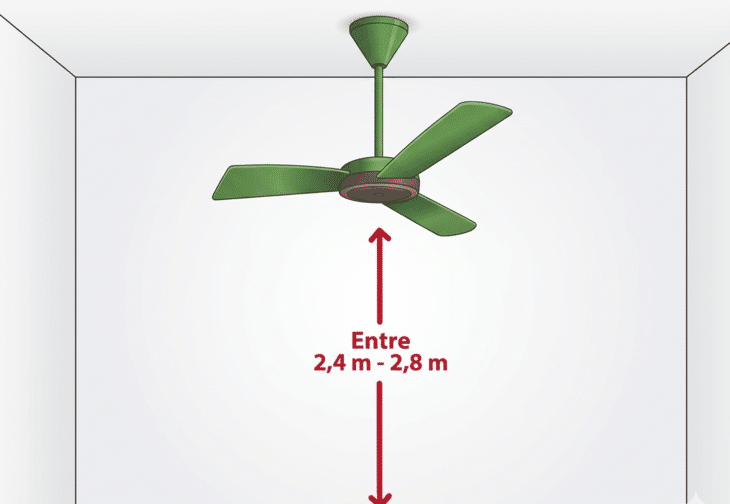
As mentioned above, a ceiling fan can lose much of its effectiveness if installed at the wrong height. The distance from the floor and ceiling determines the way air circulates through the room.
The recommended height between the ceiling fan and the floor is usually between 2.4 and 2.8 meters. This distance allows the air to reach the area correctly without generating an uncomfortable draft.
It is also important to allow sufficient clearance from the ceiling. If the ceiling fan is too close to the ceiling, it will be less able to draw air from the top, which will reduce its performance. As a reference, it is advisable to leave a minimum distance of 20 to 30 cm between the blades and the ceiling, provided that the design of the model allows it.
On high ceilings, the use of an extension pole is recommended. This piece allows you to adjust the distance between the fan and the ceiling. On low ceilings, it is preferable to choose compact models such as ceiling fans with invisible blades as they offer efficient air circulation while occupying less visual space without compromising the useful height of the room.
In addition, the ceiling fan should be installed in the center of the room. In bedrooms, it is usually placed over the central area of the room, avoiding excessive airflow over the bed. In large living rooms, it can be installed over the living area or combined with another ventilation point. For more information you can consult our guide on how to install a ceiling fan step by step.
Sizing by room
Below we will give a series of examples to facilitate the choice, however it must be taken into account that each room has its own conditions.
Small rooms
For a bedroom of e.g. 10 m², it is usual to choose a ceiling fan for small rooms with a diameter of between 50 and 101 cm. A three- or four-blade model may be sufficient, provided it has a quiet DC motor and several speeds.
Medium-sized rooms
For rooms between 10-20 m², the recommended diameter of ceilings fans for medium-sized rooms is usually between 70 and 110 cm. In this type of room, it is advisable to choose a model with a remote control as it allows you to regulate the light, speed or turn the device on and off comfortably.
Large rooms
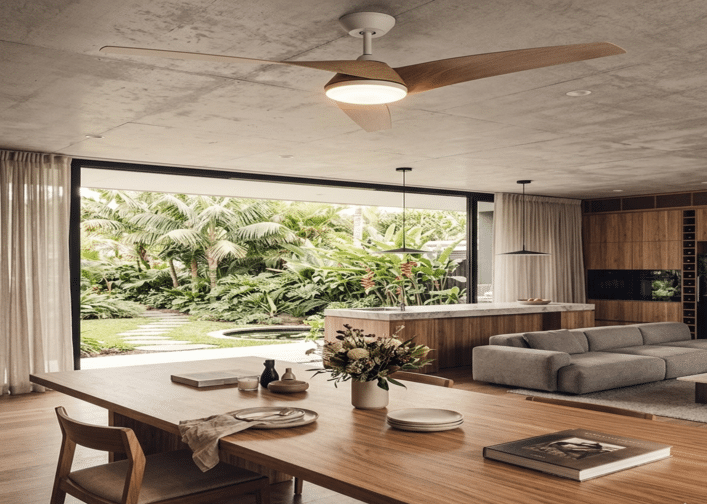
In open spaces larger than 20 m², one ceiling fan for large rooms between 132-165 cm may be sufficient. If the room is long and more ventilation is needed, you can choose to select two medium ceiling fans to better distribute the air and avoid unventilated areas.
Energy efficiency and system optimization
A ceiling fan does not completely replace air conditioning, but it can reduce its use. By moving the air continuously, it improves the thermal sensation and allows the thermostat to be raised a few degrees.
As a result, electricity consumption is reduced. The less effort the air conditioning system needs to make, the lower the energy consumption.
In addition, ceiling fans with summer-winter function allow you to change the direction of rotation of the blades to promote air destratification. In winter, warm air tends to accumulate in the upper part of the room; by gently redistributing it towards the living area, heat is better distributed and heating is used more efficiently.
If the ceiling fan is fitted with a DC motor and LED light, the whole unit offers an efficient solution all year round. It ventilates in summer, helps distribute heat in winter and provides energy-efficient lighting.
Common mistakes when choosing a ceiling fan
Choosing a ceiling fan without reviewing its technical characteristics can lead to poor performance. These are the most common mistakes:
- Choosing only by design: Design is important, however, it should not be the only criterion. Before buying, the diameter, air flow, motor, sound level and lighting should be checked.
- Installing a ceiling fan that is too small: A small fan in a large room will have to work at higher speed and will provide insufficient ventilation.
- Choosing a ceiling fan that is too large: An oversized model can create annoying drafts, take up too much visual space or not integrate well into the room.
- Not taking into account the ceiling height: The distance between the ceiling fan and the floor influences the safety and efficiency of ventilation.
- Thinking that more blades always means more air: The number of blades has an influence, but it is not the only factor.
- Ignoring the sound level: In bedrooms and offices, noise is an important issue. For these spaces, DC motors are often the best choice.
- Not checking the quality of the LED light: In fans with integrated lighting, it is not enough that they have light. It is necessary to check the lumens, color temperature and whether they allow dimming.
The diameter of blades per m² is an important reference, but should not be analyzed in isolation. In order to choose a ceiling fan correctly, all of the above points must be evaluated, which will help you to select a functional and durable fan.