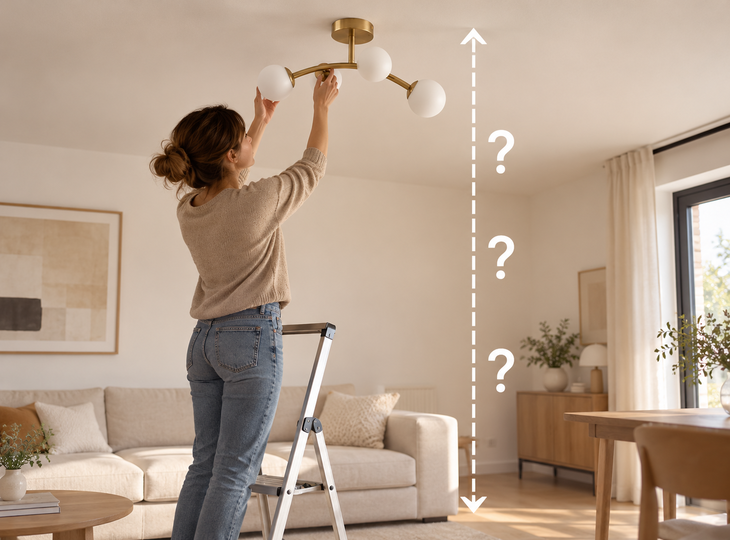
t what height should a ceiling light be hung to ensure adequate lighting without compromising the comfort of the room? Although it may seem like a minor detail, the distance between the light fitting, the ceiling and the surfaces you wish to illuminate has a direct impact on the final result.

The ideal height will depend on a number of factors. Below, we explain the approximate measurements you should bear in mind for each room.
Table of Contents
- What is the ideal height for hanging a ceiling lamps?
- Correct height for installing a ceiling lamps depending on the room
- How do you work out how far a light fitting should hang from the ceiling?
- Common mistakes when choosing the height of a ceiling lamps
- How to achieve comfortable and balanced lighting
What is the ideal height for hanging a ceiling lamps?
There is no one-size-fits-all height for all ceiling lamps. However, there are a number of reference distances that help to determine where each light fitting should be positioned.
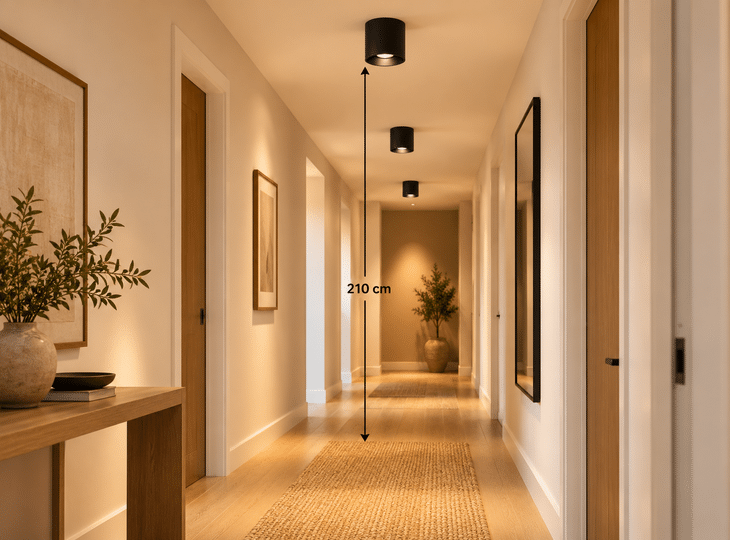
In passageways, it is advisable to maintain a clearance of approximately 210 cm between the floor and the underside of the light fitting. This allows you to move about comfortably without the light fitting becoming an obstacle.
Conversely, when the light fitting is positioned above a table, a kitchen island or a worktop, the guideline changes: the distance should be measured from that surface to the underside of the light fitting.
| Position | Guideline distance |
| Walkways | Recommended minimum of 210 cm from the floor |
| Above the dining table | 70–90 cm above the tabletop |
| Above a kitchen island | 75–90 cm above the worktop |
| Above a bedside table | 40–60 cm above the surface |
| Living room, in a walkway | Approximately 210 cm clear from the floor |
| Stairs | At least 210 cm of clear space above the walking line |
These measurements are for guidance only and should be adapted to the size of the light fitting, the ceiling height and the characteristics of each space.
It is also important to distinguish between the suspension height and the clear height. The former refers to the distance the light fixture hangs down from the ceiling, whilst the latter is the space between its underside and the floor.
Once the correct height has been determined, the next step is to adjust the suspension and secure the light fitting properly. To find out how to install it, you can consult our step-by-step guide on how to fit a ceiling light, where we explain the key aspects of its installation.
Correct height for installing a ceiling lamps depending on the room
Every room has different lighting requirements. Therefore, before deciding how low a light fitting should hang, it is important to identify what activity will take place beneath it and whether it will be situated above a fixed surface or in a walkway.
Height of a ceiling lamps in the dining room
The dining room is one of the spaces where the height of the light fitting is most important, especially when using pendant lights.
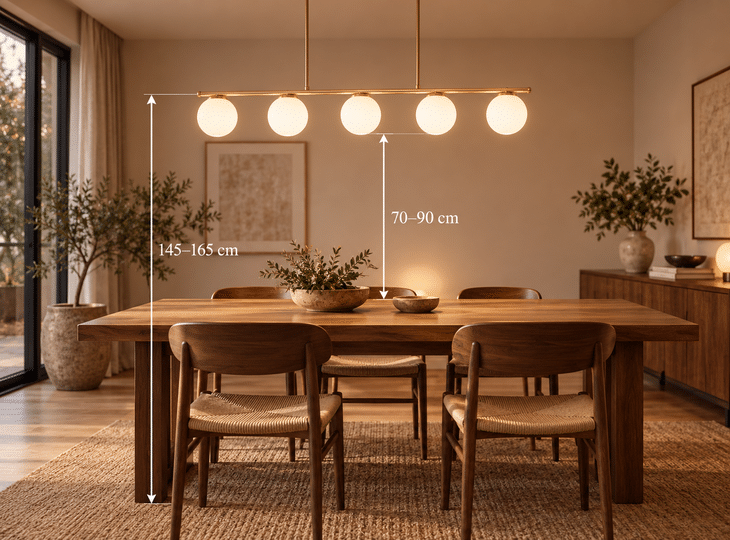
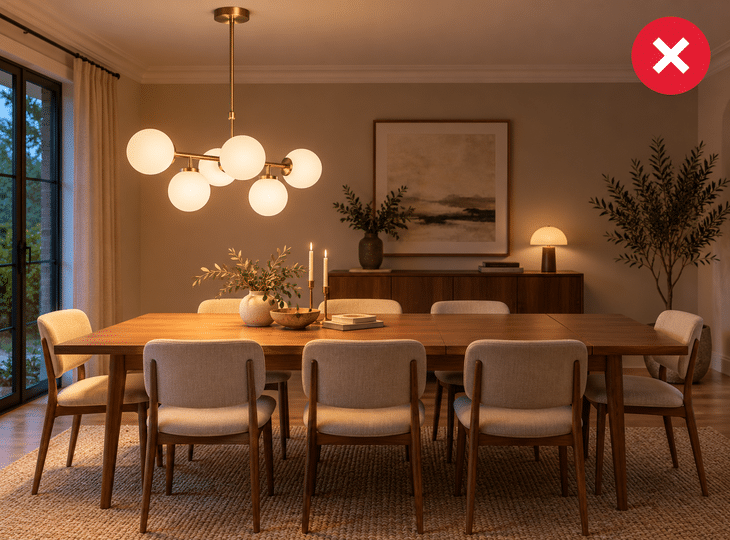
As a guide, the bottom of the light fitting should be between 70 and 90 cm above the table. This distance ensures the tabletop is well lit and creates a cosy atmosphere without hindering conversation amongst diners.
For example, if the table is 75 cm high, the bottom of the light fitting would be approximately 145 to 165 cm from the floor.
Although this height would be insufficient in a passageway, it is suitable above a fixed table, as people do not need to walk underneath it.
To achieve a balanced look, it is also advisable to consider the proportions:
- For rectangular tables, a linear light fitting or several pendant lights can distribute the light more effectively.
- For round tables, a centrally positioned light fitting usually creates a more balanced composition.
- With bulky light fittings, it may be advisable to increase the distance slightly to prevent them from obstructing the view.
The important thing is that the light reaches the table properly without causing glare for those seated.
Height of a ceiling lamps in the kitchen
Lamps suspended above a kitchen island usually combine a practical function with a decorative one. As well as lighting the worktop, they help to visually define this area.
The recommended distance is usually between 75 and 90 cm from the surface of the island to the underside of the light fitting.
This spacing makes food preparation easier and prevents the light fitting from getting in the way of everyday activities.
If the island is also used as a breakfast or dining bar, it is advisable to ensure that the lights do not obstruct eye contact between people sitting on either side.
When installing several pendant lights, it is advisable to keep them at the same height and space them out evenly across the area.
Light distribution must also be taken into account. Light fittings with very concentrated beams can create areas that are excessively bright whilst leaving other parts of the worktop in shadow. Therefore, the height must also be adjusted to suit the beam angle of each model.
Recommended products
In Stock, delivery in 15-20 days
55.99 £
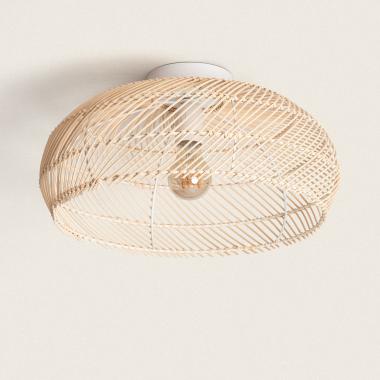
Nango Bamboo Ceiling Lamp
View product
In Stock, delivery in 24/48h
51.99 £
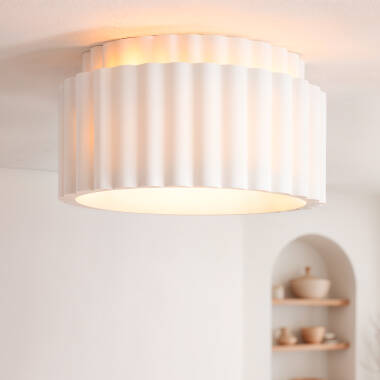
Colum Double Ceiling Lamp
View product

In Stock, delivery in 15-20 days
41.99 £
Lumpur Metal Ceiling Lamp
View product

In Stock, delivery in 15-20 days
10.59 £
Adonai Aluminium Ceiling Lamp
View product
Height of ceiling lamps in the living room
In the living room, the height depends particularly on the location of the light fitting.
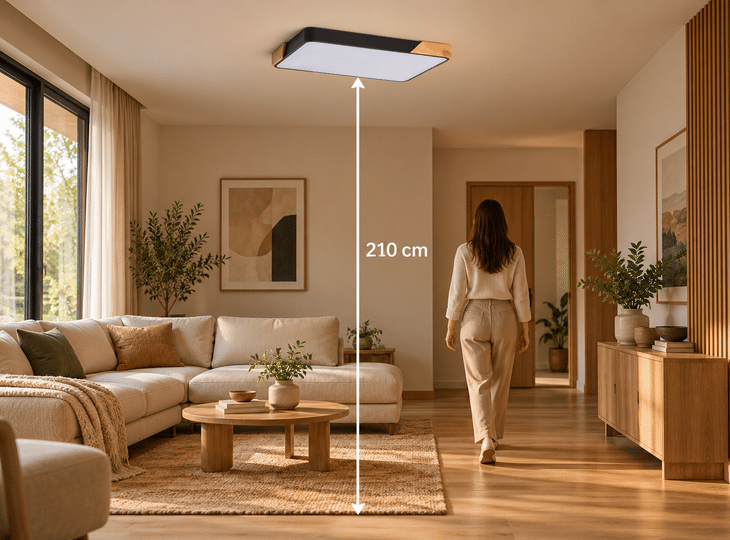
If the light fitting is situated in an area where people regularly walk through, it is advisable to maintain a clear height of approximately 210 cm from the floor.
However, when it is positioned above a coffee table or in a seating area where there is no direct passageway, the height can be slightly lower.
In such cases, there is no single distance that suits all living rooms. It is important to consider the height of the sofa, the size of the lamp and the view from the various seats.
A lamp that is too low may obstruct the view of the television or become a visually dominant feature.
In living rooms with standard-height ceilings, designer flush ceiling lights or short-hanging pendant lights can be practical alternatives, as they allow for greater headroom.
In any case, the available height is not the only factor to bear in mind when choosing a light fitting. The design, dimensions and type of lighting also influence the choice. You can explore the different options in our guide to types of ceiling lights .
Height of ceiling lamps in the bedroom
In the bedroom, it is common to use a central light fitting to provide general lighting. In this case, if the light is situated in a walkway, it is also advisable to maintain a clear height of approximately 210 cm.
However, it is becoming increasingly common to use small pendant lights on either side of the bed, replacing traditional table lamps.
When placed above bedside tables, a common guideline is to position the bottom of the light fitting between 40 and 60 cm above the table.
The exact height will depend on the position of the bed and the type of lampshade.
It is advisable that the light source is not directly at eye level when a person is sitting on the bed, especially if the bulb is visible.
It is also a good idea to choose a light fitting that provides pleasant lighting for reading or relaxing, avoiding light beams that are too intense.
Height of light fittings in hallways and entrance halls
In hallways and entrance halls, the priority is to ensure comfortable movement and even lighting.
For this reason, the bottom of the light fittings should be approximately 210 cm above the floor or higher, provided the dimensions of the room allow for this.
In narrow corridors or those with low ceilings, large pendant lights can make the space appear smaller and make it difficult to walk through.
In these situations, it is usually more appropriate to opt for ceiling lights with spotlights. Another very useful option is ceiling lights, as their compact design allows you to make better use of the available height without taking up too much space.
In hallways with high ceilings, pendant lights can provide a striking decorative feature. However, their length must be adjusted to keep the entrance area clear and allow nearby doors or cupboards to be opened.
At what height should light fittings be positioned on staircases?
Staircases require special attention because the floor level changes along their length.
To determine the position of a pendant light, the reference point should be the distance between its lower edge and the steps directly below. As a general rule, it is advisable to maintain at least 210 cm of headroom above the walking line.
On open staircases or those with double-height ceilings, arrangements comprising several pendant lights at different levels may be used.
How do you work out how far a light fitting should hang from the ceiling?
Once you have determined the height at which the light fitting should be positioned, calculating the suspension length is straightforward.
For a light fitting situated in a passageway, you can use the following formula:
Maximum suspension length = ceiling height − desired clearance height
For example, in a room with a ceiling height of 250 cm, if you want to maintain 210 cm of headroom from the floor, the light fitting can be suspended a maximum of 40 cm from the ceiling to its lowest point.
In the case of a lamp on a table, the calculation is different:
Drop from the ceiling = ceiling height − table height − desired distance above the table
If we have a ceiling height of 250 cm, a table height of 75 cm and we want the lamp to be 80 cm above the tabletop, the total drop will be 95 cm.
It is important to bear in mind that this measurement includes both the cable or suspension system and the lamp body.
Therefore, the length of the cable should not be confused with the total distance the light fixture hangs down.
Common mistakes when choosing the height of a ceiling lamps
Even when the recommended distances are followed, certain mistakes can affect the lighting outcome.
- Failing to take the size of the light fitting into account. A large light fitting can appear too imposing if hung at the same height as a compact model.
- Measuring only the suspension cable. The final height should be calculated down to the lowest part of the light fitting, including the shade or any decorative elements.
- Failing to take glare into account. A light fitting may be correctly positioned and yet still cause discomfort if the light source is directly visible.
- Choosing the height without considering the light distribution. The beam angle, orientation and optical design all influence the illuminated area. Adjusting the height can also alter the size of the area receiving light.
- Ignoring the layout of the furniture. A lamp placed on a table should be positioned with its final location in mind, particularly in the case of extendable furniture or spaces that can be rearranged.
How to achieve comfortable and balanced lighting
Choosing the correct height for a ceiling light helps to improve both the functionality and the aesthetics of a room.
To achieve the right result, it is important to take into account the dimensions of the space, the type of light fitting and the lighting requirements of each area. In this way, it is possible to create pleasant and balanced environments, where light is distributed efficiently and contributes to everyday comfort.