Choosing between different types of ceiling lights isn’t just about which one best suits the décor. The ceiling height, the size of the room, the activities we carry out in it and the amount of natural light available also influence the decision.

A kitchen requires different lighting to a bedroom, whilst in the living room we might look for a light fitting with a more decorative presence. Even within the same room, the arrangement of the furniture can determine whether we need general lighting, several adjustable spotlights or a light fitting positioned above a specific area.
That’s why, before choosing a ceiling light, it’s worth considering both the space itself and how we use it. Below, we’ll go through the factors you should bear in mind and the types of lights that work best in each room of the house.
Table of Contents
- What should you bear in mind when choosing a ceiling light?
- Ceiling spotlights: a versatile solution for rooms with low ceilings
- Ceiling lights to make the living room stand out
- Ceiling lights for a cosier bedroom
- Ceiling lights for the kitchen
- Ceiling lights for the bathroom
- Ceiling lights for hallways and entrance halls
- Ceiling lights for outdoor areas
- What colour should you choose for a ceiling light?
- How to choose the right type of ceiling light for each room
What should you bear in mind when choosing a ceiling light?
Before focusing on the design of the ceiling light, consider the characteristics of the room.
One of the main factors is the ceiling height. In rooms with low ceilings, it’s best to choose light fittings that take up little vertical space, whilst in rooms with higher ceilings there’s more freedom to use bulky designs or pendant lights.
It is also important to take the size of the room into account. A small light fitting may prove insufficient in a spacious living room, whilst one that is too large may visually overwhelm a bedroom measuring just a few square metres.
The layout of the furniture also influences the choice. If the room has several clearly distinct areas, it may be worth combining general ceiling lighting with accent lamps or using systems that allow the light to be directed towards different points.
Another key consideration is how we use the room. In a kitchen, for example, we need functional lighting that allows us to work comfortably. In the bedroom, on the other hand, we usually seek a softer, more relaxed atmosphere.
It’s also worth considering the material and finish of the light fitting. Wooden models can add warmth, whilst glass can create a lighter, brighter effect.
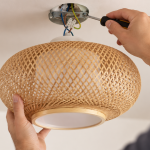
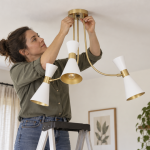
Once you’ve chosen the most suitable model, it’s also important to install it correctly. If you’re replacing a light fitting or installing a new one, you can consult our step-by-step guide on how to fit a ceiling light, where we explain the process from preparation right through to connecting and securing the light.
Recommended products
In Stock, delivery in 15-20 days
5.29 £
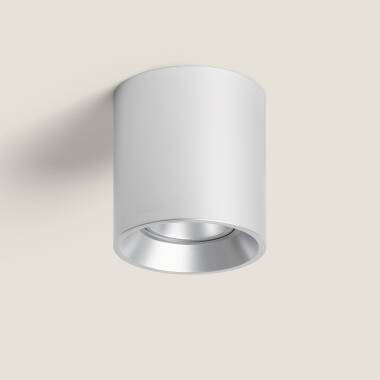
Quartz White Ceiling Light
View product
In Stock, delivery in 24/48h
15.89 £
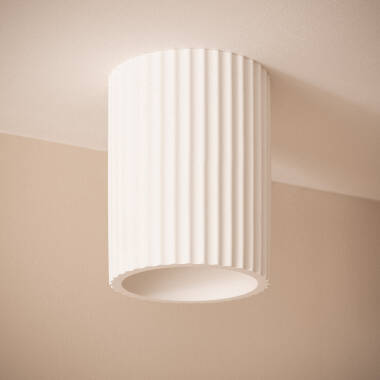
Colum Plaster Ceiling Light
View product
In Stock, delivery in 24/48h
5.29 £
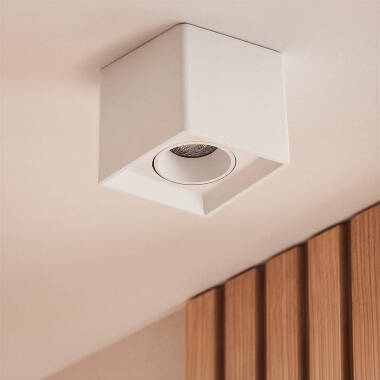
Jaspe White Ceiling Light
View product
In Stock, delivery in 24/48h
17.99 £
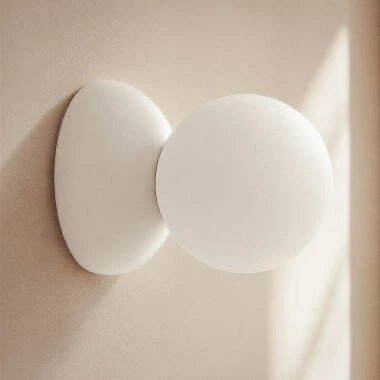
Deyla Plaster Ceiling Light
View product
Ceiling spotlights: a versatile solution for rooms with low ceilings
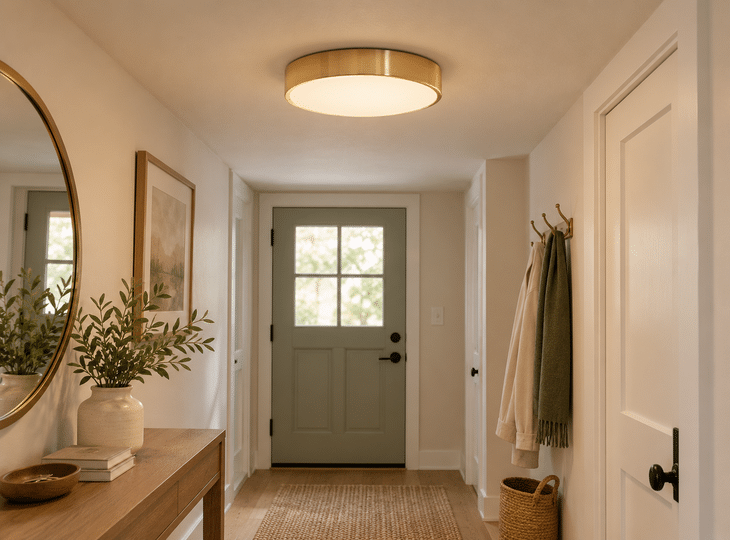
Among the different types of light fittings, designer flush ceiling lights stand out for their versatility.
They are fitted directly onto or very close to the ceiling surface, so they take up little space and are particularly useful where headroom is limited.
Furthermore, they tend to provide fairly even lighting. This means they can be used as general lighting in bedrooms, hallways, kitchens, bathrooms or even living rooms.
If you have a home with low ceilings, this type of light fitting may be one of the first options worth considering, as it helps to maintain a greater sense of space.
Ceiling lights to make the living room stand out
The living room is one of the spaces in the home where lighting serves the most varied purposes.
During the day, it can receive plenty of natural light, whilst at night we need to adapt the atmosphere to different activities: watching television, reading, entertaining guests or simply relaxing.
For this reason, the ceiling light usually serves primarily as general lighting, complemented by other light sources such as floor lamps, table lamps or indirect lighting.
Crystal light fittings
In spacious living rooms, a crystal ceiling light can work very well.
The crystal allows light to pass through the structure and create reflections, so it can appear visually lighter than other materials even when the light is quite substantial.
What’s more, it suits a wide range of styles. Designs with simple lines fit easily into contemporary interiors, whilst chandeliers with multiple glass elements can add a more decorative touch.
If the living room features neutral colours, a crystal chandelier can also help to introduce a focal point without adding too much visual weight.
In small rooms or those with low ceilings, however, it may be better to opt for a ceiling-mounted light or a more compact fixture that keeps the upper part of the room uncluttered.
You can also play around with finishes. A black frame can create contrast in a living room with light colours, whilst gold detailing adds a warmer, more sophisticated touch.
Wooden light fittings
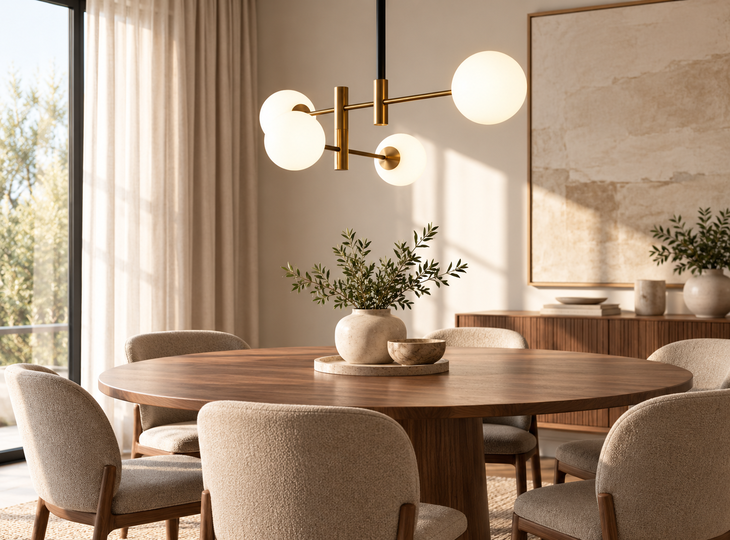
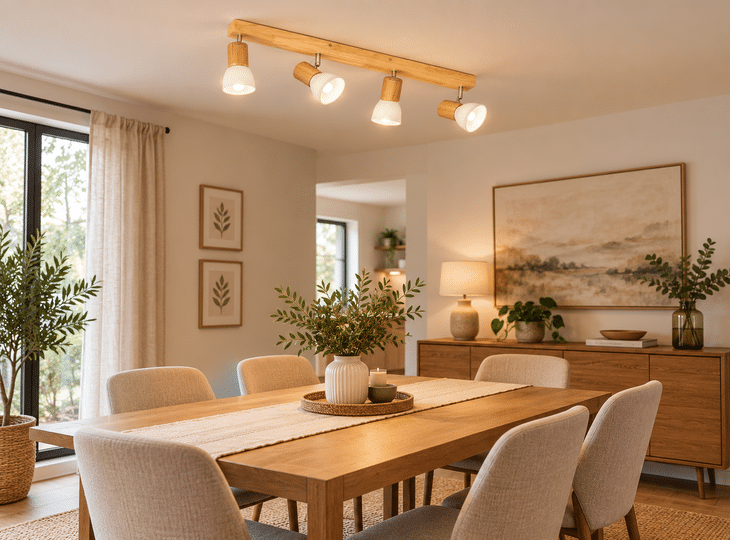
Wooden ceiling lights are a good choice for dining rooms where natural materials predominate.
Wood adds texture and warmth, especially when combined with tables made from the same material, plant fibres, beige tones, etc.
Not every element needs to have exactly the same finish. In fact, combining different shades of wood can result in spaces that feel more natural and less uniform.
In Nordic- or contemporary-style dining rooms, a light fitting with a simple wooden frame can help soften the straight lines of the furniture.
If the living room and dining room share the same space, it’s a good idea to seek some connection between their light fittings. They don’t have to be identical, but they can share a common element, such as a metallic finish, a colour or a shape.
Ceiling lights for a cosier bedroom
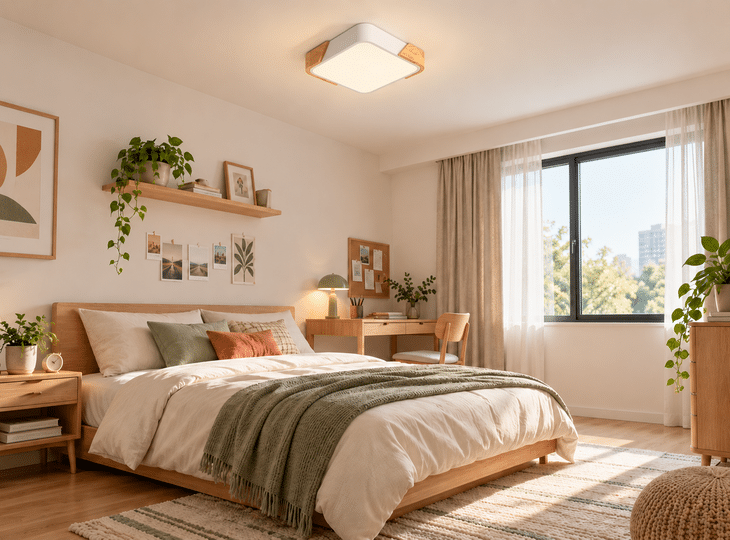
Bedroom lighting should be practical enough to allow us to get dressed, tidy the room or move about comfortably, but also pleasant when we want to rest.
That’s why softer lighting usually works better here than in spaces such as the kitchen.
Lamps with fabric shades
Fabric ceiling lights work very well here.
The texture of the fabric helps to visually soften the light and brings a warmer feel to the space.
Shades in shades of white, beige or cream can be easily integrated into neutral décor, whilst other colours allow the lamp to become a more prominent feature.
Ceiling lights for the kitchen
In the kitchen, functionality takes centre stage.
We need sufficient light to prepare food, clean and move about comfortably, so a single, poorly positioned light source can create areas of shadow.
As well as general ceiling lighting, many kitchens require additional light above the worktop or under the wall units.
Ceiling lights with spotlights to direct the light
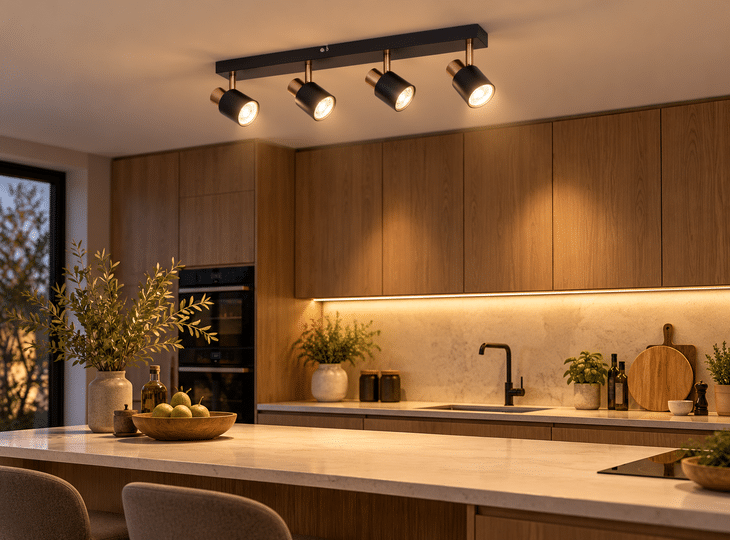
Ceiling lamps with spotlights are very practical in this room as they allow you to direct the light towards different areas.
There are models with two, three, four or five spotlights, so you can choose the configuration depending on the size and layout of the kitchen.
In a small kitchen, two or three spotlights may be sufficient to distribute the light. In larger or more elongated spaces, four or five spotlights allow you to cover a larger area.
One of their main advantages is that each spotlight can be directed towards a specific area. For example, some can be aimed at the preparation area whilst others illuminate passageways or a side table.
In any case, ceiling lighting should be supplemented where necessary with other specific light sources to avoid shadows on work surfaces.
Ceiling lights for the bathroom
Bathrooms are usually relatively small in size, but require functional lighting.
General lighting should allow the room to be used comfortably, although it is usually advisable to supplement this with specific lighting around the mirror.
Compact ceiling lights for bathrooms
A ceiling-mounted light fitting is usually a particularly practical solution for the bathroom.
As they take up little space, they keep the ceiling visually uncluttered and distribute the light fairly evenly.
White models are common because they blend easily into the ceiling and help maintain a clean, uncluttered look. However, in contemporary bathrooms, black ceiling lights can also be used when there are other elements with the same finish, such as taps, shower screens or fittings.
Beyond design, there is one particularly important aspect to consider in this room: humidity levels.
Not all light fittings are suitable for every area of the bathroom. Before installing a light fitting, it is essential to check its technical specifications and ensure that its protection rating is appropriate for the specific location and any proximity to water.
Ceiling lights for hallways and entrance halls
Corridors and hallways are usually narrow spaces, so it is best to avoid light fittings that are too bulky.
Furthermore, in long corridors, a single central light fitting may not be sufficient to achieve even lighting.
Where there are several electrical sockets, distributing different light fittings along the length of the corridor can create a more balanced effect.
Ceiling-mounted lights or spotlights to make better use of the space
Ceiling-mounted lights are once again one of the most practical options as they barely reduce the available headroom.
In wider corridors, adjustable spotlights can also be used, particularly if you wish to highlight features on the walls.
In this type of space, it is best to opt for relatively simple designs to avoid visually overwhelming the area.
Ceiling lights for outdoor areas
Covered terraces, porches, balconies or entrance areas can also have lighting fitted to the ceiling.
However, in these spaces, we should not choose a light fitting solely on the basis of its design.
Ceiling lights specifically designed for outdoor use
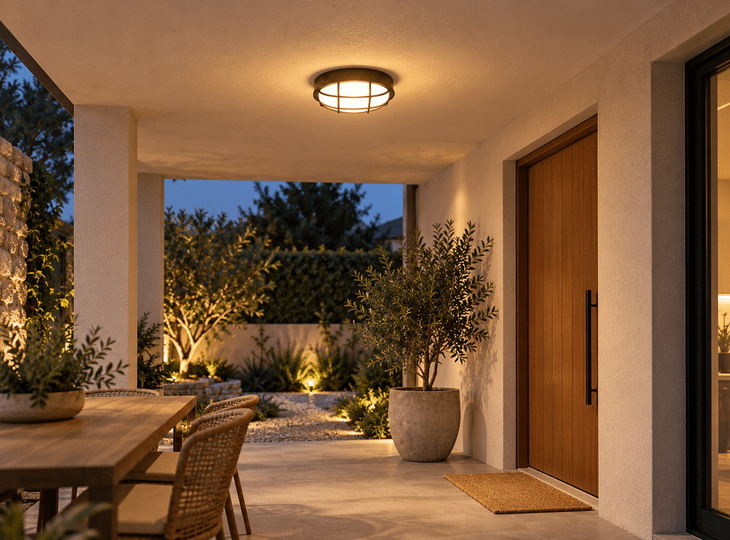
Outdoor ceiling lamps are designed to cope with conditions that differ from those found inside the home.
Depending on where they are installed, they may be exposed to damp, dust, temperature changes or contact with water. For this reason, you should always check that the light fitting has the appropriate protection rating for its location.
From a decorative point of view, black lights work very well in contemporary outdoor settings, particularly when combined with metalwork or light-coloured façades. Warmer designs can also be used on terraces featuring wood or natural fibres, ensuring the lighting blends in with the surroundings.
What colour should you choose for a ceiling light?
As well as the type of light fitting and the material, the finish has a significant influence on how we perceive the light fitting within the room.
White ceiling lights are one of the most understated options. Against a white ceiling, they can go almost unnoticed and are particularly effective when functional lighting is required.
Black ceiling lights have a more distinctive character and create contrast. They work well in modern kitchens, contemporary living rooms or spaces where other black elements are already present.
The choice depends, to a large extent, on the role you want the light fitting to play. It can blend discreetly into the room or become one of its main decorative features.
How to choose the right type of ceiling light for each room
There isn’t a single type of ceiling light that works equally well throughout the whole home.
Rather than choosing a light fitting solely for its appearance, it’s best to first consider how we use each room and what sort of lighting we need.
From there, materials, colours and finishes allow you to adapt the light fitting to the style of your home and ensure it blends seamlessly into the décor.
Good ceiling lighting not only allows you to see properly: it also helps to create different atmospheres and makes the space feel much more comfortable.