

Residual current devices (RCDs) are essential electrical mechanisms in any electrical installation. Their function is to detect potential current leaks and automatically cut off the power supply when certain fault conditions occur, thereby reducing the risk of electrical accidents.

However, not all residual current devices offer the same performance. There are different types, designed to respond to different forms of residual current. Among the best known are Type A and Type AC residual current devices, two devices that may appear similar but which have significant differences in their operation and applications.
Below, we analyse how each device works, what their main differences are, and what factors should be taken into account when choosing the right residual current device.
Table of Contents
- What is a residual current device (RCD) and what is it used for?
- What is a Type AC residual current device?
- What is a Type A residual current device?
- Key differences between a Type A and a Type AC residual current device
- How to identify a Type A and a Type AC residual current device
- Other types of residual current circuit breakers
- How to choose the correct residual current device for each installation
What is a residual current device (RCD) and what is it used for?
A residual current device (RCD) is an electrical safety device designed to detect imbalances in the current flowing through the live conductors of an installation.
Under normal conditions, the current entering a circuit must be equal to the current returning. If an insulation fault occurs and part of that current flows along an unintended path, such as a metal casing connected to earth, a difference arises which can be detected by the device.
When the residual current reaches the trip threshold set for the device, the circuit breaker automatically cuts off the power supply.
This mechanism helps to reduce the risks associated with indirect contact and provides additional protection against certain types of direct contact when highly sensitive devices are used.
For example, if a domestic appliance has an insulation fault causing a current leak to its metal casing, the residual current device can detect the imbalance and cut off the supply before the situation worsens.
However, it is important to distinguish its function from that of other protective devices.
The residual current device is not designed to protect against overloads or short circuits. That task falls to circuit breakers, unless a combined device incorporating both functions is used.
Therefore, residual current devices and circuit breakers are complementary protective measures within an electrical panel enclosures.
Recommended products

In Stock, delivery in 15-20 days
21.99 £
Residential Differential Circuit Breaker 2P 30mA 25-40A 6kA Class AC LEGRAND RX³ 402056
View product

In Stock, delivery in 16-21 days
109.99 £
SCAME Switchboard with 11 DIN 2 socket modules 3P+N+T 16 A + 2 F-type sockets - IP44
View product

In Stock, delivery in 15-20 days
64.99 £
SCAME Switchboard with 11 DIN Modules + 4 sockets – IP66
View product
In Stock, delivery in 15-20 days
17.99 £
E27 Infrared Bulb PHILIPS 375W G125
View product
How does it detect a current leak?
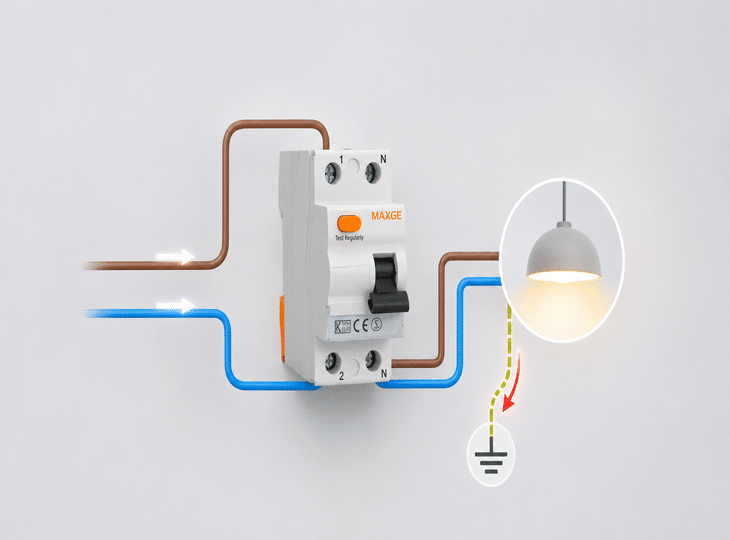
The operation of a residual current device is based on measuring the sum of the currents flowing through the live conductors.
In a single-phase installation, the device compares the current flowing through the live wire with that returning via the neutral.
When the two are equal, there is no significant residual current. However, if part of the current is diverted to earth or another external path, an imbalance occurs.
This imbalance is detected by the residual current measurement system, which activates the trip mechanism when the relevant conditions are met.
The device’s ability to recognise this imbalance depends, amongst other factors, on the waveform of the residual current. It is precisely here that the fundamental difference between Type A and Type AC residual current circuit breakers lies.
ⓘ Illustrative contextual content generated or edited using AI (Art. 50 AI Act).
What is a Type AC residual current device?
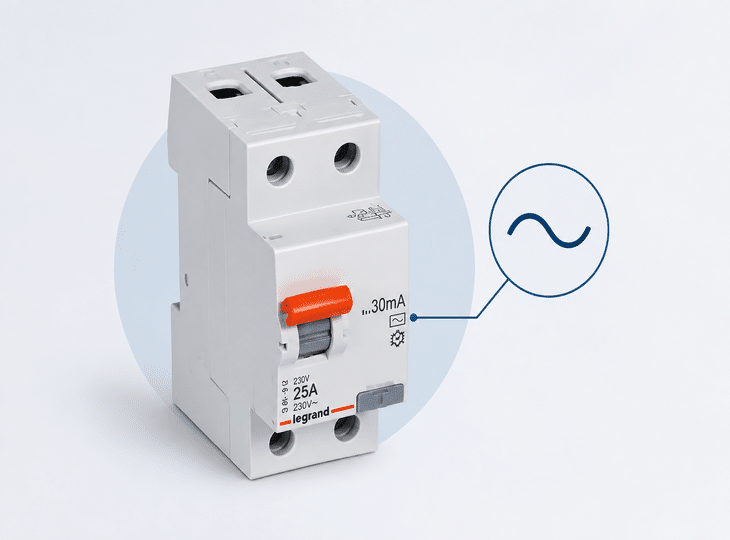
An AC-type residual current device is a device designed to detect sinusoidal alternating residual currents, which are characteristic of certain electrical faults in circuits supplied with alternating current.
This type of residual current device has traditionally been used in numerous electrical installations, particularly in circuits with simple loads that do not incorporate power electronics.
It is designed to detect earth faults whose waveform corresponds to a sinusoidal alternating current, such as those that may occur in certain resistive equipment.
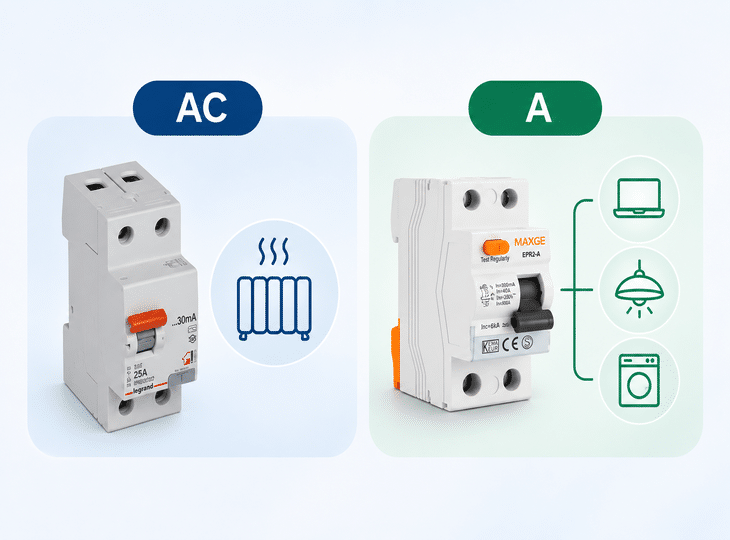
For example, in an installation powering a conventional heating element, an insulation fault may generate an alternating residual current that an AC-type residual current device is designed to detect.
However, its main limitation arises when the leakage current contains pulsating direct current components.
Electronic devices incorporating rectifiers and other power conversion systems can generate residual currents with waveforms different from those of a conventional sinusoidal alternating current.
In such circumstances, an AC-type residual current device (RCD) is not guaranteed to trip in response to all fault currents that may occur.
Furthermore, certain direct current components may affect the device’s operation and compromise its detection capability.
For this reason, although AC residual current devices still have specific applications, their use must be assessed taking into account the actual characteristics of the connected equipment.
ⓘ Illustrative contextual content generated or edited using AI (Art. 50 AI Act).
Applications of AC-type residual current devices
AC-type residual current devices may be used in circuits where it has been established that the expected residual currents are exclusively sinusoidal alternating currents and where their use is permitted by the applicable regulations.
Traditional applications include circuits designed to power conventional electrical resistors or certain loads without electronic components.
However, the presence of electronic controls, regulators or power supplies may alter the characteristics of the fault current.
Therefore, it is not enough simply to identify a piece of equipment as resistive to automatically assume that an AC-type residual current device is suitable. It is necessary to consider its design and the manufacturer’s recommendations.
What is a Type A residual current device?
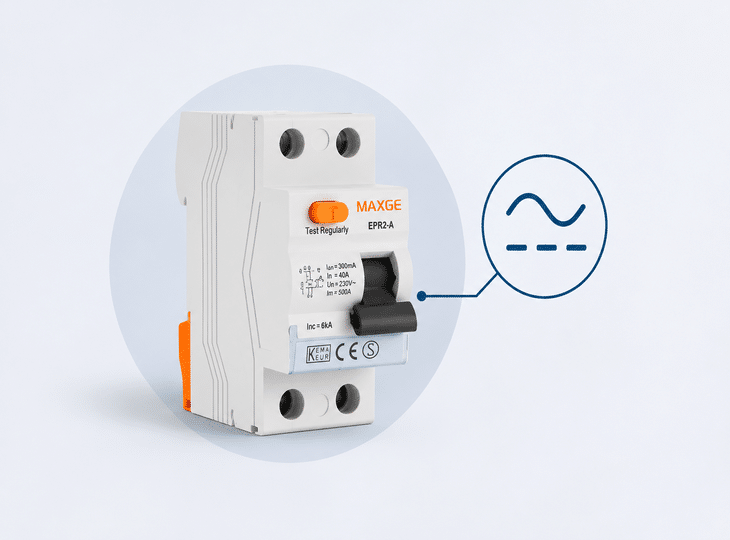
A Type A residual current device is designed to detect sinusoidal alternating residual currents and pulsating direct residual currents.
This additional capability is its main advantage over the AC type, as it enables it to respond to certain current leaks associated with equipment containing electronic components.
Many modern devices use rectifier circuits to convert part of the AC supply current into direct current. When an insulation fault occurs in certain parts of these circuits, the residual current may take on a pulsating waveform.
Under these conditions, a Type A residual current device offers a detection capability that is not guaranteed in Type AC devices.
This makes it particularly suitable for numerous circuits powering modern domestic appliances, electronic systems and equipment with switched-mode power supplies.
Common applications include installations featuring electronic washing machines, induction hobs, computers and certain LED lighting systems.
However, it should be noted that a Type A residual current device is not designed to detect any direct current.
Although it may operate in the presence of pulsating direct currents and tolerate certain smoothed direct current components within the limits set by its product standard, it is not a substitute for a Type B residual current device when it is necessary to detect smoothed direct residual currents.
ⓘ Illustrative contextual content generated or edited using AI (Art. 50 AI Act).
Applications of Type A residual current devices
Type A isolators are commonly used in installations where there is equipment capable of generating pulsating alternating and direct residual currents.
Their scope of application includes numerous domestic and commercial circuits, particularly those powering electronic devices.
They are also used in certain LED lighting systems, where the power supplies incorporate electronic components to adapt the electrical power to the requirements of the light-emitting diodes.
In installations featuring state-of-the-art household appliances, control systems or computer equipment, type A is usually a more suitable solution than type AC.
However, the final choice must take into account the characteristics of the installation and the technical specifications of the loads, as some applications may require Type F or Type B residual current devices, or other additional measures.
Key differences between a Type A and a Type AC residual current device
Although both devices are designed to detect earth faults and cut off the power supply, their operating characteristics are not identical.
The fundamental difference lies in the types of residual current for which they are guaranteed to operate.
Types of residual current they detect
The AC-type residual current device responds to sinusoidal alternating residual currents, whilst the Type A residual current device also detects pulsating direct currents.
This second type of current can occur in certain electronic equipment, particularly when it incorporates rectifier circuits.
Therefore, a type A residual current device offers broader coverage in terms of the types of residual current it can detect.
This does not mean that it necessarily has a higher rated sensitivity or that it responds more quickly to any fault. Sensitivity and trip times depend on the specific characteristics of the device.
Compatibility with electronic equipment
Another important difference relates to the equipment that can be connected to the protected circuits.
AC-type residual current devices are designed for installations where only sinusoidal alternating residual currents are anticipated.
In contrast, type A residual current devices are more suitable for circuits supplying electronic devices capable of generating pulsating direct current components.
For example, an installation containing computers, LED lighting and electronic household appliances may present operating conditions that differ from those of a circuit supplying only a conventional resistor.
In such cases, selecting the correct class of residual current device is essential to ensure adequate protection.
ⓘ Illustrative contextual content generated or edited using AI (Art. 50 AI Act).
Comparison table between Type A and AC residual current devices
| Feature | Type AC differential | Type A residual current device |
| Sinusoidal alternating residual current | Yes | Yes |
| Pulsating direct residual current | Detection is not guaranteed | Yes |
| Smoothed DC detection | No | No |
| Circuits with electronics | Limited use depending on the loads | Suitable for numerous applications |
| Typical applications | Linear loads without electronics | Household appliances, electronics and LED lighting |
| Sensitivity of 30 mA | Available | Available |
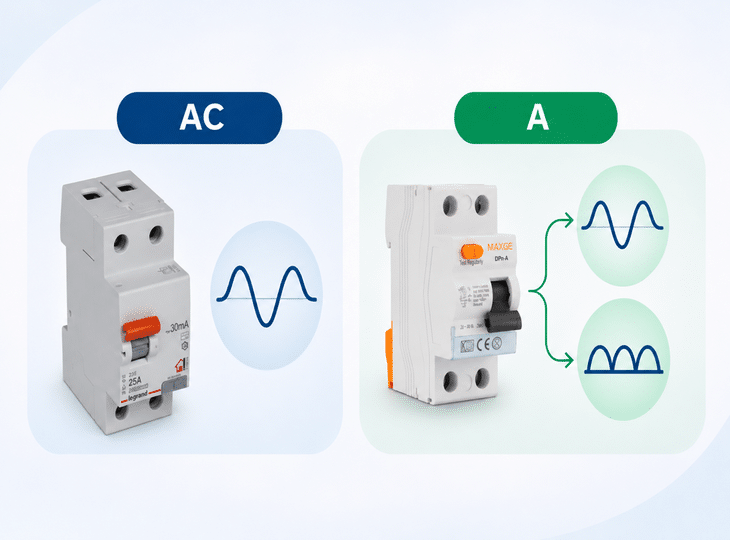
| Identification | Sine wave symbol | Sine wave and pulsating current symbol |
The choice should not be based solely on this comparison. The rated current, sensitivity, number of poles and the specific requirements of each circuit must also be taken into account.
How to identify a Type A and a Type AC residual current device
Residual current devices feature a series of markings and symbols that enable their main technical characteristics to be identified.
To distinguish a Type A residual current device from a Type AC one, look for the symbol indicating the detection class, which is usually located on the front of the device.
A type AC residual current device is identified by a symbol representing a sine wave.
A Type A residual current device, on the other hand, features a representation of the alternating sinusoidal wave alongside that of pulsating direct current.
This identification is particularly important because two residual current devices may look almost identical on the outside, yet offer different detection capabilities.
It is also common to find other technical markings, such as the rated current and sensitivity.
ⓘ Illustrative contextual content generated or edited using AI (Art. 50 AI Act).
Other types of residual current circuit breakers
In addition to Type A and Type AC residual current devices, there are other types designed to respond to residual currents with different characteristics.
Their use depends on the connected equipment and the anticipated operating conditions. To find out about other electrical protection solutions and their applications, please refer to our guide on types of switches.
Type F residual current devices
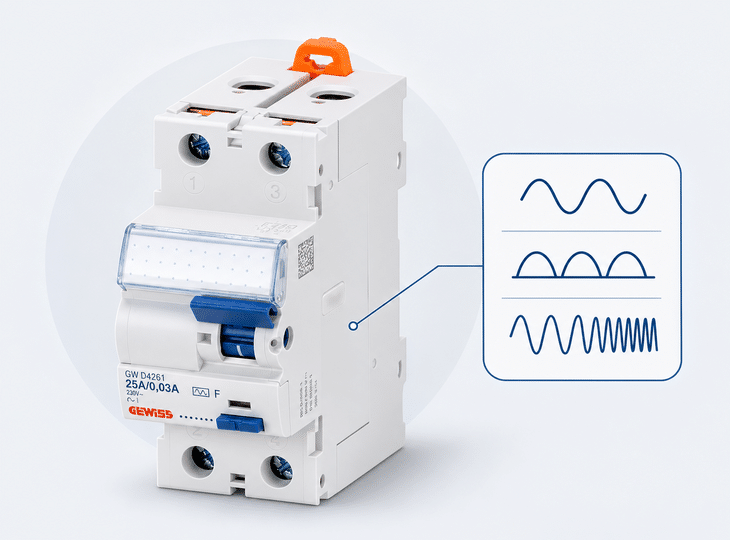
Type F residual current devices are designed for specific applications involving electronic equipment with single-phase frequency converters.
As well as detecting the residual currents specified for Type A devices, they can respond to certain composite residual currents and frequencies other than the fundamental frequency of the mains supply.
As such, they may be suitable for certain air-conditioning systems, heat pumps and domestic appliances with electronically controlled motors.
ⓘ Illustrative contextual content generated or edited using AI (Art. 50 AI Act).
Type B residual current devices
Type B differentials incorporate a broader detection capability, which includes certain smoothed continuous residual currents.
These currents may occur in power electronics equipment, such as certain inverters, converters and variable-speed drives.
They may also be required in certain photovoltaic installations or electric vehicle charging infrastructure, depending on the characteristics of the equipment and the built-in protection measures.
It is important to remember that a Type A residual current device does not automatically replace a Type B device when there is a possibility of smoothed DC residual currents exceeding its operating limits.
How to choose the correct residual current device for each installation
Ultimately, understanding the differences between Type A and Type AC residual current devices is essential to ensuring adequate electrical protection. Although both devices play a vital role in the safety of installations, their characteristics and applications differ. Therefore, choosing the correct residual current device requires taking into account the connected equipment, the characteristics of the installation and the applicable regulations, thereby ensuring safe and efficient operation.