Lighting is no longer viewed solely as a functional tool for providing visibility in a space. In today’s buildings, light is part of a broader strategy related to energy efficiency, automation, and the user experience. That is why concepts such as smart lighting and artificial intelligence are becoming increasingly important in building lighting management.

Table of Contents
What is smart lighting?
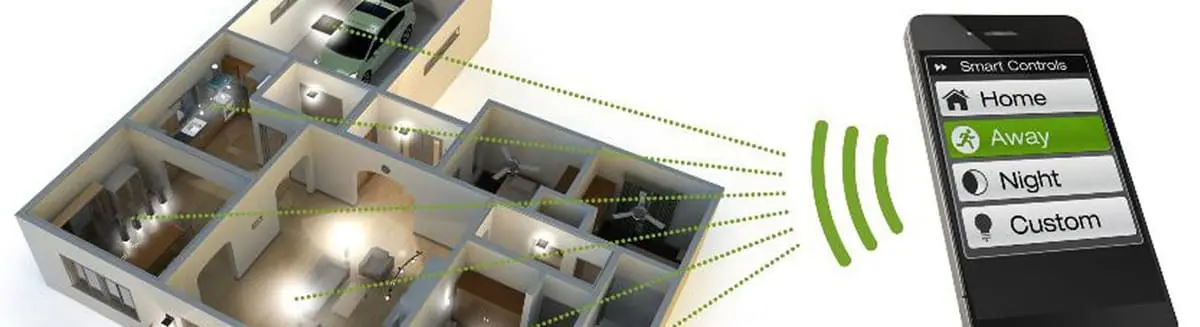
To understand the role of AI in lighting management, we must first clarify what smart lighting is. Smart lighting is a system capable of controlling, dimming, and adapting light based on different variables. These variables can include the presence of people, the amount of available natural light, energy consumption, or user preferences.
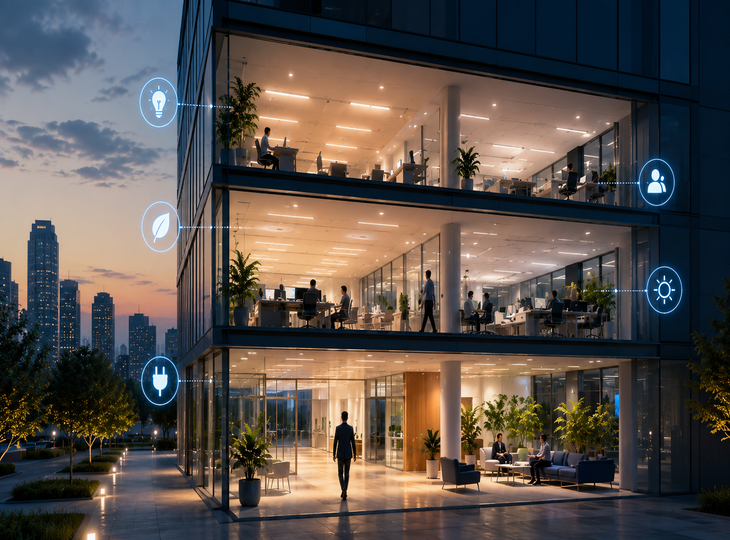
In a conventional installation, lighting is usually controlled by switches or manual dimmers. In contrast, in a smart system, lighting responds to data. This means it can be switched on, switched off or dimmed according to what is happening in the space. For example, in an office, the system can detect that a meeting room is empty and automatically switch off the luminaires.
Smart lighting is not limited to connected light bulbs or control via a mobile app. Although these elements are part of the concept, especially in the field of smart home lighting, in commercial buildings the system is usually more complex. It can include sensors, dimmable LED lights, management platforms, etc.
Recommended products
In Stock, delivery in 16-21 days
55.99 £
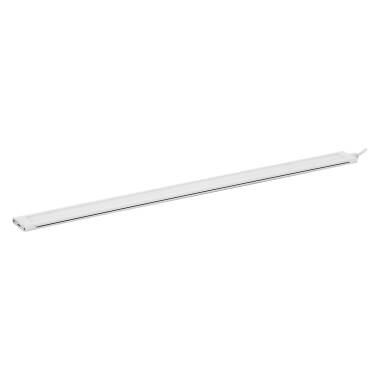
7W Smart+ WiFi Undercabinet LED Linear Bar 45.7cm LEDVANCE 405807575575691
View product

In Stock, delivery in 15-20 days
11.69 £
PIR Motion Sensor for Smart LED UFO High Bay IP65
View product
In Stock, delivery in 16-21 days
103.99 £
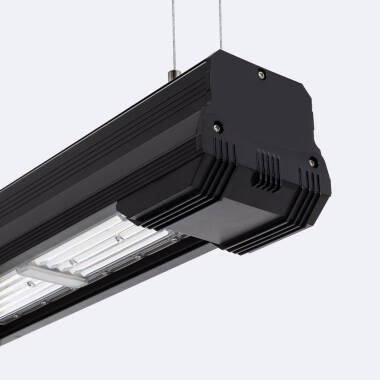
Linear 100W LED High Bay Smart Zhaga Plug & Play IP65 160 lm/W
View product
In Stock, delivery in 16-21 days
119.99 £
Linear 150W LED High Bay Smart Zhaga Plug & Play IP65 160 lm/W
View product
How does a smart lighting system work?
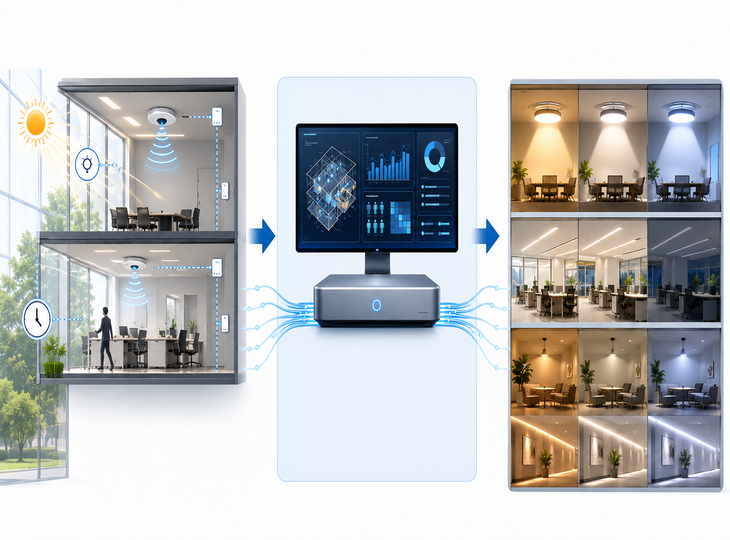
A smart lighting system can be divided into three phases: data collection, information processing, and lighting control.
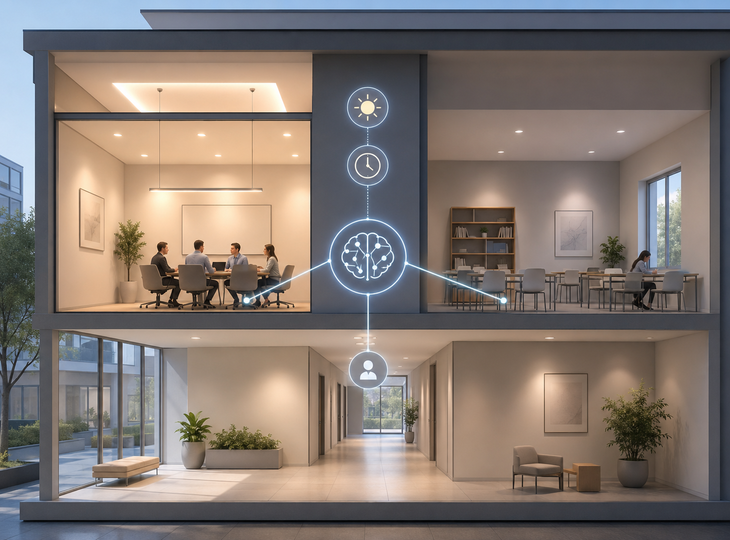
The first phase is data collection. To do this, the system uses sensors and connected devices that gather information about the environment. Occupancy sensors detect whether there are people in a room. Light sensors measure the amount of available natural light. Timer sensors allow the lighting to be adjusted according to the time of day. Additionally, in more advanced buildings, the system can receive information from other systems, such as HVAC or window shades.
The second stage is information processing. The data collected by the sensors is sent to a control system, which interprets the situation and decides what the lighting should do. In basic installations, these decisions are based on predefined rules.
In more advanced installations, artificial intelligence comes into play. In this case, the system not only applies fixed rules but also analyzes usage patterns and learns from the building’s behavior. It can detect which areas are used most frequently or at what times occupancy is highest.
The third phase is acting on the lighting. Once the decision is made, the system adjusts the behavior of the lights. It can turn them on, turn them off, adjust their brightness, change the color temperature, or activate specific scenes. In buildings with dimmable LED lights, this adjustment can be made very precisely and by individual zones.
The Role of AI in Smart Building Lighting
Artificial intelligence enables smart building lighting to evolve from basic automation toward truly adaptive management. In a traditional automated system, the system executes programmed commands. In an AI-enabled installation, the system can learn from data and optimize its behavior over time.
This is especially useful in buildings where usage patterns are not always the same. A hybrid office, for example, may have days with high occupancy and others with many empty workstations.
In this regard, AI brings three key capabilities to lighting management: analysis, prediction, and optimization. It analyzes what is happening in the building, predicts likely behaviors, and optimizes lighting to balance comfort and functionality.
Furthermore, AI can help better manage complex buildings. The more zones, floors, schedules, and usage profiles there are, the more difficult it becomes to control lighting manually. An intelligent system can centralize that management and make consistent decisions in real time.
Below we will analyze the different applications and benefits:
Adaptive learning of light to space
Adaptive learning is one of the most interesting applications of artificial intelligence in lighting management. It involves the system progressively learning from the building’s behavior to improve its decisions.
Instead of always operating on the same schedule, the system adapts the lighting based on real-time data. This allows the lighting to better respond to the space’s needs and avoid unnecessary energy consumption.
For example, in an office, the system can learn that certain meeting rooms are used mainly in the morning, while others are rarely occupied. It can also detect that some areas receive sufficient natural light for most of the day and do not need to keep artificial lighting at maximum brightness. Based on this data, it can adjust the intensity, on/off schedules, or lighting scenes for each area.
One example is educational buildings; adaptive learning can help regulate lighting in classrooms, hallways, or common areas based on schedules and actual occupancy.
Advanced Analysis of Lighting Behavior
Artificial intelligence adds value to lighting management by enabling the continuous interpretation of large volumes of data. In a building, lighting generates constant information: hours of use, intensity levels, area occupancy, energy consumption, etc. When analyzed in isolation, this data may have limited value. However, when processed using AI models, it provides a much more accurate picture of the building’s actual operation.
This analytical capability is especially relevant in corporate buildings, logistics centres, hospitals and hotels, where lighting demand changes according to the activity or the user profile. AI can identify patterns that are not always evident in conventional programming.
The main difference from rule-based management is that AI is not limited to executing fixed instructions. Its function is to interpret the building’s behavior and draw operational conclusions. This enables a shift from reactive lighting to knowledge-based lighting, where decisions are supported by real data and not just initial estimates.
Predicting Lighting Demand in Buildings
One of the most important applications of AI in building lighting management is prediction. Predictive models can anticipate how much light will be needed in a given area based on different variables.
In hybrid offices, for example, not every day has the same level of occupancy. Some spaces may be very busy on Tuesdays and Wednesdays, while others are barely used on Fridays. An AI-powered system can learn these patterns and adjust the lighting before demand arises, preventing both excessive energy consumption and a lack of comfort.
In commercial buildings, prediction can also help adapt lighting to visitor flows. In this way, AI helps lighting keep pace with the building’s actual rhythm.
Visual comfort and data-driven personalization
AI can also help create more comfortable and functional spaces for people. Visual comfort depends on factors such as intensity, uniformity, glare, color temperature, and adapting the light to the activity taking place in each area.
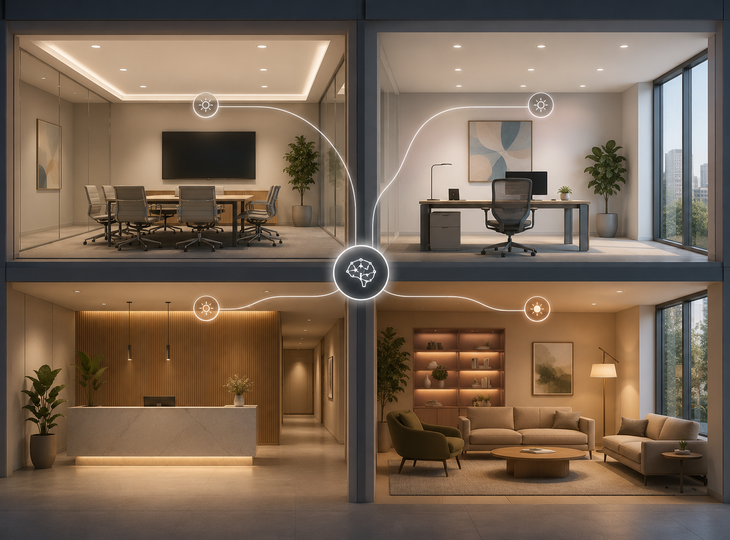
In a corporate building, not all areas have the same needs. A meeting room, an individual workstation, a reception area, or a break room require different lighting solutions. AI can help dynamically adjust these environments, taking into account the actual use of each space.
For example, in areas requiring concentration, it can prioritize more stable light levels suitable for visual work; in spaces where activity changes throughout the day, it can adapt the lighting according to the time and type of use.
This management helps avoid environments that are too cold or poorly balanced. Light thus becomes a tool for enhancing the indoor experience and boosting productivity.
Energy Optimization
Energy efficiency is one of the main reasons why artificial intelligence is gaining prominence in building lighting. Artificial light accounts for a significant portion of electricity consumption in many professional spaces, so any smart adjustment can have a direct impact on operating costs.
AI enables consumption optimization by striking a balance between savings and lighting quality. It is not simply a matter of turning off lights or reducing brightness, but of maintaining the appropriate level of lighting at the lowest possible cost. To do this, it can analyze when a light fixture is operating at a higher level than necessary, when there is sufficient natural light, or when an area can operate with a more efficient lighting scene.
Additionally, algorithms can compare the energy performance of different areas of the building. If two floors have similar occupancy but one consumes significantly more energy than the other, AI can detect this discrepancy and help identify potential causes. These could include poor configuration, less efficient lighting fixtures, or improper use of the space.
Predictive Maintenance and Incident Reduction
Another key application is predictive maintenance. Instead of acting only when a light fixture fails, AI can analyze the system’s behavior and anticipate potential issues.
To do this, the system can review data such as variations in energy consumption, gradual performance loss, recurring failures, or anomalous behavior in specific areas. If a light fixture begins to consume energy irregularly or shows an unusual drop in performance, AI can detect this anomaly before a visible failure occurs.
This allows for more efficient maintenance planning. In large buildings, where there are hundreds or thousands of light fixtures, this capability is highly valuable. It helps reduce emergency interventions, optimize the work of technical teams, and prevent disruptions to the building’s daily operations.
Furthermore, predictive maintenance helps extend the facility’s lifespan. By detecting problems early, issues can be corrected before they affect the entire system.
The Future of Lighting Management with AI
In short, artificial intelligence in building lighting management is a highly useful tool capable of providing data, anticipating needs, and supporting management decisions. Thanks to AI, processes can be automated and the use of light optimized according to the building’s actual behavior, contributing to greater energy efficiency, improved visual comfort, and more sustainable management.
AI does not replace good lighting design, but rather complements it, adding analysis and adaptability that allow the system to remain tailored to the space’s needs throughout its entire lifespan.