
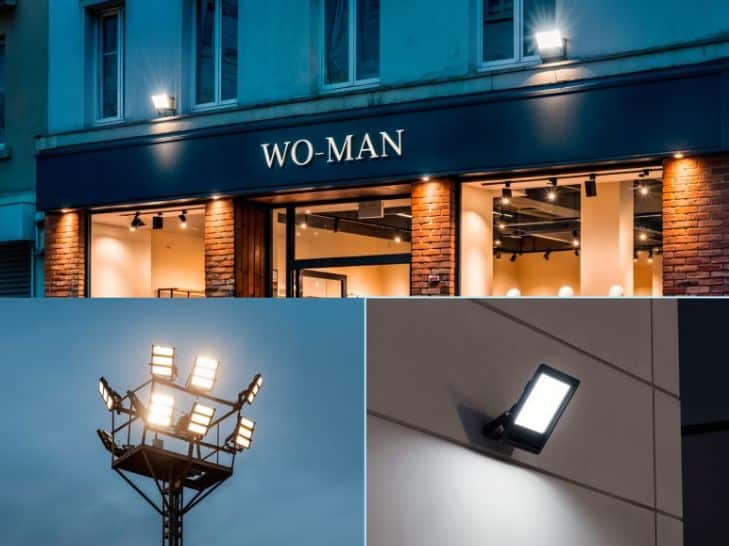
Choosing the right wattage for an outdoor LED floodlight is a key decision if you want efficient lighting without skyrocketing energy consumption. It is very common to think that the more watts a spotlight has, the more it will illuminate.
However, with LED technology this is no longer the case: the power mainly indicates the power consumption, not the amount of light we perceive. To make the right choice, it is useful to first understand the difference between watts and lumens, and then relate the power to the use, the area to be illuminated and the installation height.
Table of Contents
Power or lumens: what is really important
In LED lighting, power in watts (W) only tells us how much energy the projector consumes. To know whether a projector is bright or dim, the correct reference is the lumens (lm), i.e. the actual amount of light it emits.
From there, another important figure comes into play: luminous efficacy, which is expressed in lumens per watt (lm/W). This value indicates how much light the projector generates per watt consumed. A projector with good efficacy can provide the same illumination with less power. Thus, a 30 W LED projector can provide light equivalent to that of an old 150 W halogen.
In short, to make the right choice, it is not enough to look at the wattage. You need to look at the total lumens and the efficacy of the projector.
How to choose the power of an outdoor LED projector
Although, as we have seen, the characteristic that defines the amount of light is brightness not power, we will use the latter as a reference since it is the one most familiar to most users.
The power required is not the same to illuminate a small terrace as to illuminate a parking lot or a large garden. The use that you are going to give to the projector conditions both the power and the number of projectors to install.
For functional or ambient lighting on balconies and small terraces, a spotlight between 10 and 20 W is usually sufficient. The idea in these cases is not to achieve a very intense illumination, but to create a pleasant atmosphere without dazzling and with a reduced consumption.
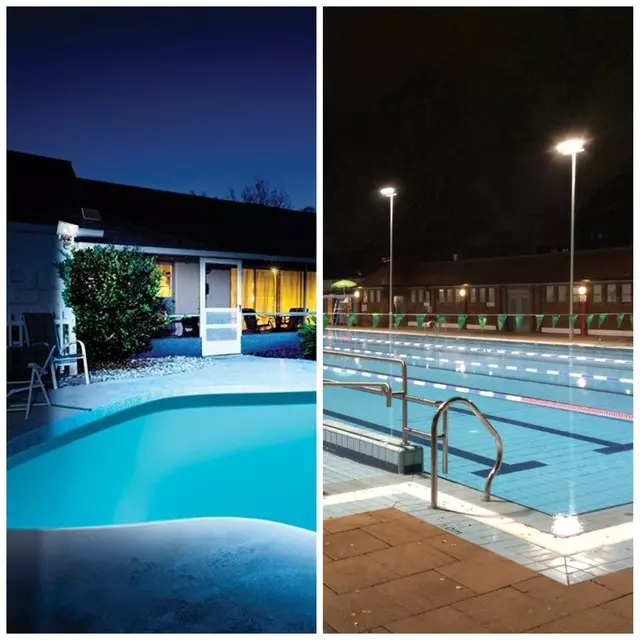
When it comes to illuminate areas of passage or security, such as entrances, accesses or gates, the recommended power usually goes up to a range of 20 to 30 W. With this light level it is possible to see and be seen clearly, especially if the floodlight is combined with a motion detector.
In patios, medium-sized gardens or facades, it is usual to work between 30 and 50 W. This range offers a balanced lighting level for moderate sized areas, sufficient to enjoy the space and move around comfortably.
For larger areas, such as large gardens, parking lots or outdoor work areas, the recommended power is usually between 50 and 100W. In these cases it is also important to consider the installation height and the opening angle, as the light must be evenly distributed.
Finally, in professional or industrial environments such as warehouses, sports fields or loading docks, it is not uncommon to use high power floodlights that can exceed 250 W, always looking for good efficiency and a design suitable for the application.
Relationship between brightness, area and height of outdoor installation
In addition to the use, the approximate size of the area to be illuminated and the height at which the floodlight will be installed are also important. As a guideline, if we are looking for a general illumination (about 100 lux) the following table can be used:
| Surface area | Recommended lumens | Installation height |
| 10 m² | ~1,000 lm | 3 m |
| 10 m² | ~1,600 lm | 6 m |
| 20 m² | ~2,000 lm | 3 m |
| 20 m² | ~3,200 lm | 6 m |
| 50 m² | ~6,500 lm | 5 m |
| 100 m² | ~16,000 lm | 8 m |
The higher you install the floodlight, the more power you will need to compensate for the loss of intensity as the light scatters. Therefore, in very tall installations it is often preferable to use more powerful floodlights or to distribute several light points instead of relying on a single one.
Recommended products
In Stock, estimated delivery from 20-30 days
244.99 £
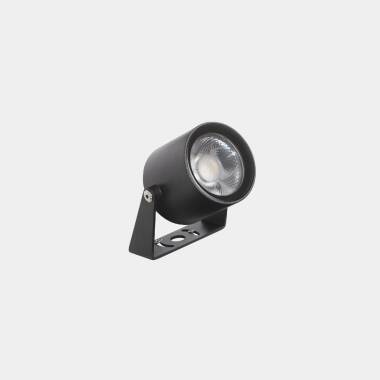
LED Floodlight 6.5W MAX Aluminium IP66 LEDS-C4 AI18-P7W9M2BBZ5
View product
In Stock, delivery in 24/48h
6.49 £
10W LED Floodlight IP65 with PIR Sensor
View product
In Stock, delivery in 24/48h
8.69 £
20W LED Floodlight IP65 with PIR Sensor in White
View product
In Stock, delivery in 24/48h
12.99 £
50W LED Floodlight IP65 with PIR Sensor in White
View product
The role of the aperture angle
Power is not everything. The aperture angle of the light beam has a decisive influence on how the illumination is perceived. A spotlight with a narrow angle concentrates the light on a specific area, while one with a wide angle spreads the light over a larger area but with less point intensity.
A narrow angle, for example between 30° and 60°, is useful for highlighting specific elements. A medium angle, around 60° to 90°, is often a versatile choice if you are looking to illuminate without concentrating the light too much. Finally, wide angles, around 100° to 120°, are intended to cover large areas or provide more uniform illumination.
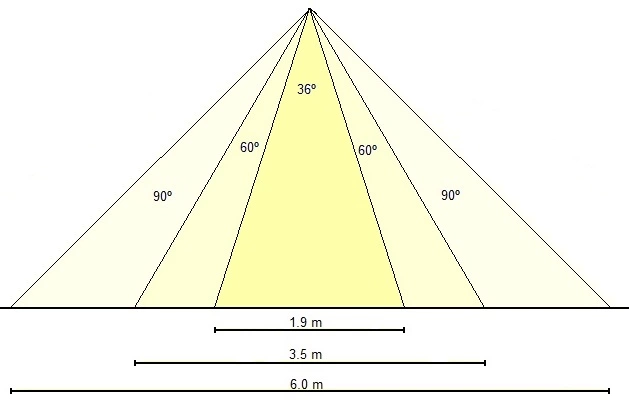
In the case of floodlights, most have a wide opening angle, typically around 120°, making them ideal for illuminating large spaces evenly.
LED floodlights with motion detector: which power to choose
In LED projectors with motion detector, it is usual to opt for medium power, since they only turn on when they detect presence and it is not necessary to maintain a very intense continuous illumination.
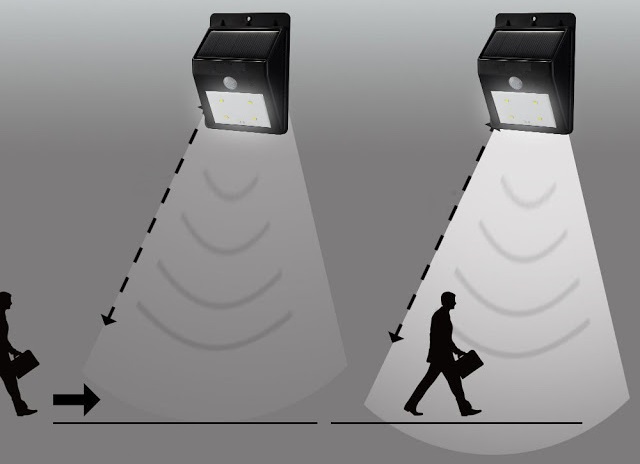
For entrances, accesses and doors, a floodlight of between 20 and 30 W with a sensor is usually sufficient. For gardens or larger passageways, it may be more appropriate to move up to the 30 to 50 W range. This provides effective light when needed, avoids unnecessary glare and reduces the overall power consumption of the installation.
Practical recommendations to get the right wattage
When choosing the power of an outdoor LED floodlight, several aspects should be taken into account. The first is to avoid choosing only by wattage: the reference should be total lumens and luminous efficacy. As a guideline, it is advisable to look for projectors with at least 100 lm/W efficacy, and if it is close to 120-140 lm/W, even better.
It is also important to think about the installation height and the opening angle, as both factors directly influence the perceived level of illumination. For residential areas, it is usually preferable to err on the side of caution with power to avoid dazzling neighbors or pedestrians, especially when there are several floodlights. Outdoors, it is also essential to choose equipment with an adequate degree of protection, usually IP65 or higher, to withstand rain and dust.
In large areas, it is often more efficient and convenient to combine several projectors of lower power at different points than to resort to a single very powerful spotlight. This solution improves light uniformity and reduces harsh shadows.
Key points to consider
Choosing the right power of an outdoor LED floodlight involves going beyond the number of watts. The decision should be based on the amount of light emitted by the floodlight, the size of the area to be illuminated, the installation height, the opening angle and the intended use.
In most applications for a residential floodlight, the ideal power is usually between 20 and 50 W, while in more demanding environments we usually find professional floodlights with power ratings above 100 W and a more elaborate lighting design with, for example, special optics.
Taking these factors into account, it is possible to achieve efficient, comfortable outdoor lighting adapted to each space.