
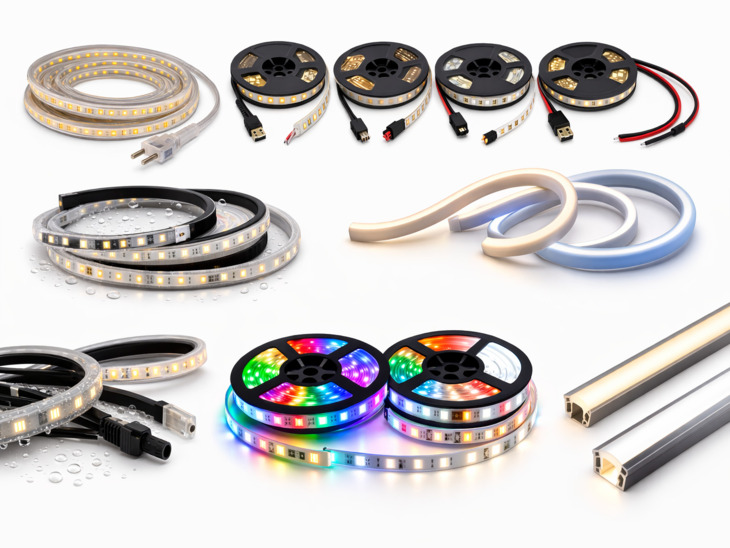
Right choice between different types of LED strips lights requires understanding key technical aspects such as operating voltage, installation system, protection against external agents and the thermal behavior of the assembly.
In this article, we take an in-depth look at the main options on the market, from low-voltage LED strips to specific outdoor options, detailing their technical advantages and most common applications.
Table of Contents
LED Strips by Voltage
Within the low voltage LED strips we can find the following types:
5V DC LED strips
The 5V DC LED strips are common in projects that require lighting control, since they work with digital controllers that allow programming different effects and light sequences, which makes them a very attractive solution for creative projects.
Advantages: Highlights the dynamic control, ideal for environments where the visual component has a leading role. They are common in gaming setups, decoration, events and audiovisual projects where eye-catching and customized effects are sought.
Limitation: They have a higher voltage drop compared to 12V or 24V systems, so they are only recommended for short distances. They are not intended as a main lighting solution, but as a decorative resource.
LED strips 12V DC
12V DC LED strips are one of the most widespread options in domestic installations and small lighting projects. Their popularity is due to their ease of installation and the wide availability of wattages and color temperatures in the market. They are a practical solution when looking for a simple implementation without high technical complexity.
Advantages: They are characterized precisely by their ease of installation and versatility in small-scale applications. They are a good option for projects where distances are not very long and consumption is not high.
Limitations: They have a higher voltage drop over long distances, which makes it necessary to feed them every 5 meters or so to avoid loss of luminous intensity at the end of the section. In addition, in extensive installations, their efficiency is lower compared to 24V or 48V systems.
Typical use: They are usually used for lighting furniture, kitchens and corridors where a functional or ambient light is required without great technical demands.
LED strips 24V DC
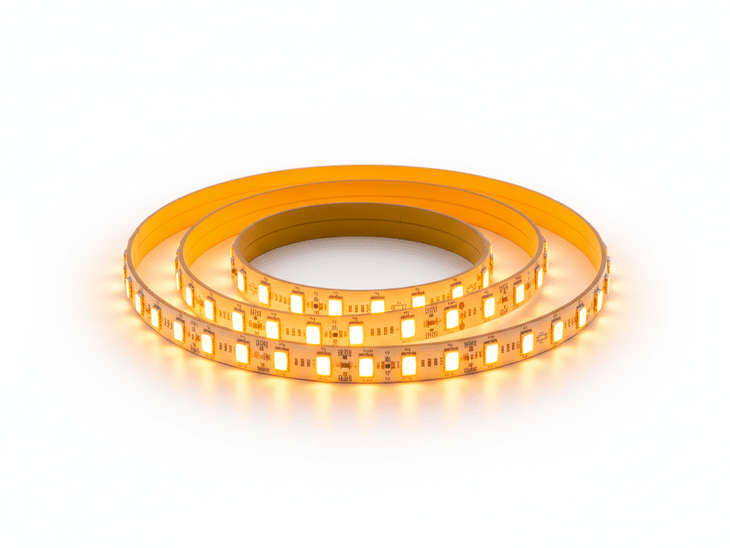
24V DC LED strips have become the standard in professional lighting projects thanks to their performance and efficiency. This type of system allows more demanding installations from a technical point of view, offering a more stable electrical behavior than lower voltage solutions.
Advantages: They offer a lower voltage drop, which translates into a more uniform illumination along longer stretches without loss of intensity. In addition, they allow longer continuous runs and offer high energy efficiency.
Limitations: They require a compatible power supply and their initial cost may be slightly higher than 12V strips. However, in medium to large projects, this difference is compensated by greater stability.
Typical use: Typical use is in professional linear lighting, offices, retail spaces, hospitality and in general in any environment where continuous functional lighting with a durable finish is required.
LED Strips 48V DC
48V DC LED strips are designed for long length projects where greater electrical stability is required. This type of system allows to address extensive linear installations minimizing the usual problems of voltage drop that appear in lower voltages.
Advantages: Its main advantage is the possibility of long runs without significant loss of light intensity. By working with higher voltage, the current intensity is lower, improving the overall performance of the system and optimizing efficiency in large-scale installations.
Limitations: This model also requires a dedicated power supply but is a reliable option for different uses.
Typical use: Typical use is in architectural projects, facades and large surfaces.
LED Strips 220V-240V AC
Unlike the previous ones, 220V-240V AC LED strips work directly connected to the mains. This considerably simplifies the installation since they work both indoors and outdoors and only a power supply is needed.
Advantages: As mentioned above, installation is simple and quick, as is their efficiency for long runs without the need for multiple transformers and, depending on the model, they can be protected against dust and moisture, making them suitable for outdoor environments. They also adhere easily to all types of surfaces and can cover large spaces while maintaining uniform illumination, even when strips of many meters in length are involved.
Limitations:Their cutting flexibility is usually less, as the cutting points are more widely spaced than in 12V or 24V strips.
Typical use: Façades, outdoor perimeter lighting, industrial buildings, gardens and large shop windows.
LED Strips According to Color
Single Color LED Strips
Single color LED strips emit only one color of light. They are the simplest option when you are looking for a constant illumination, without color changing effects.
Main characteristics: They offer a homogeneous light and low energy consumption. Their installation is flexible and simple thanks to their adhesive backing, and their intensity can be adjusted with compatible dimmers.
Typical use: They are used for general lighting in homes, offices or stores. They can also be used to illuminate rooms and furniture, offering a clear and constant light.
Recommended products
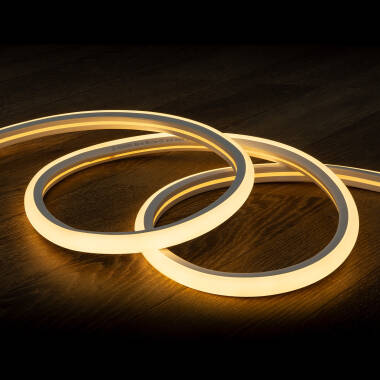
In Stock, delivery in 16-21 days
9.89 £
220V LED Neon Strip Dimmable in Warm White Semicircular 180º 7.5W/m Cut at Every 100cm IP67 Custom Length
View product
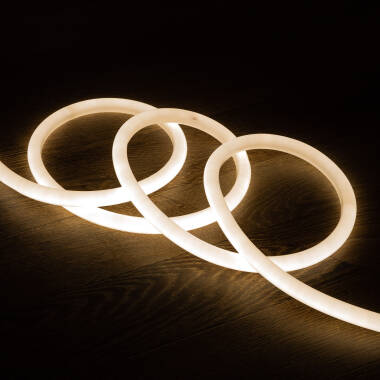
In Stock, delivery in 16-21 days
76.99 £
220V LED Neon Strip Dimmable in Neutral White Round 360º 9W/m Cut at Every 100cm IP67 Custom Length
View product
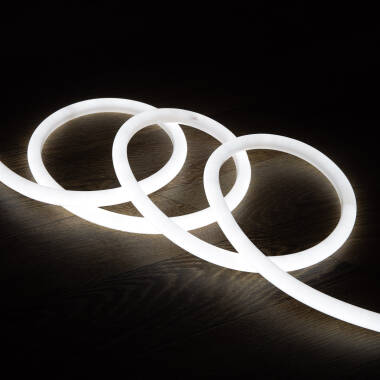
In Stock, delivery in 16-21 days
76.99 £
220V LED Neon Strip Dimmable in Cool White Round 360º 9W/m Cut at Every 100cm IP67 Custom Length
View product
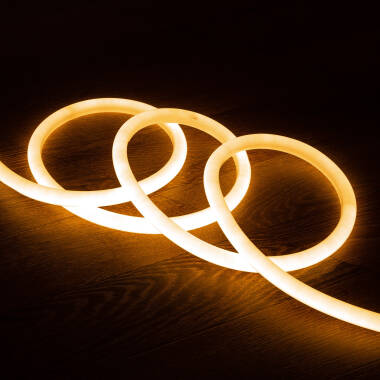
In Stock, delivery in 16-21 days
142.99 £
220V LED Neon Strip Dimmable in Warm White Round 360º 9W/m Cut at Every 100cm IP67 Custom Length
View product
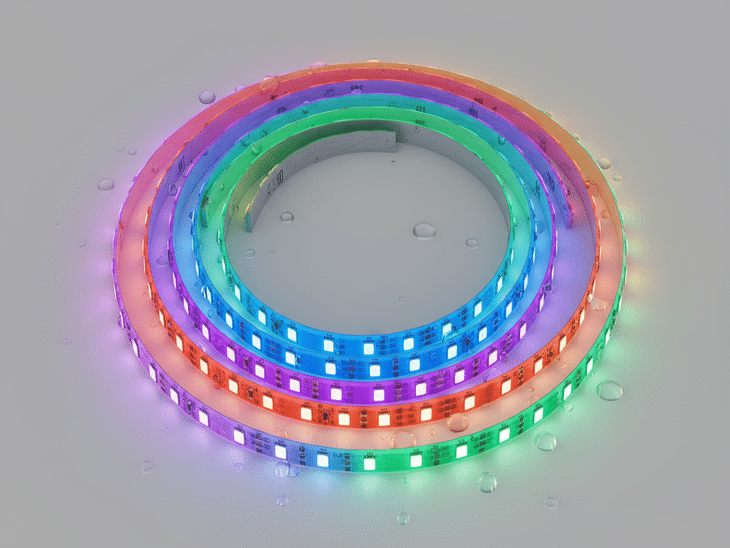
RGB LED Strips
RGB LED strips are lighting strips that combine the three basic colors, red, green and blue, in each LED, allowing to generate a wide range of colors through additive mixing. This makes them ideal for creating customized and dynamic environments, with programmable color changes and lighting effects according to the needs of the space.
Main features: RGB LED strips offer the possibility to control color, intensity and effects such as flickering or sequential change. Their flexibility allows them to be adapted to curved or linear surfaces, and many come with adhesive backing for easy installation. Their energy consumption is low and the life of the LEDs is high. In addition, they can be combined with controllers for more advanced operation.
Typical use: They are used for decorative and ambient lighting, both in homes and commercial spaces. They are widely used to highlight furniture, ceilings and in events where striking visual effects are sought.
RGBW/RGBWW LED Strips
RGBW/RGBWWW LED strips combine traditional RGB LEDs with an additional white light LED, allowing for color mixing and precise whites. This offers more versatile lighting.
Main features: This type of model is brighter and consumes less power than the previous ones. Like RGB strips, they can be integrated with controllers for advanced lighting management.
Typical use: They are used in homes, offices and commercial spaces. They can be used to illuminate rooms and ceilings, offering the possibility of changing the light according to the time or activity.
LED Strips According to Format
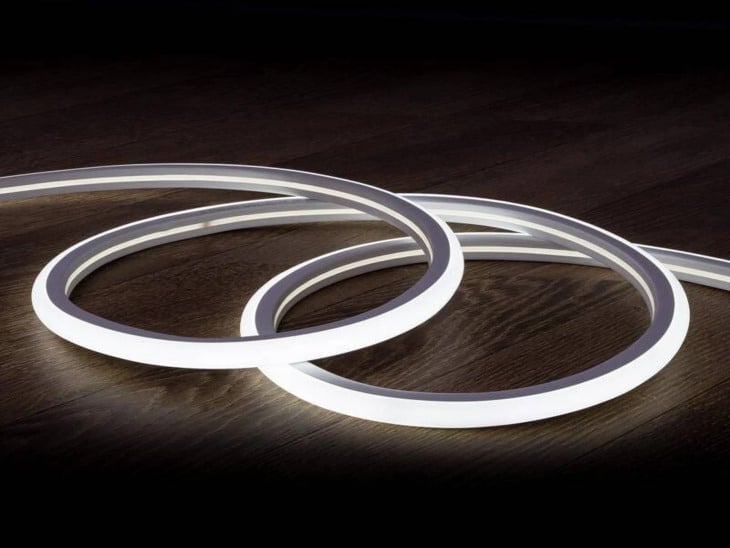
LED Neon Flex Strips
Strips LED Neon Flex represent an aesthetic and technical evolution of the traditional LED strip. It consists of a strip encapsulated inside a silicone or PVC cover that filters the light, eliminating the stippling effect. The result is a clean and professional visual illumination.
Main characteristics: It maintains a homogeneous illumination, together with a high mechanical resistance and a very neat aesthetic finish. In addition, its flexibility allows it to adapt to curves and contours, which significantly expands the design possibilities.
Limitations: They are not designed to offer the same light output as high power LED strips, such as 24V DC models, designed to offer higher intensity.
Typical use: Typical applications include signage, architectural lighting or decorative perimeters.
Moldings for diffuse lighting
The moldings for diffused lighting are designed to integrate light indirectly in ceilings or walls, creating elegant and glare-free environments. Usually made of high density extruded material, they can house LED strips inside so that the light source is completely hidden and only the luminous effect projected on the surface is perceived.
Their main contribution is architectural integration, since they form part of the design of the space and are not perceived as an added element. They generate a soft and uniform indirect light, reducing harsh shadows and improving visual comfort. In addition, they provide a neat aesthetic finish, with clean and minimalist lines that elevate the perception of the whole.
This type of solution is commonly used in modern homes, hotels, offices and premium commercial spaces where a sophisticated atmosphere is sought. By completely concealing the light source, they allow the creation of enveloping environmental effects that add depth and quality to the interior design.
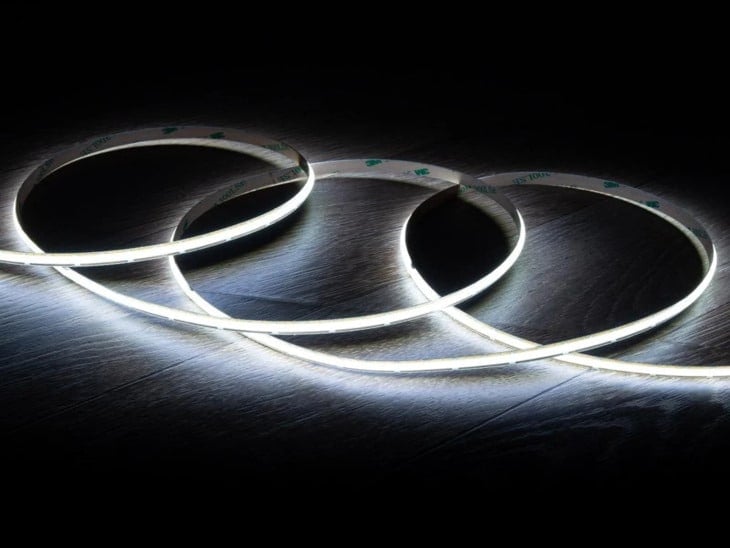
Cob strips
COB LED Strips (Chip on Board) are a type of LED lighting in which multiple LED chips are mounted directly on the same surface, creating a continuous surface of light. This allows for a more uniform and brighter output compared to traditional LED strips, reducing individual points of light and providing a more aesthetically pleasing finish.
Main characteristics: COB strips stand out for their high chip density, which generates a more homogeneous light without the dot effect typical of conventional LEDs. Their flexibility allows them to be adapted to different surfaces and they usually offer good color rendering for lighting that requires color accuracy.
Typical use: They are commonly used in decorative, architectural and commercial lighting projects. Ideal for illuminating shelves, furniture, corridors and ceilings, as well as for creating indirect lighting effects.
Rigid strips
Rigid LED Strips are lighting solutions in which a LED strip is already incorporated into an aluminum profile, offering a simpler installation and an elegant and functional finish. These profiles generate an indirect and clean light, with a minimalist design perfect for both residential and commercial spaces.
Main features: The profiles have the LED strip installed inside a structure to reduce glare, are available in various powers and sizes to fit different places. Their design allows a choice of different color temperatures and some models offer practical features such as touch-free switching or dimming by hand approach.
Typical use: They are used in both residential and professional spaces to create continuous lines of light on walls, ceilings, stairs or corridors. They are also very common for decorative lighting and in environments that seek a modern and welcoming aesthetic.
LED Strips According to Use
Outdoor LED Strips
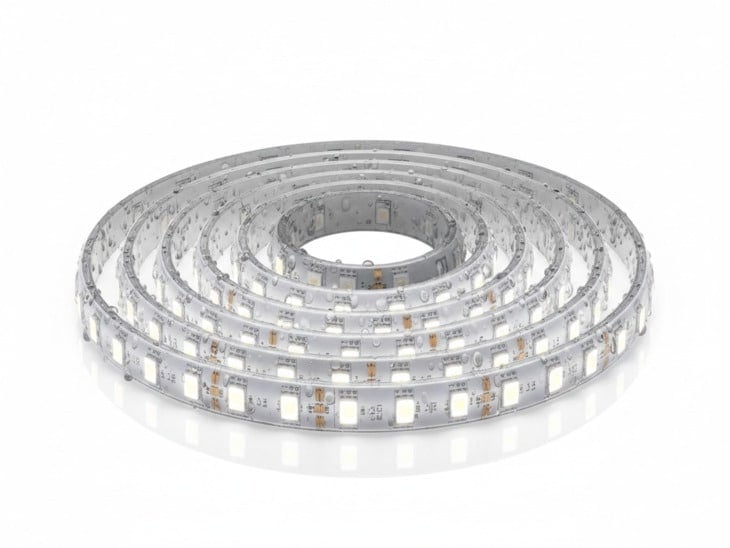
Outdoor LED strips are specifically designed to withstand demanding environmental conditions such as rain, humidity, dust or sudden changes in temperature. To choose the right option, it is essential to look at its IP rating, which indicates the level of resistance to external agents, recommending IP65 or higher to ensure adequate protection against splashes and humid environments.
Thanks to their shape and flexibility, these strips are ideal for illuminating the silhouette of a house, highlighting stairs, creating eye-catching environments in gardens or terraces, marking paths or enhancing any type of outdoor structure.
Indoor LED strips
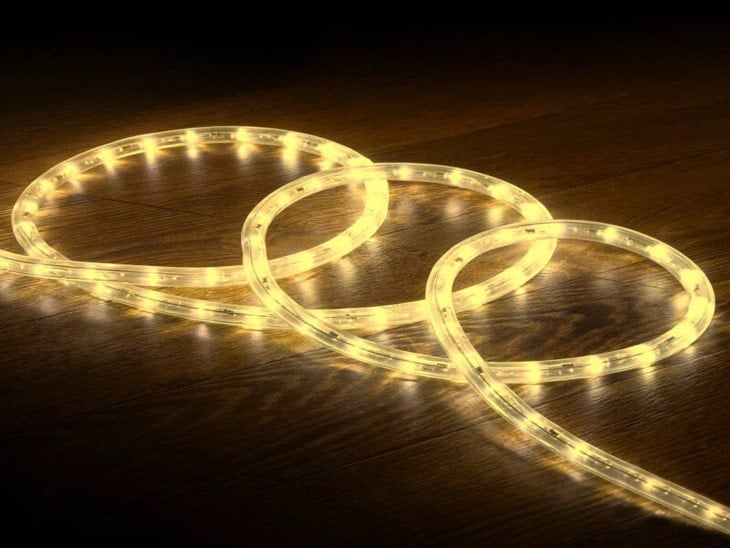
Indoor LED strips are those specifically designed for environments protected from moisture, rain and dust, so they do not require a high degree of IP protection. They are the ideal choice for homes, offices and indoor spaces where optimal lighting is sought, whether ambient or decorative.
Indoor strips include single-color strips, which provide constant light; RGB and RGBW/RGBWWW strips; COB strips, which generate continuous and homogeneous light; Neon Flex strips; and profiles with integrated LED strip, which provide clean indirect light.
Each type of strip offers specific advantages: from dynamic color control and visual effects to functional lighting, whether for rooms or furniture decoration.
Which type of LED strip provides the most light?
The light output depends not only on the voltage or format, but also on the type of strip:
- Power in W/m: This indicates the power consumption per meter of strip. The higher the power, the greater the potential light emission capacity, although this data alone does not guarantee more luminosity if the chip is not efficient.
- Lumens per meter: This represents the actual amount of light emitted. This is the value that really allows us to compare which LED strip emits more light. Two strips with the same power may offer different levels of illumination if their efficiency is different.
- Chip efficiency: This is measured in lumens per watt (lm/W). A high quality chip transforms energy into light better and generates less heat, thus providing higher performance and lower consumption for the same light intensity.
How to choose the best LED strip
From our professional experience, we recommend to evaluate:
- Type of installation: It is not the same to illuminate an environment in a decorative way than to use the LED strip as the main light source. The power and quality of the system must be adapted to the intended use.
- Total length of the project: The distance directly influences the choice of voltage and the need for intermediate power points to avoid voltage drops.
- Location: The environment determines the degree of IP protection required, as well as resistance to moisture or dust.
- Dimming or control requirements: If dimming or color change is required, it is essential to select a compatible strip and controllers.
- Quality of the manufacturer: The reliability of the chip, PCB type and packaging materials have a direct influence on durability and light stability.
There is no one-size-fits-all solution for all lighting projects, as each application has different technical and functional requirements. The key is to select the most suitable system according to the environment, installation length, required power and conditions of use. If you need guidance, we offer a guide with practical advice on how to install your LED strip, including detailed steps and recommendations for a safe result.