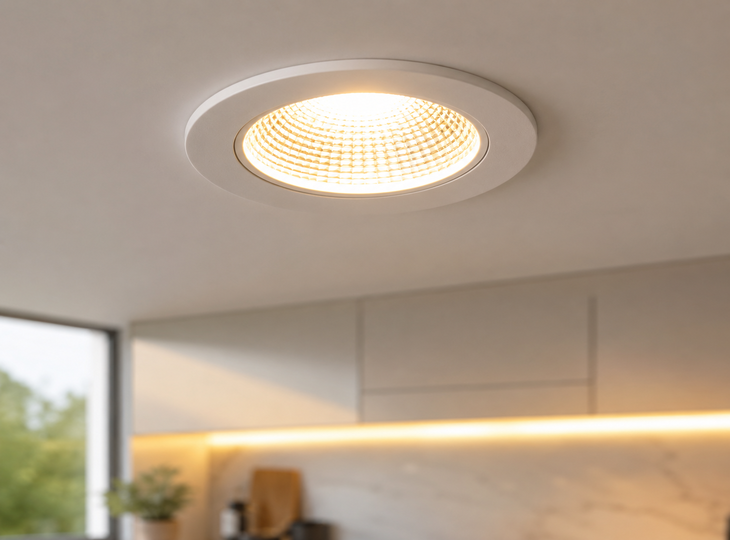
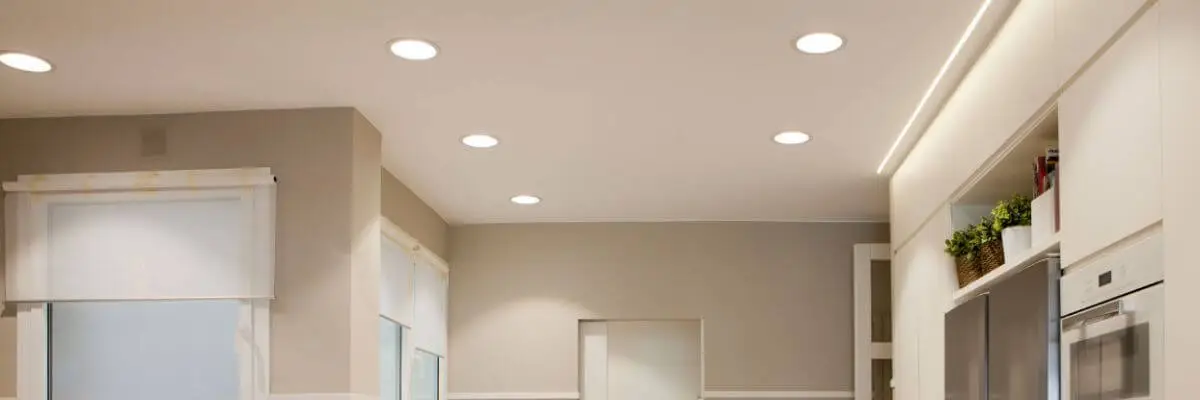
Replacing an old light fitting with an LED downlight or installing a new one is one of the most common improvements in lighting projects. However, before switching it on, it is important to ensure the electrical connection is carried out correctly, as both the performance of the fixture and the safety of the installation depend on it.

Below, we explain step by step how to connect an LED downlight, what materials are required and how to make each connection correctly.
Table of Contents
What you need to know before connecting an LED downlight
Before starting the installation, it’s worth being aware of a few technical details that will make the installation easier and help you avoid problems whilst connecting the lights.
Types of downlights and connection systems
Not all LED downlights are connected in exactly the same way. The system will depend mainly on the type of luminaire and the driver it incorporates.
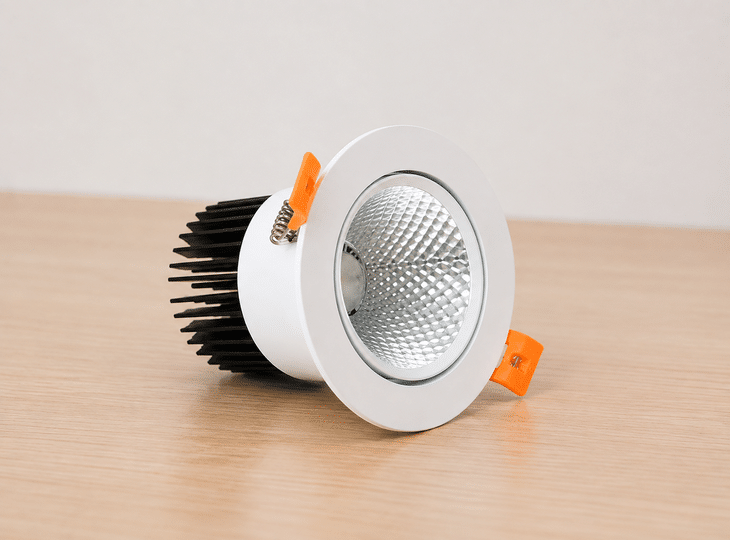
Most current models operate using an external driver, which converts the mains supply to the correct current for powering the LEDs. In these cases, the mains supply is first connected to the driver, which in turn powers the downlight.
Before making any connections, it is advisable to check the product’s wiring diagram to correctly identify the driver’s inputs and outputs.
Tools and materials required
Having the right tools allows you to carry out the installation more quickly and safely. You will usually need:
- Insulated screwdriver.
- Wire stripper.
- Voltage tester.
- Terminal blocks or quick connectors.
- Sturdy ladder.
- Protective gloves.
It is also advisable to check that both the driver and the downlight are compatible with each other and that the supply voltage matches that of the electrical installation.
Safety precautions before you start
All electrical installations must be carried out with the power completely switched off.
It is best to switch off the relevant circuit breaker at the fuse box and then check, using a voltage tester, that no current is actually flowing through the cables you are going to be working on.
It is also important to work with dry hands, use insulated tools and avoid making makeshift connections or unsafe splices.
Recommended products
In Stock, delivery in 16-21 days
17.99 £
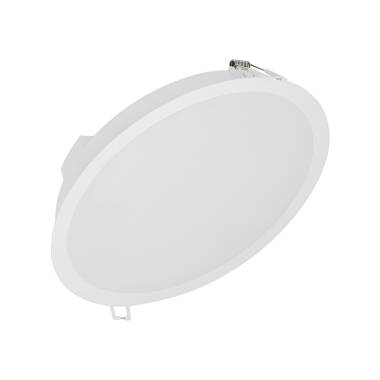
30W LED Downlight LEDVANCE 100lm/W with Ø200 mm Cut Out IP44
View product
In Stock, delivery in 24/48h
8.69 £
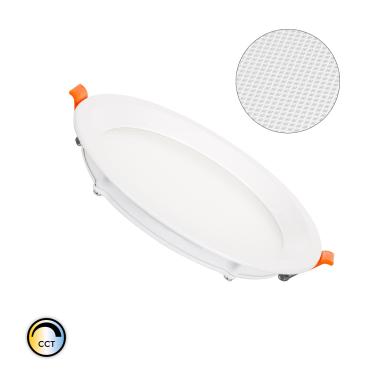
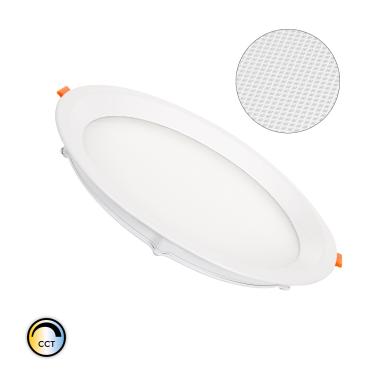
16W LED Downlight Ø150mm Cut Out Selectable CCT Microprismatic LIFUD
View product
In Stock, delivery in 24/48h
10.89 £
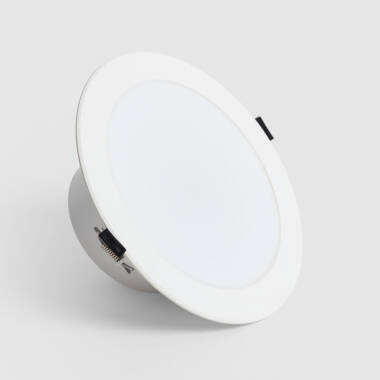
Round 20W LED Downlight Ø205mm Cut Out CCT Microprismatic LIFUD
View product
In Stock, delivery in 15-20 days
20.99 £
Round 25W LED Downlight for Bathroom Ø145mm Cut Out IP44
View product
How to connect an LED downlight
Once you have prepared the materials and checked that all safety requirements are met, you can begin the installation.
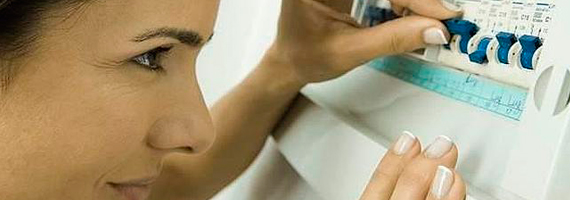
1. Switch off the power supply
The first step is to completely cut off the power supply.
Although this may seem obvious, this step is essential to prevent electric shocks whilst working on the wiring.
After disconnecting the circuit, you should check once again that there is no voltage present before touching any conductors.
2. Remove the old light fitting
Using a ladder, remove the old light fitting from its mounting and disconnect it from the mains supply. You must remove any components (transformer, ballast, etc.) that came with the old ceiling light or halogen fitting, as our downlight has its own driver.
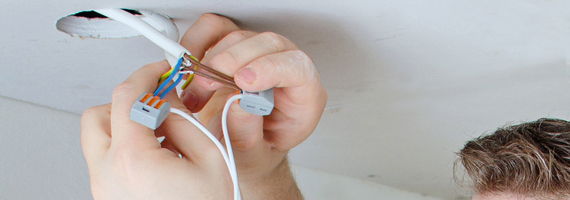
If you need to enlarge the hole required for installation or drill a new one, use a drill and its hole-cutting attachment to drill through the ceiling.
3. Prepare the wiring
The next step is to prepare the power cables.
If it is a new installation, you will need to strip approximately one centimetre of insulation from each conductor to make connection easier.
There are usually three wires: live, neutral and earth. (For more information, see our post on the colours of electrical wires).
It is advisable to check that the insulation on the conductors is in good condition and that there are no damaged or worn areas.
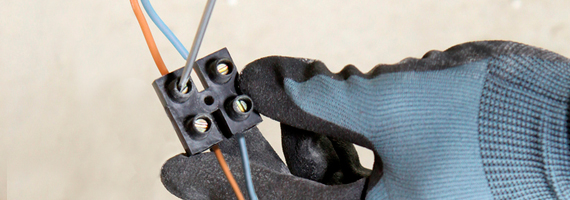
4. Connect the driver
In most LED downlights, the mains supply first reaches the driver.
The live and neutral wires must be connected to the input, which is usually labelled INPUT, AC IN or with the corresponding symbols for alternating current.
The driver’s output, usually marked as OUTPUT, is then connected to the downlight using the connector supplied by the manufacturer.
It is important to follow the manufacturer’s instructions and not to reverse the connections where the equipment specifies a particular polarity.
Furthermore, a driver must never be replaced with an incompatible one simply because it is a similar size. The output current, power and operating range must be compatible with the luminaire.
5. Connect the downlight to the driver
Once the LED driver is powered up, connect the cable from the downlight itself.
Most manufacturers include quick-connect fittings that simply require you to insert both parts until you hear them click into place.
With other models, it may be necessary to use small terminals or specific connectors.
Before continuing, you should check that all connections are secure and that no metal conductors are exposed.
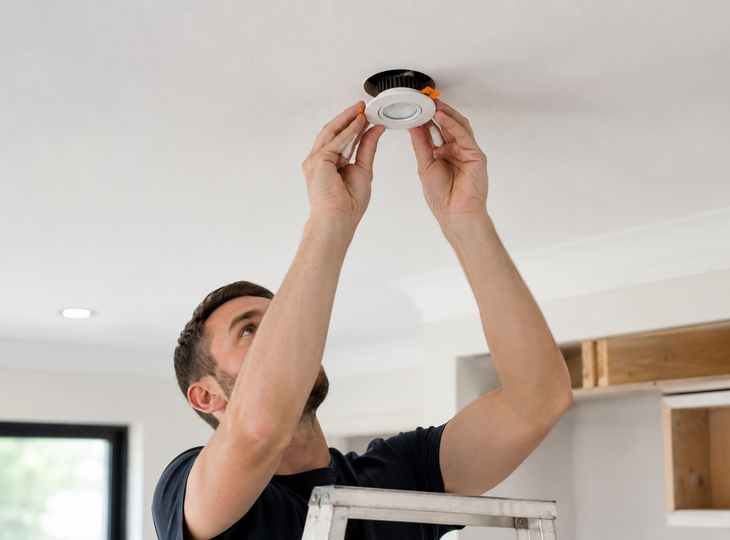
6. Fit the downlight to the ceiling
Once all the connections have been made, the light fitting can be fitted in its final position.
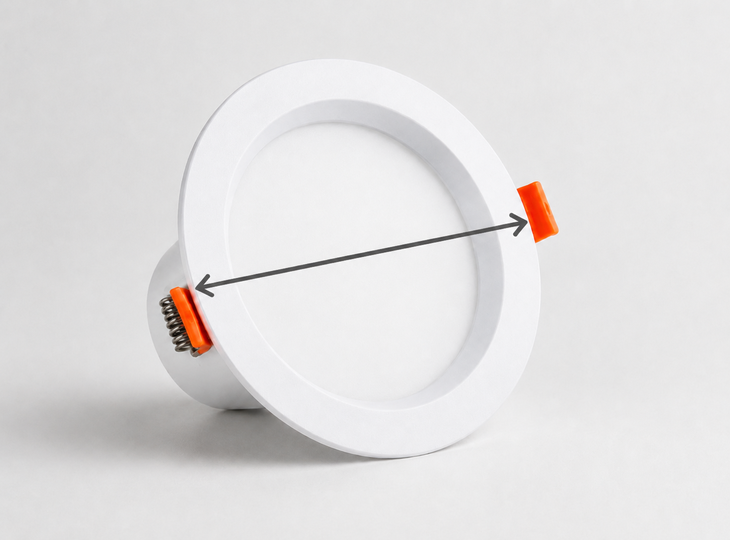
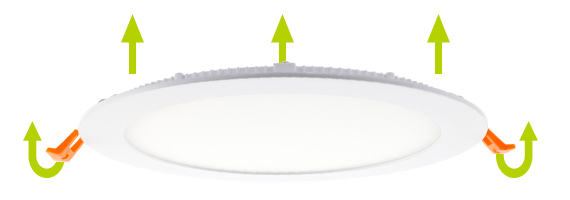
Downlights usually feature two side springs that allow them to be secured to the suspended ceiling by applying pressure to the panel. Simply compress both springs, insert the body of the downlight into the hole and release gently so that it is firmly secured.
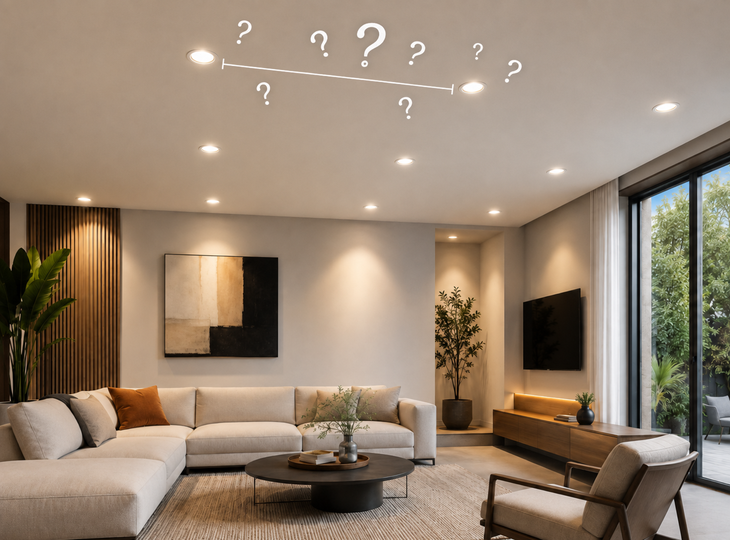
Before inserting the light fitting, it is advisable to check that the diameter of the hole is compatible with the model being installed. If you have any doubts about the dimensions or the most suitable size, you can consult our guide on how to choose the diameter and dimensions of an LED downlight.
During installation, it is important to ensure that the driver is not compressed or trapped between the light fitting and the ceiling structure, as poor ventilation can affect its performance and reduce its lifespan.
7. Check that it is working properly
Once the light fitting has been installed, the power can be switched back on from the fuse box.
When the switch is turned on, the downlight should come on immediately, without flickering, buzzing or fluctuations in brightness.
If the light fitting does not come on, you should check all the connections again before dismantling the unit or replacing any of its components.
Common mistakes when connecting an LED downlight
Although installation is relatively straightforward, there are some common mistakes that can affect the light fitting’s performance.
- Using a driver that is incompatible with the downlight. Although two drivers may look similar on the outside, their electrical specifications may differ. Installing a model that does not supply the correct current or power can lead to unstable operation, reduce the luminaire’s lifespan or even cause irreversible damage.
- Making insecure connections. Leaving wires poorly secured or partially exposed can lead to loose contacts, flickering and power loss. Furthermore, a poor connection can cause overheating, which compromises the safety of the installation.
- Installing the driver without sufficient ventilation. The driver generates heat during operation and needs to dissipate it properly. Placing it in very confined spaces or where there is no air circulation can increase its operating temperature, affect its performance and shorten its service life.
- Exceeding the circuit’s power rating or reusing damaged wiring. Before carrying out the installation, it is important to check that the circuit can handle the intended load and that the wiring is in good condition. Using damaged conductors or overloading the circuit can increase the risk of breakdowns and electrical faults.
- Carrying out work without checking that the circuit is de-energised. Switching off the relevant circuit breaker does not always guarantee that the circuit is completely de-energised. It is therefore advisable to always check that the circuit is de-energised using a suitable voltage tester before handling any conductors, thereby avoiding potential electric shocks.
Maintenance after installation
Once the LED downlight has been installed, it requires very little maintenance, although carrying out some periodic checks helps to ensure it continues to function correctly for many years.
It is advisable to check occasionally that the light fitting remains securely fastened and that there is no play in the electrical connections. It is also recommended to keep the diffuser clean using a soft, slightly damp cloth, always avoiding abrasive products or solvents that could damage the materials.
If, over time, you notice flickering, a loss of brightness or a humming noise, it is advisable to check the condition of the driver and ensure that the connections are still secure.
Simple maintenance and regular checks will help to extend the lifespan of the installation and ensure efficient and safe lighting.

Final recommendations for a safe installation
Connecting an LED downlight correctly not only ensures that the light fitting works straight away, but also helps to improve its performance and maintain the safety of the entire electrical installation.
Taking a few minutes to check the wiring and using a compatible driver prevents most of the problems that usually arise after installation. Furthermore, making the connections carefully and checking that everything is working properly before completing the installation allows any faults to be detected immediately. In this way, the downlight will deliver its full efficiency and high-quality lighting for many years to come.