
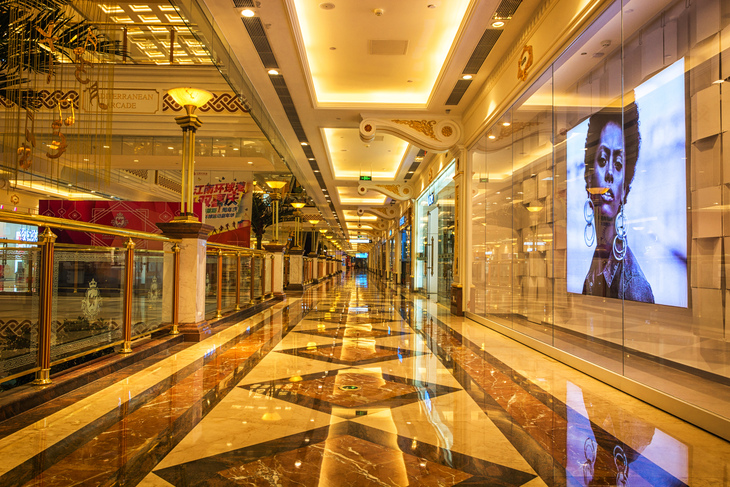
Large-scale projects place special demands on lighting. Whether production halls, shopping centers, schools or streets – each project presents its own individual challenges. Standard solutions from the catalog quickly reach their limits here. Customized LED solutions offer the flexibility to tailor lighting concepts precisely to the respective requirements and achieve the optimum ratio of investment to operating costs.

Commercial, industrial and public lighting differs fundamentally from residential lighting. Longer operating hours, more demanding ambient conditions and strict regulations require professional planning and high-quality products. In addition, there are industry-specific standards that must be complied with. In this guide, you will find out what is important for large-scale projects, what special features apply to the various sectors and how you can benefit from subsidies and volume discounts.
Table of Contents
- When are customized LED solutions worthwhile?
- Commercial lighting: combining function and atmosphere
- Industrial lighting: Standards and robustness
- Municipal lighting: schools, sports halls and administration
- Public lighting: streets, paths and squares
- Procurement procedures for public contracts
- Quantity advantages and project conditions
- Project process: from consultation to implementation
- Conclusion: Professional planning pays off
When are customized LED solutions worthwhile?
Not every lighting project requires customized solutions. For smaller properties with standard requirements, catalog products that are quickly available and economical are often sufficient. However, from a certain project size or for special requirements, customized concepts offer considerable advantages that justify the additional expense
Typical scenarios for customized LED solutions are projects with more than 100 luminaires, unusual installation situations or special lighting requirements. Individual advice is also useful when retrofitting existing buildings, as the existing infrastructure such as cable routes, fixing points and circuits have a significant influence on the optimum choice of luminaires. Special solutions are often indispensable, especially for listed buildings or architecturally sophisticated properties.
From an economic point of view, the higher planning costs and any custom-made products pay for themselves through optimized energy efficiency and reduced maintenance costs. Lighting that is precisely tailored to its use avoids oversizing and undersizing and reduces operating costs over the entire service life of the system. Particularly in projects with long operating times of 4,000 hours a year and more, the savings quickly add up to considerable amounts that more than justify careful planning.Your Attractive HeadingYour Attractive Heading
Commercial lighting: combining function and atmosphere
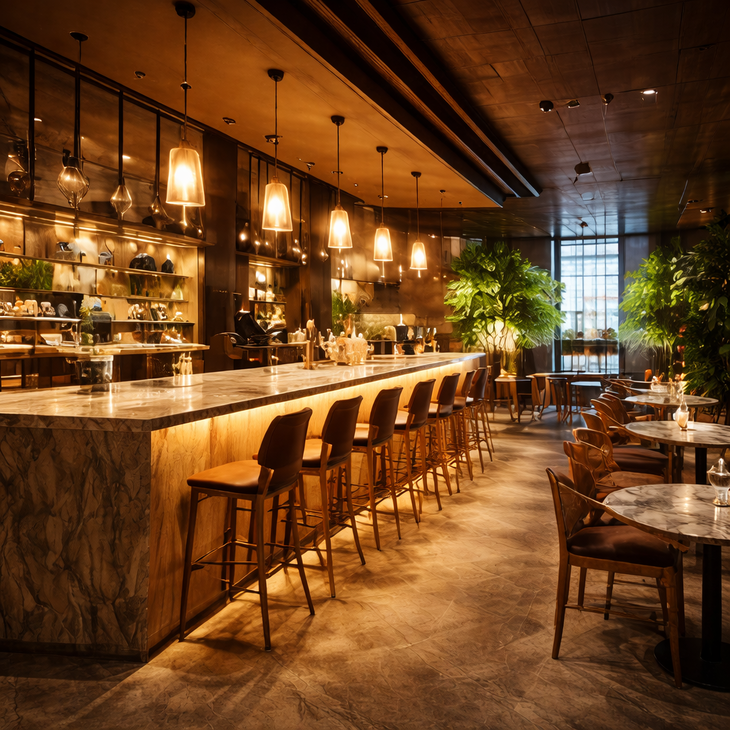
Commercial lighting covers a wide range of applications with the most diverse requirements. The areas of application range from retail, restaurants and hotels to office buildings and surgeries. What they all have in common is that the lighting must not only be functional, but also contribute to the atmosphere, the brand experience and the well-being of customers and employees.
In the retail sector, lighting has a direct influence on customers’ purchasing behavior. The presentation of goods, routing and brand identity are specifically staged by light. Accent lighting highlights products, while ambient lighting provides orientation.
Commercial LED lighting must be cost-effective and visually appealing. The high number of operating hours often exceeding 3,000 per year makes energy efficiency a crucial cost factor. At the same time, customers and employees expect a pleasant lighting atmosphere that encourages them to stay. Modern LED technology combines both requirements through high luminous efficacy and a wide range of design options. Dimmable systems and different color temperatures, from warm white to daylight white, create the perfect ambience for each area and at any time of day.
Industrial lighting: Standards and robustness
LED lighting for industry must comply with numerous regulations and technical standards. The Workplace Ordinance and the technical rules for workplaces define minimum requirements for illuminance, uniformity and glare limitation. The requirements vary considerably depending on the activity performed. DIN EN 12464-1 specifies the requirements for various work areas and visual tasks in detail.
In production halls with visual inspection tasks, illuminance levels of 500 to 1,000 lux are required. For rough assembly work and storage, 300 lux is sufficient, while precision mechanics, quality control and precision work require 1,000 lux and more. Color rendering plays an important role in the assessment of surfaces, materials and product quality. A color rendering index of at least Ra 80 is prescribed for most industrial applications, while Ra 90 and higher is required for color testing.
Robustness and reliability are decisive factors in industrial environments. Industrial lighting fixtures must be able to withstand vibrations, temperature fluctuations, dust and sometimes aggressive atmospheres. Corresponding protection classes such as IP65 or IP66 ensure trouble-free operation even in demanding environments. The long service life of 50,000 to 100,000 operating hours minimizes maintenance work and costly production interruptions for luminaire replacement.
Municipal lighting: schools, sports halls and administration
Municipal lighting covers a wide range of building types with a wide variety of usage requirements. Schools, kindergartens, sports halls, town halls, libraries and cultural facilities each have their own lighting requirements. What they all have in common is public use by many different groups of people and the need to use taxpayers’ money efficiently. Switching to modern LED technology offers particularly large potential savings here and at the same time improves the quality of light for users.
In schools, the focus is on pupils’ ability to concentrate and their well-being. Glare-free light with the right color temperature promotes learning and reduces fatigue. LED panels with UGR below 19 meet the strict requirements for VDU workstations and are ideal for modern classrooms with interactive displays. Neutral white light with 4,000 Kelvin supports attention without causing fatigue. In canteens and common areas, warm white light can create a relaxed atmosphere.
Recommended products

In Stock, delivery in 24/48h
28.49 £
LED Panel 120x30cm Dimmable 40W Microprismatic UGR17 4000lm
View product

In Stock, delivery in 24/48h
14.19 £
600x600mm LED Panel 100lm/W
View product

In Stock, delivery in 24/48h
58.99 £
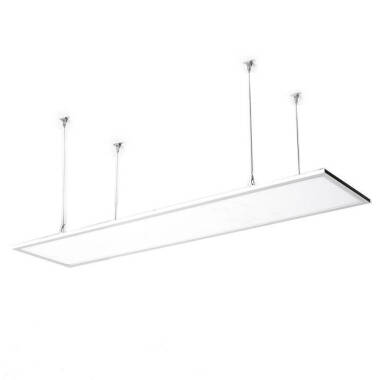
1200x600mm 64W LED Panel 7000lm PHILIPS Xitanium with Quick Connection Box & Safety Cable
View product
In Stock, delivery in 24/48h
70.99 £
1200x600mm 63W LED Panel 6300lm LIFUD + Suspension Kit
View product
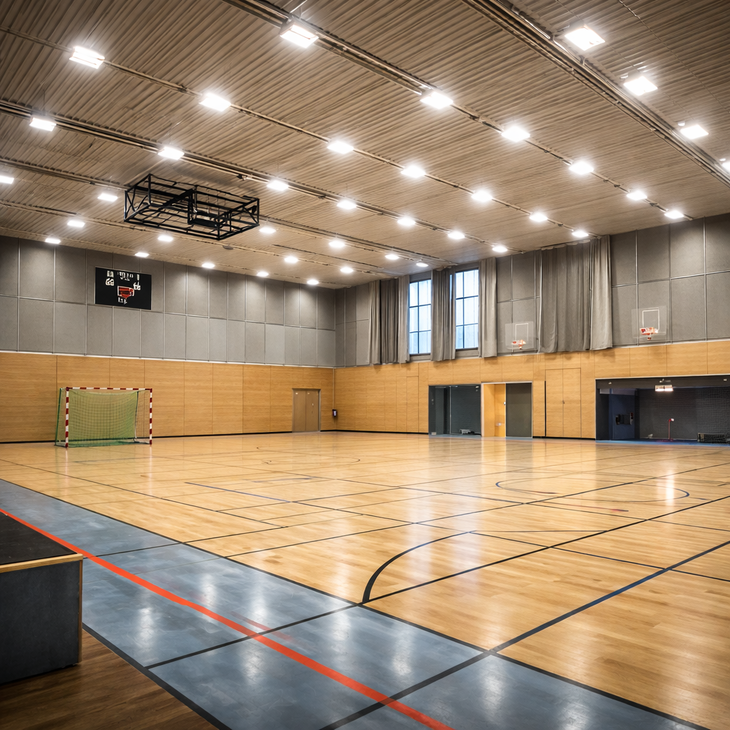
Sports halls require particularly robust luminaires with tested ball impact safety in accordance with DIN 18032-3. The illuminance depends on the type of sport and the intended use. It ranges from 300 lux for school sports and popular sports to 750 lux for competitions at league level. Dimmable systems enable flexible adaptation to different usage scenarios, from yoga classes to handball matches. In multi-purpose halls, separate control of different lighting zones is particularly important so that different areas can be used independently of each other.
Public lighting: streets, paths and squares
The public lighting of streets, paths and squares is one of the biggest energy consumers in municipalities and generates considerable running costs. Switching to LED technology offers local authorities enormous savings potential while improving lighting quality and safety at the same time. Modern LED street lights reduce electricity consumption by 50 to 70 percent compared to conventional sodium vapor lamps and offer better color rendering for greater road safety.
The planning of public lighting follows strict technical standards. DIN EN 13201 defines lighting classes for different traffic situations and road types. Main roads require different lighting values than residential areas, pedestrian zones or cycle paths. Lighting calculations using special software ensure that the lighting complies with the standard and avoids both over- and undersizing. Aspects such as light pollution and environmental compatibility are also taken into account.
Intelligent control opens up additional savings potential beyond the pure LED conversion. Adaptive lighting dynamically adjusts the brightness to the actual volume of traffic and the ambient brightness. In the late hours of the night, the light level can be reduced to 50 percent without compromising traffic safety. Radio-based systems enable the central monitoring and control of all luminaires in the urban area, report failures automatically and make maintenance planning considerably easier.
Procurement procedures for public contracts
Public contracting authorities are subject to public procurement law and must comply with special procedural regulations when procuring. Above certain thresholds, contracts must be put out to tender across Europe. For local authorities, this means more planning and documentation work, but also offers the opportunity to receive competitive bids from specialist providers from all over Europe.
The specification is at the heart of every tender and is decisive for the quality of the bids submitted. Technical requirements must be formulated in a product-neutral way to ensure fair competition. Quality criteria such as luminous efficacy, color rendering, service life and energy efficiency class should be clearly and measurably defined. Warranty conditions, availability of spare parts and services can also be taken into account as award criteria in order to optimize life cycle costs.

Quantity advantages and project conditions
For large-scale projects with high quantities, manufacturers and specialist dealers offer attractive project conditions that are significantly lower than the list prices. Depending on the scope of the project, discounts of 15 to 30 percent can be realized compared to individual prices. In addition, shipping costs, minimum quantity surcharges and other additional costs that would be incurred for small orders are often eliminated for larger orders.
In addition to the direct price advantage, project business offers further economic and organizational advantages. The delivery is bundled and delivered to the construction site on time, in line with the progress of construction. Reserve stocks for maintenance and later replacement can be stored at the same favorable conditions. With long-term framework agreements, the supply of identical products is guaranteed for years to come, which is important for the maintenance and expansion of systems.
Project process: from consultation to implementation
Successful large-scale projects follow a structured process with clearly defined phases. It starts with a comprehensive needs analysis: Which areas should be examined? Which normative requirements and operational wishes apply? What does the existing electrical installation look like? This information forms the indispensable basis for further planning and the subsequent invitation to tender.
The lighting design is computer-aided using professional design software. Simulations show the light distribution in the room in three dimensions and enable the number, type and arrangement of luminaires to be optimized. The result is a lighting concept that reliably achieves the required values without oversizing and thus wasting costs. Visualizations and render images help with coordination with architects, clients and users.
After placing the order, delivery is carried out as planned and coordinated with the construction site. In large projects, partial deliveries can be advantageous to align with construction progress and save storage space. Installation is usually performed by a qualified local electrician familiar with site conditions. A final photometric measurement documents the actual lighting levels achieved and serves as proof for funding providers and as an acceptance certificate.

Conclusion: Professional planning pays off
LED solutions for large-scale projects combine technical expertise with economic optimization and create long-term added value. Whether commercial lighting, industrial lighting or municipal lighting – professional planning ensures that all normative requirements are met and that the investment pays for itself quickly. Volume benefits and subsidies further improve cost-effectiveness and make even extensive modernizations affordable.
Discover the extensive range of professional LED luminaires for trade, industry and local authorities and let us advise you on your project without obligation. Benefit from individual expert advice and attractive project conditions – making your lighting project an economic success.