
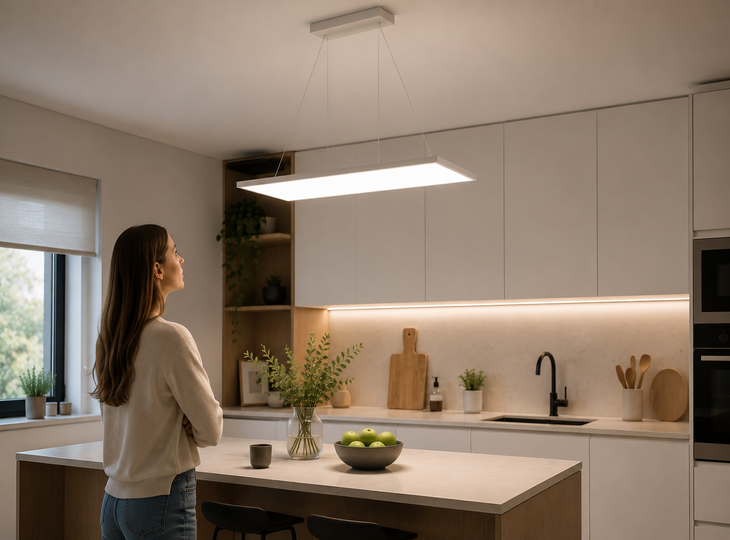
Choosing the best LED panels lights isn’t just about comparing wattage, size, or price. To achieve comfortable and efficient lighting, you need to consider where they will be installed, the activities that take place there, the ceiling height, and the amount of natural light available.

In this guide, we’ll explore which LED panel to choose based on the room or location, the advantages of each format, and the factors to consider before installation.
Table of Contents
Which LED panel is best for each space?
There is no single model that can be considered the best in all situations. The choice depends on the area you want to illuminate and the desired result.
Small formats, such as 30 × 30-centimeter LED panels, work very well in small areas or as a complement to other light sources. The 60 × 60 models are common in offices, classrooms, and retail spaces due to their ability to illuminate large areas. Meanwhile, the 120 × 30 and 120 × 60 panels are better suited for large spaces or those with high ceilings.
Before choosing the most suitable model, it is advisable to consider the size of the room, the ceiling height, the amount of natural light available, the furniture layout and how the space will be used.
The best LED panels for professional spaces
In professional spaces, lighting must be adapted to both the dimensions of the space and the tasks performed there. Choosing the right LED panel improves visibility and comfort.
LED Panels for Offices
Office lighting should facilitate concentration and allow people to work comfortably for several hours. It is important for the light to be distributed evenly, especially in spaces with numerous workstations and computers.
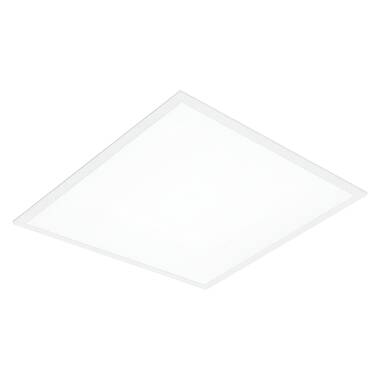
The 60 × 60 cm LED panel is one of the most commonly used sizes in offices, especially those with accessible drop ceilings. Its dimensions typically match the standard panels used in this type of ceiling, which makes it easy to integrate and allows for the replacement of old fluorescent fixtures.
Its large light-emitting surface helps distribute light evenly, reducing harsh shadows on desks. For this reason, it is a suitable option for open-plan offices, private offices, and workspaces.
To achieve optimal lighting, the panels should be arranged with the position of desks and computer screens in mind. A well-planned installation prevents light from reflecting directly onto monitors or some workstations from being less well-lit than others.
It’s also important to consider the panel’s glare level. In spaces where people work continuously in front of screens, visually comfortable lighting is just as important as the amount of light available.
Recommended products
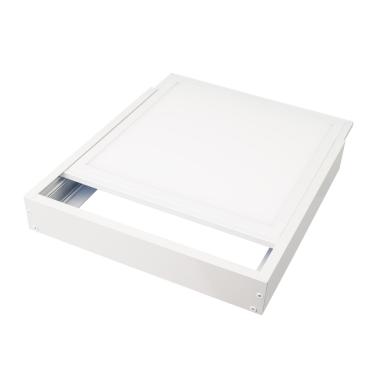
In Stock, delivery in 24/48h
11.59 £
Surface Kit with Screws for 60x60cm LED Panel
View product
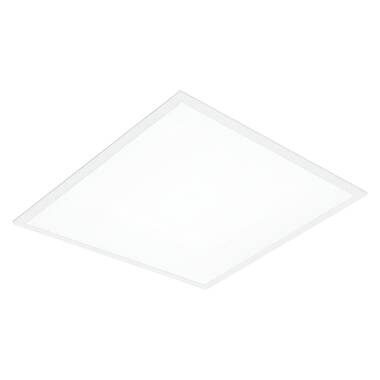
In Stock, delivery in 16-21 days
24.39 £
60x60cm 36W LEDVANCE Eco 600 LED Panel 3600lm
View product
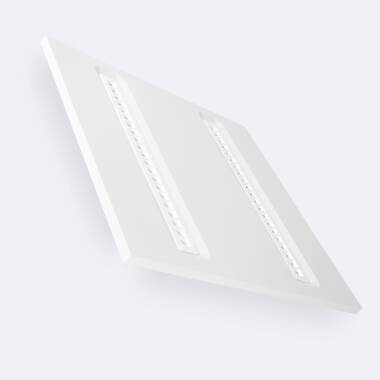
In Stock, delivery in 15-20 days
35.99 £
60x60cm 30W PHILIPS Certadrive VisualConfort Selectable CCT LED Panel 4200lm
View product
In Stock, delivery in 16-21 days
110.99 £
60x60cm 35W LEDVANCE Compact 600 DALI Dimmable UGR19 LED Panel 3640lm
View product
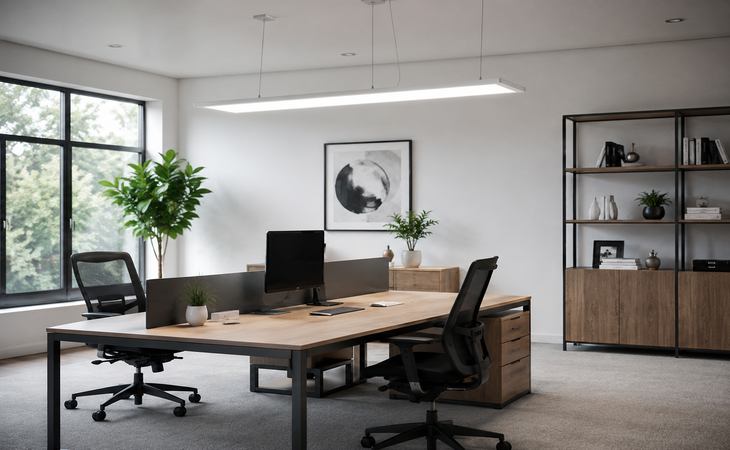
Another option is suspended LED panels, which are very useful for offices with high ceilings. Since they are suspended by cables, they can be positioned closer to the work area to make better use of the light they emit.
They are suitable for shared desks, meeting rooms, and reception areas. In addition to providing light, they help visually distinguish specific areas within an open-plan space.
The suspension height must be carefully calculated. If the panel is hung too low, it can obstruct the view or be distracting. If installed too high, some of the light may be scattered before reaching the work surface.
LED panels for shops and retail spaces
In a retail setting, lighting influences both customer comfort and how products are perceived. A poorly lit store may have dark areas, make it difficult to read labels, or distort the appearance of colors.
For these spaces, 120 × 30 cm LED panels are useful in stores with shelving, display cases, or long aisles. Their rectangular design allows the lighting to be oriented in the same direction as the layout of the store.
They can be installed above long counters or in walkways. By covering a longitudinal surface, they help prevent interruptions in lighting and allow for the creation of visually more orderly pathways.
They can also be a good option in narrow stores, where a large square panel might take up too much space on the ceiling or not fit the layout of the store properly.
To ensure products are displayed attractively, in addition to panel size, it’s important to consider color rendering. High-quality lighting helps display colors, materials, and finishes more accurately.
LED Panels for Classrooms and Educational Institutions
Classrooms, academies, libraries, and study rooms require stable lighting that allows students to read and work on screens without causing excessive eye strain.
The two most recommended options are the 60 × 60-centimeter LED panel and the 120 × 60-centimeter LED panel.
The 60-centimeter panel works well in medium-sized classrooms. By installing several units in a regular pattern, you can achieve balanced lighting both at the desks and in the walkways.
Its design makes it easy to integrate into accessible drop ceilings, which are common in schools, universities, and training centers.
The placement of the panels should take into account the position of the whiteboard, screens, and desks. A poorly oriented light fixture can cause glare on the whiteboard or cast shadows on students’ notebooks.
It is also advisable to avoid significant differences in lighting between the front and back of the classroom. The lighting should ensure that all students have similar visual conditions.
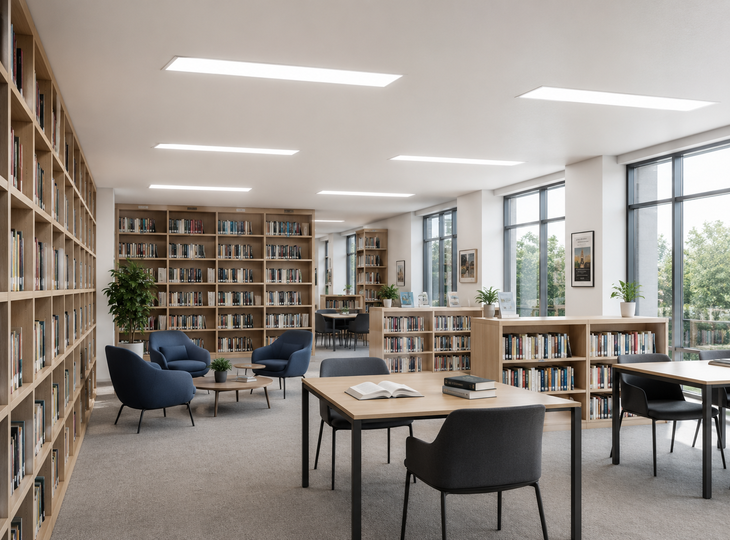
The 120 × 60 cm LED panel is designed for larger spaces. Its wide light-emitting surface allows it to cover extensive areas and can reduce the number of fixtures needed. It is suitable for large classrooms, libraries, or auditoriums.
Due to its size, installation requires a structure capable of supporting the panel. The spacing between fixtures must also be calculated, as using large panels alone does not guarantee uniform light distribution.
LED Panels for Clinics and Healthcare Facilities
Clinics, laboratories, and waiting rooms require bright, stable lighting. In many of these spaces, it is necessary to accurately observe colors, documents, or materials.
The most recommended sizes are the 60 × 60-centimeter LED panel and the 120 × 30-centimeter LED panel.
The 60-centimeter panel provides uniform general lighting and is well-suited for clinics and waiting rooms.
Its large surface area helps reduce harsh shadows and maintain a sense of balanced brightness. In patient care areas, it also helps create a clean and orderly atmosphere.
Color temperature should be chosen carefully. Light that is too cool can feel unwelcoming, while a tone that is too warm might make certain visual tasks difficult. Neutral lighting typically offers a good balance for these environments.
The 120 format is a good choice for hallways and laboratories. It can be installed above work tables or surfaces where continuous light is needed. Its elongated shape allows it to follow the path of hallways and prevent areas with uneven lighting.
In healthcare facilities, it is also important to choose stable, high-quality components, as the light fixtures may remain on for many hours a day.
The Best LED Panels for Different Rooms in the Home
Home lighting must also combine functionality and comfort, since not all rooms are used in the same way. Therefore, the size and features of the LED panel should be chosen based on the specific needs of each room.
LED Panels for Kitchens
The kitchen is a space that requires functional lighting. When preparing food, it’s important to clearly see work surfaces, utensils, and ingredients.
For home kitchens, two particularly versatile sizes are the 60 × 30-centimeter LED panel and the 30 × 30-centimeter LED panel.
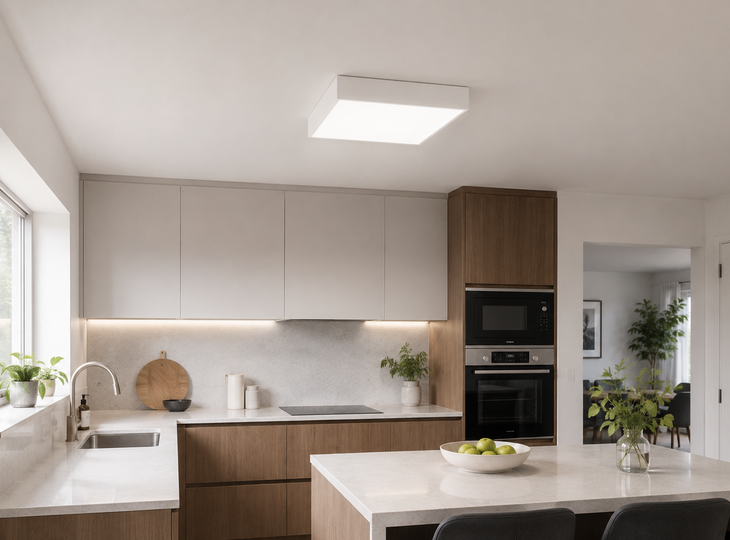
The 60 × 30 cm LED panel is well-suited for narrow or medium-sized kitchens. Its size allows light to be distributed throughout the room without taking up too much ceiling space.
It can be installed in the center of the kitchen or positioned along the length of the countertop. In longer rooms, multiple units can be spaced evenly apart to avoid dark spots.
This model is especially useful when a 60 × 60 panel is too large, but a small light fixture does not provide sufficient coverage.
General lighting can be supplemented with under-cabinet lights to reduce shadows on the countertop.
The 30 × 30 cm panel is a suitable option for small kitchens or auxiliary areas. Its compact size allows it to be easily integrated into ceilings with limited space.
It can also be used to highlight a specific area, such as a small table or a walkway.
In larger kitchens, several 30 panels can be distributed across the ceiling to create different light sources. This arrangement can be more effective than using a single central light fixture.
In all cases, it’s best to choose a panel that’s easy to clean and avoid installing it directly over areas where it may be continuously exposed to heat, steam, or grease.
LED Panels for Living Rooms and Dining Rooms
The living room is one of the most versatile spaces in the home. It can be used for relaxing, reading, watching TV, working, and more. For this reason, the lighting should be able to adapt to different times of day and activities.
Dimmable panels allow you to increase or reduce the amount of light as needed. A higher light level can be useful for cleaning or working, while softer lighting helps create a more relaxing atmosphere.
Dimming is also practical when the living room receives plenty of natural light during part of the day. Instead of keeping the panel at maximum brightness, you can adjust the artificial lighting.
LED Panels for Bedrooms
In the bedroom, lighting should allow you to perform daily tasks without creating an environment that’s too bright before bedtime. Comfort and ease of control are especially important in this room.
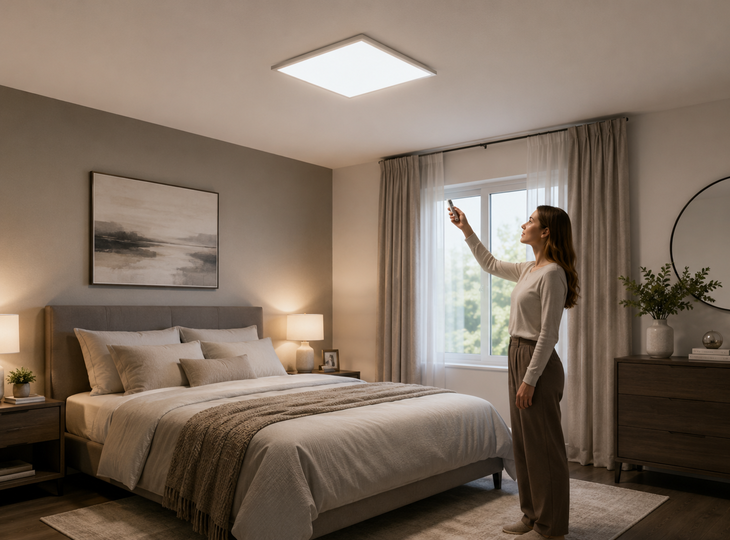
The most recommended models are the LED panel with a remote control and the 30 × 30-centimeter LED panel. A controllable LED Panel allows you to turn the lights on, off, or adjust the lighting without getting out of bed. Depending on the model, it may also allow you to change the brightness or select different color temperatures.
This flexibility is useful for adapting the light to different activities. You can use brighter lighting when tidying up the room or getting dressed and reduce the brightness as bedtime approaches.
Some models feature a timer or preset modes. It’s a good idea to check the available features, as they can vary considerably from one panel to another.
The 30 panel is suitable for small bedrooms or children’s rooms. Its size ensures a discreet presence on the ceiling and allows you to combine general lighting with bedside lamps or wall sconces.
LED Panels for Bathrooms
Bathrooms typically have limited space and, in many cases, little natural light. The lighting should allow you to use the bathroom comfortably.
Two suitable options are the 30 × 30-centimeter LED panel and the 60 × 30-centimeter LED panel.
The 30-cm panel is well-suited for small restrooms and bathrooms. Its compact size allows it to be placed in a central position without visually dominating the room.
It can provide good general lighting, though it’s best to complement it with a task light next to the mirror. A single light fixture on the ceiling can cast shadows on your face.
On the other hand, the 60-cm panel is well-suited for elongated bathrooms where the sink and shower are arranged in a straight line.
Its rectangular design helps distribute light throughout the room and prevents one end from being less well-lit.
In any bathroom, it’s essential to ensure that the panel is suitable for the area where it will be installed. Proximity to water and high humidity require the use of a light fixture with the appropriate protection.
LED Panels for Hallways and Entryways
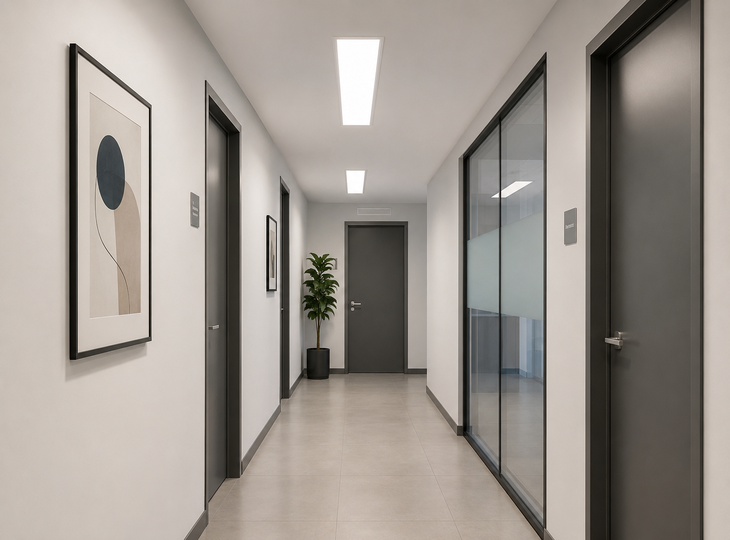
Hallways require continuous lighting that makes it easier to navigate and prevents sudden transitions between light and dark areas. Due to their shape, rectangular panels tend to work best.
The two most recommended options are the 60 × 30-centimeter LED panel and the 120 × 30-centimeter LED panel.
The 60-cm panel is suitable for short hallways, entryways, and foyers. Its shape allows it to be oriented in the same direction as the path.
In medium-sized hallways, several units can be installed at regular intervals. When installing them, care should be taken to ensure that the ends do not remain dark or that the light is concentrated solely in the center.
The 120-cm panel offers greater longitudinal coverage and works well in long hallways in homes, offices, etc. Installing several units in a row creates a sense of continuity and provides more uniform lighting.
Factors That Determine the Quality of an LED Panel
The quality of an LED panel does not depend solely on its power or size. To properly assess its performance, it is important to analyze various characteristics such as:
Luminous Flux
Luminous flux is expressed in lumens and indicates the amount of light emitted. When comparing panels, it is more useful to look at lumens rather than focusing solely on watts.
Luminous efficiency
Luminous efficiency relates the amount of light emitted to the energy consumed. It is expressed in lumens per watt. An efficient panel can produce more light while consuming the same amount of energy or less than another model.
Color Temperature
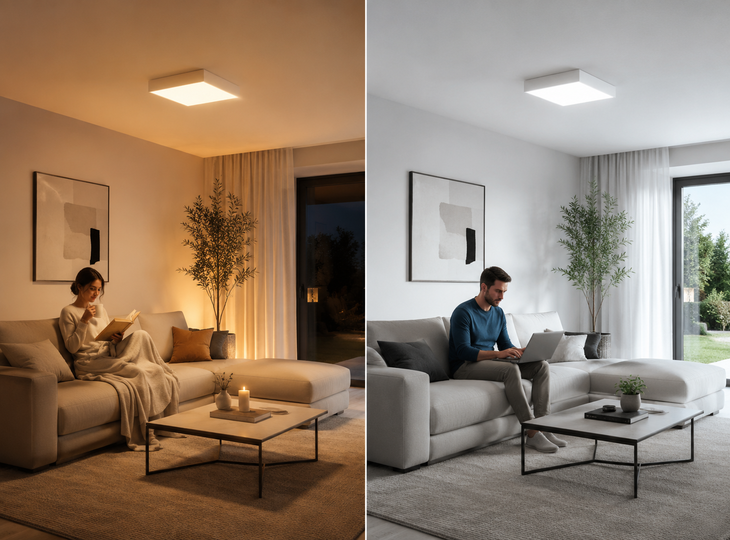
Color temperature influences the atmosphere a space conveys.
Warm light creates a cozy atmosphere and is often used in bedrooms, living rooms, and dining rooms. Neutral light offers a good balance for kitchens, bathrooms, offices, and retail spaces. Cooler tones can be used in technical or work areas, though they should be used with care to avoid spaces that feel overly impersonal.
Color Rendering Index
This index indicates a light source’s ability to render colors accurately.
It is especially important in retail spaces, kitchens, makeup areas, and spaces where it is necessary to correctly distinguish between materials or shades.
Glare
A light fixture can emit a lot of light and still be uncomfortable. Glare occurs when light enters the field of vision directly or causes intense reflections.
In offices, classrooms, and spaces with screens, it is advisable to choose panels designed to provide greater visual comfort.
Driver Quality
The driver regulates the electrical power supplied to the LED panel and plays a key role in its operation. When this component is of poor quality, problems such as flickering, buzzing, irregular start-up or a gradual loss of brightness may occur. For this reason, the quality of the driver directly affects both the stability of the lighting and the lifespan of the luminaire.
Installation System
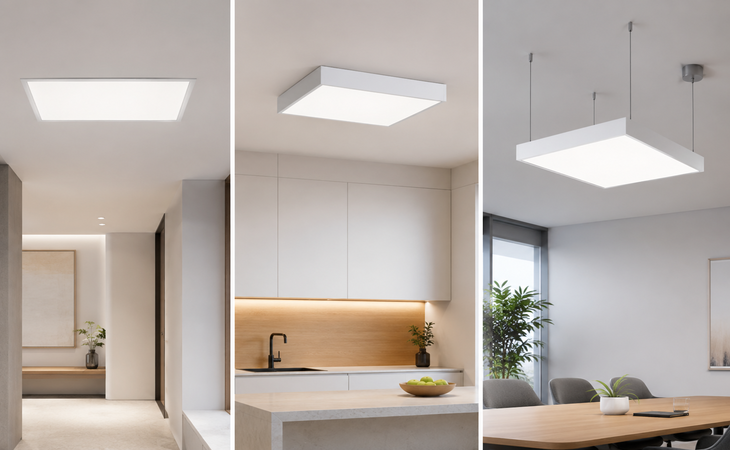
The panels can be installed recessed, surface-mounted, or suspended.
The choice will depend on the type of ceiling:
- Recessed installation can be used in suspended ceilings.
- For solid ceilings, a surface-mounted frame is usually required.
- In high-ceilinged or designer spaces, suspended systems can be used.
Before installation, check the dimensions, the location of the cables, and the available space for the driver. If you need more information on how to install an LED panel, you’ll find everything you need to do it correctly here.
Mistakes to Avoid When Choosing an LED Panel
Choosing an LED panel requires considering various factors, such as the dimensions of the space, efficiency and other relevant features. Reviewing these aspects before purchasing helps you find a model that is better suited to each room and achieve balanced lighting.
Some of the most common mistakes include:
- Not calculating the number of panels required.
- Ignoring the ceiling height.
- Choosing an unsuitable colour temperature.
- Not checking the installation dimensions.
- Failing to verify the protection rating in damp areas.
- Installing large panels with insufficient fixings.
- Choosing models with low-quality drivers.
- Positioning the luminaires without considering the furniture layout.
How to Choose an LED Panel Correctly
The best LED panels are those that are properly suited to the space and its intended use. There is no single model that is suitable for every room, as each environment requires different dimensions, light levels and types of lighting.
Before making a choice, it is advisable to consider all the factors discussed above. A well-planned decision not only improves the lighting but also helps create more comfortable, functional and energy-efficient spaces.