Efficiency of a LED floodlight: how to evaluate it
The efficiency of a LED floodlight cannot be assessed solely by looking at the watts listed on the data sheet. While power consumption is important, it alone does not indicate whether the fixture illuminates well, makes good use of energy, or will maintain its performance over time.
An efficient LED floodlight is one that transforms the energy consumed into an adequate amount of useful light, distributes that light correctly, maintains good thermal behavior and offers a stable service life. Therefore, in order to evaluate it correctly, several factors must be analyzed.
What does the efficiency of a LED floodlight mean?
When we talk about efficiency in LED lighting, we usually refer to the ratio between the light emitted and the energy consumed. This ratio is expressed in lumens per watt, i.e. lm/W.
A 50 W LED floodlight offering 5,500 lumens has a luminous efficacy of 110 lm/W. On the other hand, another 50 W model offering 6,750 lumens has a luminous efficacy of 135 lm/W. Both consume the same amount of power, but the second one delivers more light with the same energy.
Although it is not always convenient to choose the projector with more lumens per watt if that means worse thermal dissipation, shorter life or inadequate light distribution.
Also, in a LED floodlight it is not enough to check the chip performance. Efficiency must be evaluated on the entire projector, as the internal components and control system directly affect performance and luminous flux.
Lumens and watts: How do they differ?
One of the most common mistakes when choosing a LED floodlight is to look only at the wattage. For years, higher power has been associated with higher illumination, but in LED technology this relationship is not always straightforward.
Watts indicate the power consumption of the projector and lumens indicate how much light it emits. Therefore, if we want to evaluate the efficiency of a LED floodlight, lumens are more important than watts.
Here are some examples for reference:
LED floodlight
Consumption
Luminous flux
Luminous efficiency
Model A
30 W
3,000 lm
100 lm/W
Model B
30 W
4,500 lm
150 lm/W
Model C
50 W
5,500 lm
110 lm/W
Model D
50 W
6,750 lm
135 lm/W
In this case, model B is more efficient than model A because it consumes the same power and provides more light. Model D is also more energy efficient than model C, even though both have the same power.
A LED floodlight can have good luminous efficacy and still perform poorly if it does not distribute the light correctly. The optics determine how the luminous flux is distributed over the surface.
LED floodlights usually have different beam angle: 30º, 60º, 90º and 120º. A very narrow angle concentrates the light in a reduced area. It can be useful for facades or specific accesses. On the other hand, a wide angle distributes the light better on terraces, parking lots or passageways.
The key is to adapt the light beam to the actual use. If a floodlight with too wide an aperture is installed in a small area, light is wasted. If the beam is too narrow for a large area, shadows and poorly lit areas will appear.
Color temperature
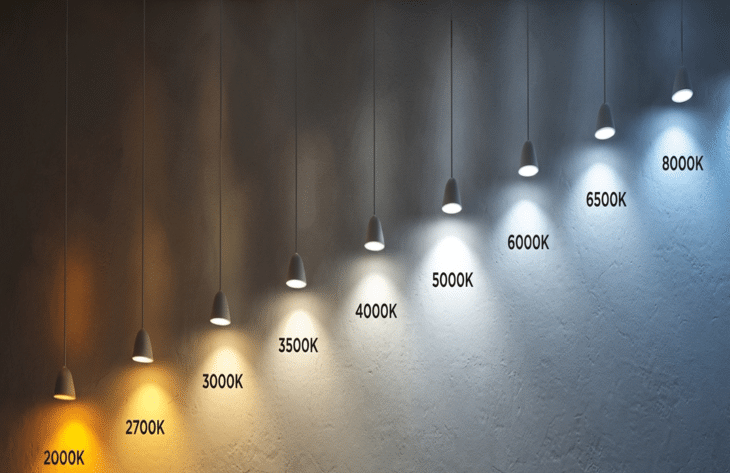
Color temperature is measured in degrees Kelvin and defines the hue of the light. In LED floodlights, the most common ranges are:
Color temperature
Light type
Recommended use
2200-3000K
Warm white
Gardens, terraces, decorative areas
3500-4000K
Neutral white
Entrances, patios, garages, facades
5000K-6500K
Cool white
Security, industrial areas, work areas
Color temperature alone does not determine efficiency, but it can influence perceived performance. Cooler temperatures tend to generate a greater sense of brightness, as the human eye perceives certain ranges of white light more intensely. In addition, in many cases, cooler lights can achieve slightly higher luminous efficacy, while warmer temperatures are more comfortable and decorative, these require more conversion to yellow or reddish tones, a process that can involve more energy losses.
In residential outdoor spaces, a 3000K or 4000K LED floodlight usually provides an appropriate balance between visibility and comfort. In industrial or security environments, cooler temperatures may be used if greater perceived brightness is desired.
The CRI
The CRI, or color rendering index, indicates the fidelity with which a light source displays colors compared to natural light. A high CRI allows colors to be seen more faithfully.
In LED floodlights, a CRI of 70 may be sufficient for walkways or general lighting. However, on terraces, gardens or facades where visual appearance is important, it is preferable to opt for CRI 80.
This point is important because some very efficient floodlights may sacrifice color quality to obtain more lumens per watt. In basic applications this may not be a problem, but in spaces where aesthetics matter, efficiency must be balanced with light quality.
An efficient LED floodlights is not just one that emits more light with less power consumption. It must also provide adequate light for the intended use.
The LED Driver
The LED driver is the system that regulates the power supply to the LED floodlight. Its function is to convert the input current into a current suitable for the LEDs, protecting them against electrical variations.
A bad driver can reduce the efficiency of the equipment, generate flickering, shorten the service life or cause premature failures. Therefore, the efficiency of a LED floodlight also depends on the quality of its internal electronics.
A power factor equal to or higher than 0.90 is usually recommended, as it indicates better electrical efficiency and less stress for the installation.
Installation and orientation
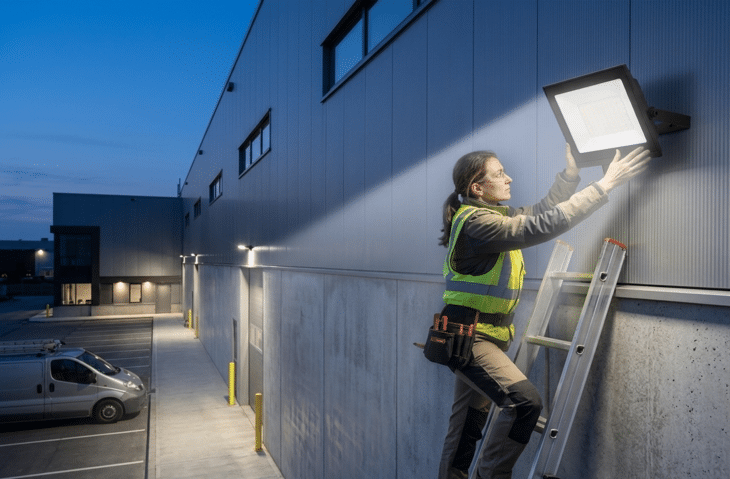
Another point to take into account is the correct installation. The height, angle and location influence the use of light.
Too low an installation can cause glare and harsh shadows. Too high an installation can increase coverage but reduce intensity on the ground. If we orient the angle wrongly, it can send part of the luminous flux to areas where it is not needed.
To improve efficiency the floodlight should be installed at a suitable height, directing the beam towards a useful area, avoiding pointing to windows or passageways, as well as choosing a corrective angle and using motion detectors to reduce consumption. If you still have any doubts, here you will find a step-by-step guide on how to install an outdoor LED floodlight correctly.
Power factor
The power factor measures the ratio between the useful energy and the total energy demanded from the grid. Its value is between 0 and 1. The closer it is to 1, the better the electrical energy is used.
A floodlight with a low power factor may consume seemingly little in watts, but demand more current from the installation. This can lead to losses, overheating or overloading.
Thermal management
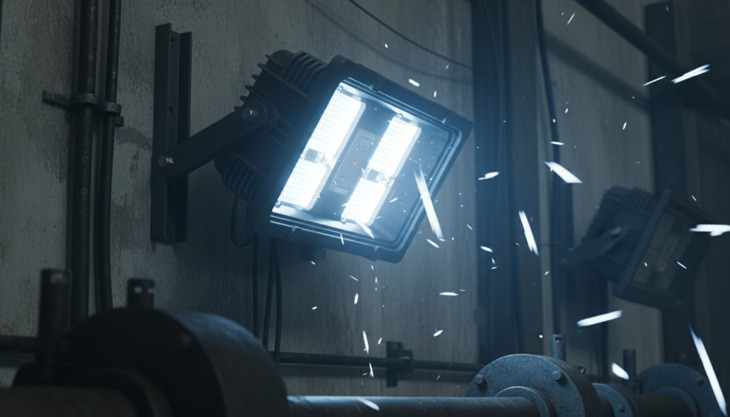
Heat is one of the main enemies of LED efficiency. Although LEDs emit less heat to the outside than other technologies, internally they generate temperature that must be properly dissipated.
If the heat is not properly dissipated, various problems arise such as overheating, accelerated degradation, driver failure or loss of efficiency.
This point is important because projectors can work for many hours, exposed to the sun or high ambient temperatures.
A good floodlight must have a housing capable of dissipating temperature and designed to facilitate heat dissipation.
IP degree of protection
The efficiency of an LED floodlight depends not only on its initial performance. It is also important to be able to maintain it in the environment where it will be installed.
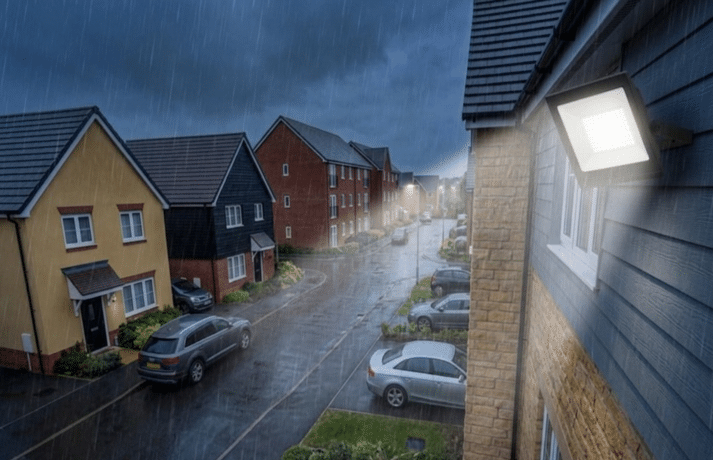
Outdoors, the IP rating is an important point to consider. This code indicates the resistance to dust and water ingress. Within the LED floodlights we usually find the IP65 that protects against dust and water and the IP66 that has greater resistance against powerful jets of water. A floodlight with low protection may lose efficiency over time due to moisture ingress, oxidation of contacts or deterioration of the driver.
In covered areas, a lower grade may be acceptable, although it is always advisable to assess the conditions of the space.
Lifetime of the LED floodlight
The lifetime of an LED floodlight should not be interpreted as the moment when it stops turning on. LEDs do not normally fail all at once, but lose luminous flux progressively.
The lifetime of the LED floodlight is measured in operating hours, typically between 30,000-50,000 hours.
The efficiency of an LED floodlight is greatly improved when combined with control systems. It is not always necessary for the equipment to run at 100% all night long.
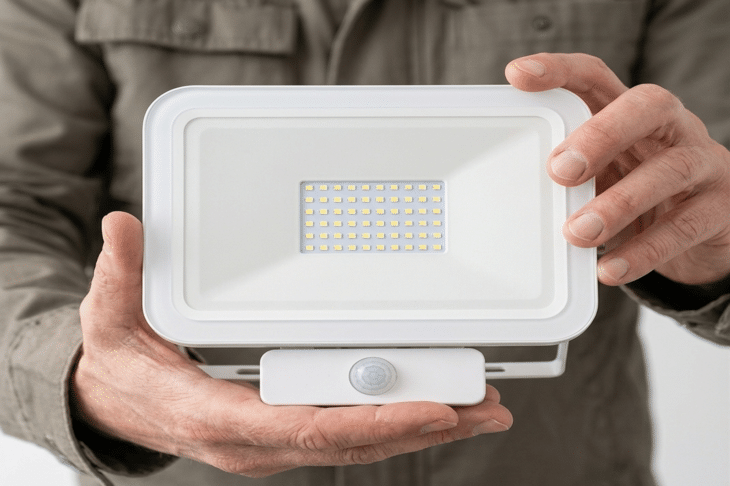
LED Motion Sensor Floodlight and dimmable models make it possible to adapt consumption to real needs. In garages or transit areas, a detector can reduce many hours of unnecessary operation.
A floodlight can end up consuming more than necessary if it remains on without control. On the other hand, a well-regulated system reduces electricity consumption and extends the life of the equipment.
How to calculate the annual consumption of a LED floodlight
To evaluate the economic efficiency of an LED floodlight, it is useful to calculate its annual consumption.
The formula is as follows:
Annual consumption = power in kW × hours of use per day × days of use.
As an example, a 50 W LED floodlight used 5 hours per day throughout the year:
50 W = 0.05 kW 0.05 kW × 5 h × 365 days = 91.25 kWh per year.
If the price of electricity were 0.136 €/kWh:
91.25 kWh × 0.136 € =12.41 € per year
This calculation allows comparing different floodlight not only by purchase price, but also by cost of use.
A more efficient model may have a slightly higher initial price, but make up the difference with lower consumption, longer life and less maintenance.
Common mistakes when evaluating the efficiency of an outdoor LED floodlight
Choosing by wattage alone: A floodlight with more wattage is not always better. It may consume more and offer lower luminous efficiency. The right thing to do is to compare lumens, watts and lm/W.
Not checking the actual luminous flux: For a reliable comparison, the lumens emitted by the complete luminaire should be assessed.
Ignoring optics: Poorly distributed light is wasted. A floodlight with a good angle and good orientation can illuminate better than a more powerful but poorly oriented one.
Not considering temperature: Heat reduces performance and accelerates the loss of luminous flux. Good heat dissipation is essential to maintain efficiency.
Buying without checking the IP: Outdoors, humidity and dust affect the performance and durability of the floodlight. For this reason, our floodlights are designed for outdoor use and are rated IP65 or higher.
How to assess efficiency in full
A truly efficient fixture must offer good light output, low power consumption, proper distribution, outdoor resistance and a consistent lifetime.
Before choosing a model, it is advisable to review the technical data sheet and check the data mentioned above. The best choice is not always the most powerful or the cheapest floodlight, but the one that correctly illuminates the required area with the lowest possible power consumption and maintains its performance over the long term.



![spotlights-projector-various-powers[1]](https://www.ledkia.com/blog/uk/wp-content/uploads/sites/4/2025/12/spotlights-projector-various-powers1.jpg "What power to choose for an outdoor LED floodlight?")
![buying-guide-sensor-floodlights[1]](https://www.ledkia.com/blog/uk/wp-content/uploads/sites/4/2026/01/buying-guide-sensor-floodlights1.jpg "How to choose a floodlight with motion sensor?")