
In a context where energy efficiency and sustainability are increasingly relevant, the way in which we manage lighting in spaces takes on special importance. It is not just a matter of reducing electricity consumption, but of doing so in an intelligent way, taking advantage of the available resources without compromising the visual comfort and functionality of the environments.

In this scenario, the concept of daylight harvesting has established itself as a key strategy in modern lighting design. Throughout this article, we will see exactly what it consists of, how it works at a technical level and what aspects should be taken into account to apply it correctly in real projects.
Table of Contents
- What is daylight harvesting?
- How does a daylight harvesting system work?
- Benefits of daylight harvesting in lighting
- Typical applications
- Technical aspects to be taken into account
- Common mistakes when implementing daylight harvesting
- Keys to the correct application of daylight harvesting in lighting projects
What is daylight harvesting?
Daylight harvesting is a lighting control system that automatically adjusts artificial light according to the amount of natural light available in a space.
Its main objective is to maintain a constant and adequate lighting level while reducing energy consumption. To achieve this, it relies on sensors that measure illuminance (amount of light measured in lux) and on dimming systems that adapt the power of the luminaires.
How does a daylight harvesting system work?
Rather than a set of isolated elements, daylight harvesting works as a dynamic system that responds in real time to ambient light conditions.
The starting point is the natural light that enters the space, usually through windows, skylights or glazed facades. This light varies throughout the day in intensity, direction and quality, requiring a system capable of continuous adaptation.
From there, light sensors (photocells) measure the actual illuminance on the working plane, i.e. the amount of useful light received by the user, expressed in lux. This measurement not only seeks to detect whether there is natural light, but to determine whether the total level of illumination – adding natural and artificial – meets the requirements of the space.
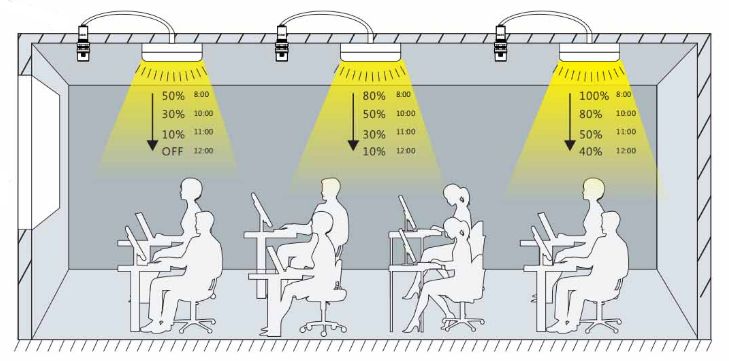
With this information, the control system compares the measured level with the previously defined target level. If it detects that the natural light is sufficient or close to meeting the target level, it progressively reduces the artificial light input. If, on the other hand, daylight decreases, it increases the intensity of the luminaires to compensate.
This adjustment is done continuously and gradually by means of dimming systems such as DALI (Digital Addressable Lighting Interface) or 1-10V, avoiding abrupt switching on and off. Instead of functioning like a switch, the lighting behaves like a variable flow that adapts to the environment.
For this process to be effective, it is essential that luminaires can modulate their luminous flux (measured in lumens). This is where solutions such as dimmable LED panels fit in particularly well, as they allow stable and precise dimming without compromising the quality of light.
Overall, the system does not “turn on or off” the lighting, but constantly balances the contribution of natural and artificial light to maintain optimal visibility conditions with the lowest possible consumption.
Benefits of daylight harvesting in lighting
The implementation of daylight harvesting systems not only responds to a logic of efficiency, but also has a direct impact on operating costs, user well-being and building sustainability. When the system is well sized and calibrated, the benefits are measurable and sustained over time.
Energy savings
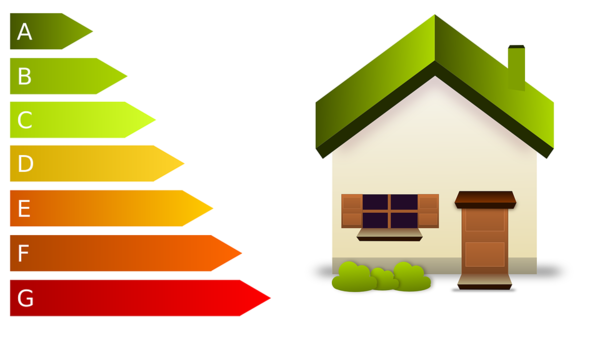
The most immediate benefit is the reduction of electricity consumption in lighting. In environments with a good supply of natural light (glazed facades, skylights or perimeter areas), savings are usually between 20% and 60%, and can exceed 70% in areas close to windows during certain time slots.
This impact depends on factors such as building orientation, latitude, space use or target illuminance level. In tertiary projects, lighting can represent between 15% and 40% of the building’s total consumption, so optimization through daylight harvesting has a relevant effect on the energy bill.
Improved visual comfort
One of the least visible but most important aspects is light stability. The system avoids sudden fluctuations in light, maintaining constant levels on the working plane.
This results in a reduction of visual fatigue and better adaptation of the eye to environmental conditions. In addition, by prioritizing natural light – which has a continuous spectrum and high color rendering – color perception (related to the CRI, color rendering index) and the overall quality of the environment are improved.
Longer luminaire life
Continuous dimming means that luminaires are not constantly working at 100% of their capacity. This reduces operating temperature and stress on critical components such as the driver.
In practical terms, it is common to see life increases in the order of 20% to 30%, as well as less frequent maintenance. Premature failures associated with on/off cycling are also reduced, as the system prioritizes smooth transitions.
Sustainability and emissions reduction
Reducing energy consumption has a direct impact on the building’s carbon footprint. In the European context, where the energy mix still includes non-renewable sources, each kWh saved means avoiding CO₂ emissions.
As a reference, reducing lighting consumption by 30% in a building with intensive use can mean several tons of CO₂ avoided per year, depending on the size of the installation. These types of strategies contribute to compliance with energy certifications and standards such as nearly zero-energy buildings (nZEB).

Typical applications
Daylight harvesting is especially applicable in spaces with good natural light entry:
Offices
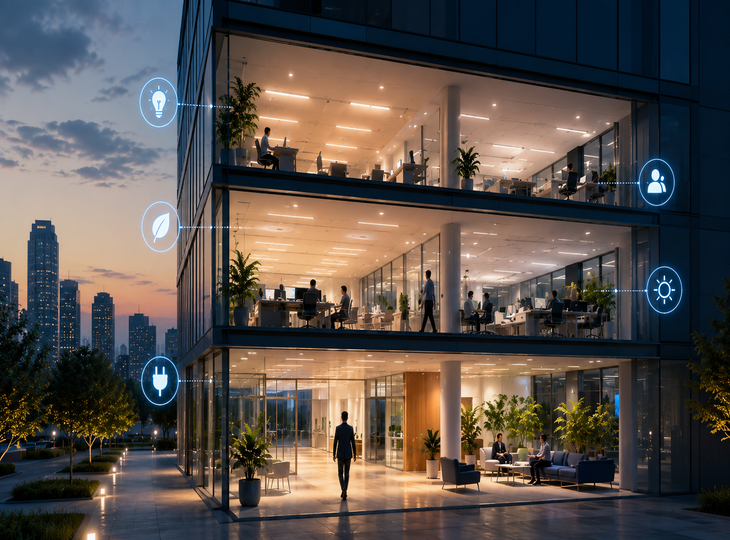
In office environments, daylight harvesting is usually implemented by zoning, differentiating between areas close to the facade and interior areas. Sensors are placed on the work surface or ceiling, calibrated to maintain levels between 300 and 500 lux.
The system progressively reduces the supply of artificial light in areas close to windows, while maintaining constant levels in deeper areas. This not only optimizes consumption, but also improves visual comfort during prolonged tasks in front of screens.
Educational centers
In classrooms and training spaces, implementation requires special attention to lighting uniformity. The system usually combines sensors with continuous dimming to avoid excessive contrasts between naturally lit areas and other more interior areas.
The main contribution here is the stability of the lighting during the school day, which helps to reduce visual fatigue and promotes concentration. It also makes it possible to adapt the lighting to different activities (reading, writing, presentations).
Commercial spaces
In retail, daylight harvesting is integrated to take into account both general and accent lighting. Dimming not only responds to natural light, but also to the need to maintain a uniform perception of the product.
In showcase areas or glazed facades, the system reduces the intensity of general lighting, while maintaining adequate levels of focal lighting. This makes it possible to optimize consumption without affecting the visual presentation of the space.
Industrial buildings
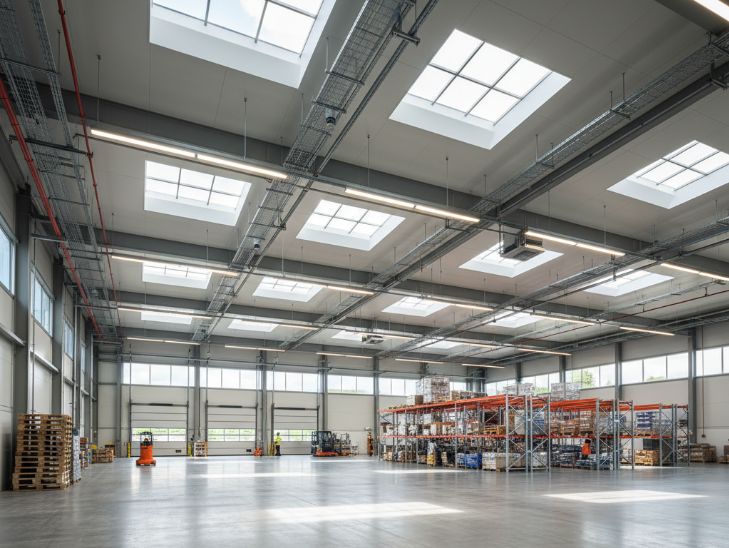
In industrial or logistics buildings, the implementation is often supported by skylights and large translucent roof surfaces. Here, daylight harvesting is combined with high-efficiency luminaires with a wide opening angle.
The system adjusts the lighting according to the available zenithal light, which can lead to significant reductions in energy consumption during daylight hours. In addition, in high-rise spaces, minimizing the use of artificial lighting has a direct impact on operating costs.
Technical aspects to be taken into account
Target illuminance level
Each space requires a certain level of illuminance, measured in lux. For example, offices usually require between 300 and 500 lux according to regulations.
Light distribution
Factors such as the opening angle of the luminaires or their arrangement influence light uniformity.
UGR index
The UGR (Unified Glare Rating) measures glare. A poorly adjusted system can cause visual discomfort if not properly controlled.
Color Temperature
Color temperature (measured in Kelvin) influences the perception of space. Integrating daylight harvesting with solutions such as dimmable LED strips makes it possible to adapt the lighting in this respect as well.
Common mistakes when implementing daylight harvesting
Although the concept is simple, the practical implementation of daylight harvesting requires precision in design, installation and commissioning. Small errors can drastically reduce the performance of the system or even generate effects contrary to those sought, both in terms of consumption and visual comfort.
Incorrect sensor placement
The position of the sensors is critical. If they are placed too close to windows, they can overestimate the available light and excessively reduce artificial lighting in the rest of the space. Conversely, if they are placed in interior areas, they can underestimate the natural light contribution.
In well-designed projects, sensors are placed taking into account the actual working plane (e.g., desks in offices) and the distribution of natural light. In some cases, multiple sensors per zone are used to avoid biased readings.
Lack of system calibration
Installing the system is not enough: it needs to be calibrated. This involves correctly defining the target illuminance level (lux) and adjusting the system’s response so that the transition between daylight and artificial light is progressive.
Poor calibration can lead to oscillations (constant rises and falls in intensity) or insufficient illuminance levels. This adjustment usually requires on-site measurements and, in complex projects, periodic reviews after commissioning.
Not considering the actual use of the space
The behavior of the system must be adapted to the use of the space, not only to its physical conditions. For example, a meeting room with intermittent use does not require the same strategy as an office with continuous work.
Ignoring these patterns can lead to inefficient or uncomfortable configurations for the user. In environments such as retail or education, in addition, changes in activity throughout the day must be taken into account.
Incompatibility of luminaires and control systems
Not all luminaires are dimmable. If non-compatible equipment is installed, the system loses its fine-tuning capability and is limited to on/off switching.
Therefore, it is key to work with solutions prepared to work with dimming systems, which integrate drivers compatible with protocols such as DALI or 1-10V. This guarantees a stable and predictable response.
Lack of zoning
Treating the entire space as a single zone is a common mistake. Daylight is not evenly distributed, so the system must be divided into areas (e.g., perimeter vs. interior).
Without zoning, precision is lost: areas close to windows may be under-lit or, conversely, interior areas may consume more than necessary.
Failure to integrate the system from the design phase
When daylight harvesting is added a posteriori, there are often installation constraints (location of sensors, wiring, equipment compatibility).
Integrating it from the start of the project makes it possible to optimize the layout of luminaires, foresee dimming and ensure correct interaction between all the elements.
Unrealistic savings expectations
Although savings can be high, they depend on multiple variables: orientation, climate, time of use or design of the space. Failure to consider these factors can lead to unrealistic expectations.
A previous analysis, supported by simulations or similar experiences, helps to correctly size the real impact of the system.
Keys to the correct application of daylight harvesting in lighting projects
When implementing a daylight harvesting system, it is advisable to validate a series of key aspects that determine its real performance. Here is a summary of the critical points to review during the design, installation and commissioning phase:
- Analyze the entry of natural light: evaluate orientation, size and type of openings (windows, skylights), as well as variations throughout the day and year.
- Define target illuminance levels (lux): adjust values according to the use of the space (office, retail, industrial) and applicable regulations.
- Correctly zoning the space: separate perimeter and interior areas to allow independent and more precise regulation.
- Select appropriate sensors and position them correctly: avoid positions that distort the reading (too much or too little light) and prioritize measurements that are representative of the work plane.
- Ensure compatibility of luminaires and control: work with dimmable equipment and compatible drivers (DALI, 1-10V).
- Adjust the dimming curve: set up progressive transitions to avoid flickering, oscillations or sudden changes in intensity.
- Calibrate the system in situ: perform real measurements after installation and adjust parameters according to the behavior of the space.
- Consider schedules and usage patterns: adapt the system to actual occupancy, activity variations and specific needs.
- Integrate the system from the design phase: coordinate lighting, control and architecture to maximize efficiency and avoid later limitations.
- Validate savings expectations: estimate results based on real conditions (climate, use, design) and not just theoretical values.
Following this brief guide allows you to move from a generic solution to an optimized system, capable of balancing energy efficiency, visual comfort and durability of the installation.