
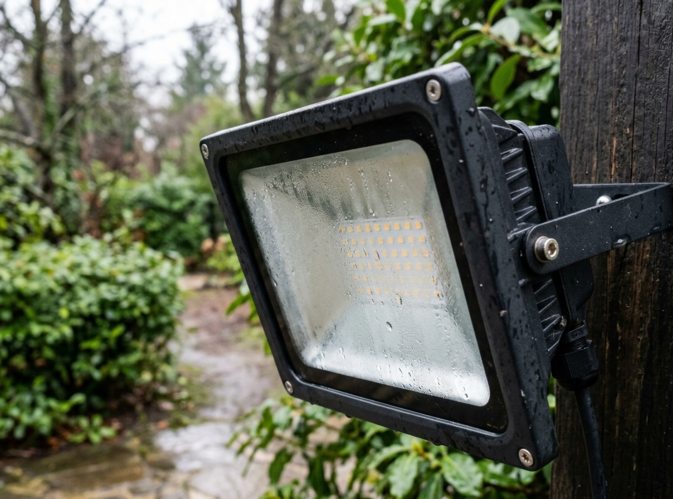
The presence of internal humidity in a LED floodlight usually occurs in installations in gardens, facades, parking lots, industrial buildings, etc. When drops appear on the front glass or mist inside the equipment, many users immediately interpret that there is a manufacturing defect or a direct entry of water. However, this is often a physical phenomenon linked to thermal changes and air dynamics inside the floodlight.

LED floodlights work in demanding conditions: rain, solar radiation, dust, fog, sudden temperature variations and continuous on/off cycles. All this influences the internal behavior of the equipment. Understanding why condensation appears makes it possible to distinguish between a one-off situation and a real problem.
Table of Contents
What is condensation in a LED floodlight?
Condensation occurs when water vapor present in the air changes to a liquid state when it comes into contact with a cold surface. In a LED floodlight this phenomenon is usually seen in the form of mist on the front glass, small internal droplets, humidity in the corners of the diffuser or fogging after sudden temperature changes.
The presence of water inside does not always mean that rain has entered from outside. In many cases, the air inside the projector itself already maintains a certain level of humidity and, as the equipment cools down after operation, this humidity condenses on the internal surfaces, especially in the cooler areas of the unit.
Recommended products
In Stock, delivery in 15-20 days
27.59 £
Floodlight Support Bracket
View product
In Stock, estimated delivery from 20-30 days
249.99 £
LED Floodlight 6.5W MAX Aluminium IP66 LEDS-C4 AI18-P7W9M2BBZ5
View product
In Stock, delivery in 24/48h
8.69 £
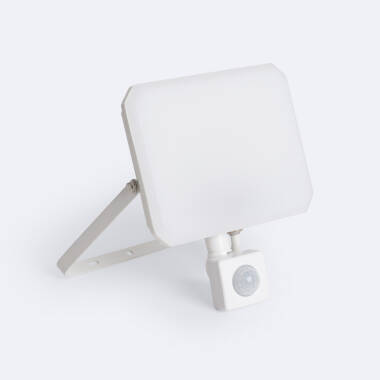
20W LED Floodlight IP65 with PIR Sensor in White
View product
In Stock, delivery in 24/48h
12.99 £
50W LED Floodlight IP65 with PIR Sensor in White
View product
Why does this occur frequently in LED floodlights?
LED floodlights have a different technical configuration than other lighting equipment. During operation, the driver generates heat and when the fixture is switched off, the housing is rapidly cooled by contact with the outside air. If the internal humidity is sufficient, condensation occurs.
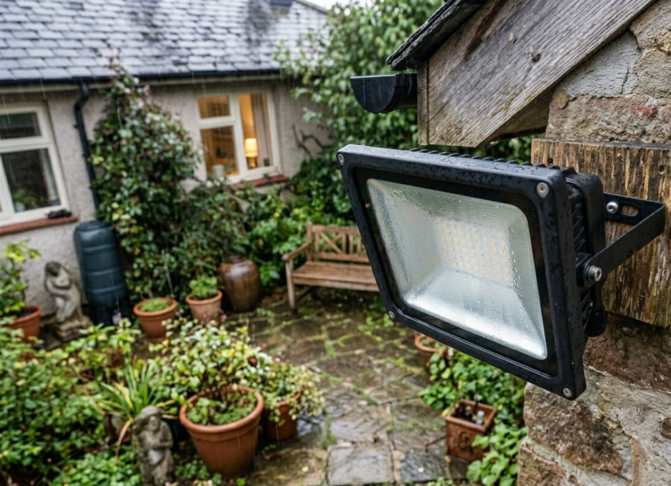
This effect is especially visible in projectors installed in outdoor areas as they face variable environmental conditions and constant thermal cycles that favor the appearance of internal humidity.
Main causes of condensation on a LED floodlight
Thermal difference
This is the most common cause. As mentioned above, during operation, the floodlight reaches a high internal temperature due to the activity of the LED module and driver and when it is switched off the metal housing cools down.
This sudden cooling causes the water vapor present inside to condense and generate droplets on the glass or in the cooler areas of the enclosure. This phenomenon is most frequently observed in winter during humid nights, in spring due to strong temperature fluctuations and in summer after rain or stormy weather.
Internal breathing of the equipment
Even if a LED floodlight has an IP65 degree of protection, no sealing system is completely airtight. During operation, the increase in temperature causes the air inside the equipment to expand, while when the equipment is switched off, the same air contracts as the casing cools.
This thermal cycle generates small inlets of outside air through the seals in the mechanical structure. If this incoming air contains moisture, it is retained inside the projector and, with subsequent temperature changes, ends up condensing on the internal surfaces.
Moisture ingress
In LED floodlight, one of the most common causes of internal humidity is the entry of water through the wiring system. This area is very sensitive since any failure in the sealing can compromise the watertightness of the assembly and allow direct infiltration of moisture from the outside.
Among the most common errors are an upward inlet orientation that favors water accumulation or the absence of a watertight junction box resulting in actual water ingress.
Aged front seal
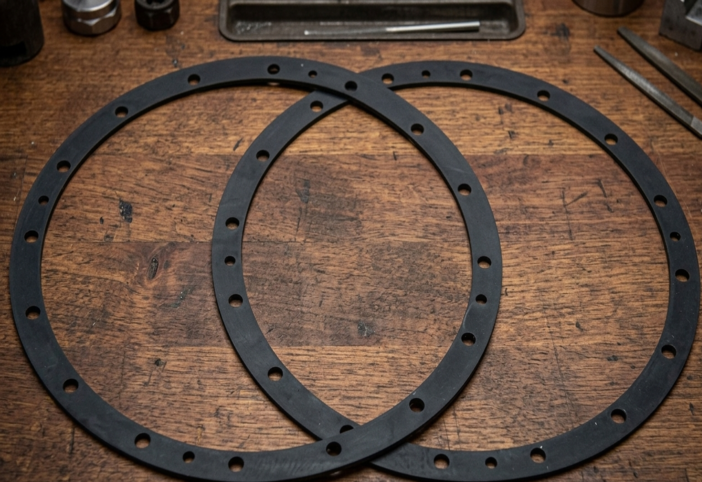
The gasket between the housing and the floodlight glass becomes less effective over time due to continuous exposure to ultraviolet radiation, high temperatures or the action of contaminants in the environment. As these conditions degrade its properties, the sealing system deteriorates, facilitating the entry of moisture into the equipment.
LED floodlight quality
Not all LED floodlight have the same level of construction quality, and in economic models it is common to find deficiencies that directly affect their durability. The most common problems include insufficient or discontinuous sealing gaskets or hardware susceptible to corrosion. These factors together significantly increase the likelihood of recurring condensation inside the projector. It is important to select the model that best suits your needs, see our guide on the types of LED floodlights and recommendations for choosing the right one.
Installation on wet surfaces
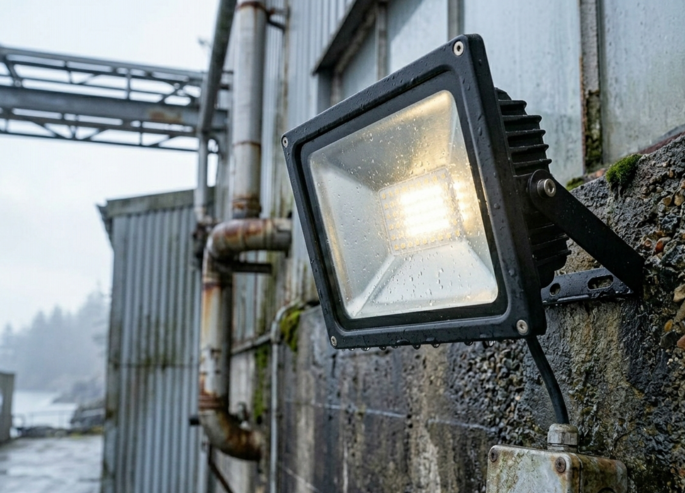
When a floodlight is installed on surfaces where moisture is present, such as leaking walls or metal structures where condensation accumulates, there is a possibility that moisture can be transmitted into the system through poorly sealed junction boxes.
Typical condensation or fault signal: how to tell the difference
Acceptable one-off situation
It is considered normal behavior when condensation manifests itself only as a slight fogging of the glass or the inside of the floodlight at specific times such as dawn or during the night, coinciding with changes in temperature and humidity. In these cases, the phenomenon is usually linked to atmospheric conditions and not to equipment failure.
Furthermore, it remains within normal parameters when the humidity disappears after several hours of operation, no accumulations of water are observed inside, the light output remains stable and there are no signs of electrical anomalies such as flickering or power outages.
Situation requiring intervention
The floodlight should be checked when the presence of humidity is persistent, such as when large drops appear and do not disappear, water accumulation in the lower part of the interior or evident signs of oxidation in screws and metallic elements. These signs usually indicate water infiltration in the equipment.
Intervention is also necessary when electrical malfunctions are detected. If these situations are repeated for weeks or are accompanied by a noticeable decrease in light intensity, it is likely that moisture is directly affecting the system. See our article on the causes of LED floodlight flicker to learn more.
Technical risks of moisture in an LED floodlight
Internal corrosion
The presence of moisture inside the floodlight significantly accelerates corrosion processes in different components of the equipment, affecting both the hardware and the system. This progressive deterioration compromises the structural and electrical integrity of the system, reducing its reliability and useful life.
LED driver failure
The LED driver is one of the most sensitive components inside a floodlight, so recurrent exposure to condensation can cause its deterioration. Humidity favors processes such as the appearance of short circuits, overheating situations and even premature failures that can render the equipment inoperative.
Reduced luminous flux
The presence of condensation inside the projector directly affects the luminous flux. This results in a dispersion of the light emitted by the LED module and reduces projection efficiency. As a result, there is a loss of intensity, irregular shadows and a reduction in the effective range of the beam.
Solutions and measures against condensation
- Analyze the condensation pattern: Observe when it appears (rain, winter, night) and if it disappears during operation. If it is punctual and linked to the weather, it is usually normal behavior.
- Check the cable entry (cable gland): Check the condition and correct tightness of the cable gland or cable gland. It is a critical point where moisture can enter if the sealing is incorrect.
- Check front gasket and seal: Make sure screws are tight, glass is well seated and gasket is in good condition. If deteriorated or hardened, it should be replaced.
- Perform technical drying of interior: Disconnect power and carefully disassemble if water is visible. Dry without extreme heat and check seals before resealing.
- Reorient the installation: Avoid upward mounting, unventilated areas or supports that accumulate water. A good tilt helps evacuate moisture and reduces condensation.
How to prevent LED floodlight condensation
Choosing the right degree of protection
The selection of the IP rating should be made according to the actual exposure level of the environment. IP65 is suitable for installations subject to moisture and dust. On the other hand, the IP66 rating withstands powerful water jets and high pressure, making it better for more hostile environments such as heavy rain.
Prioritize build quality
The choice of an LED floodlight should not be based solely on power or luminous flux, but also on the overall quality of its construction. It is essential to assess aspects such as the efficiency of the sealing system, the reliability of the driver or the anti-corrosion treatment of the materials.
Correct installation
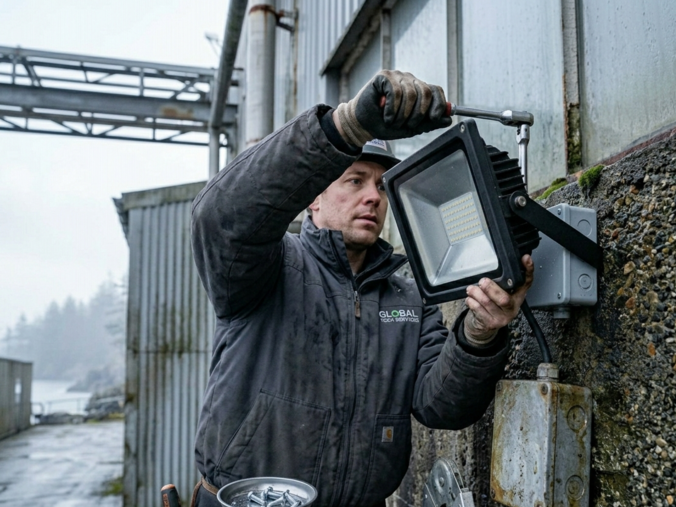
Proper installation is important to reduce the majority of incidents related to moisture or premature failure. To do this, it is necessary to use an external waterproof box for connections, use appropriate outdoor cabling, fix the projector on a firm and properly leveled support, and ensure that all connections are properly protected from the elements. Here you will find a step-by-step guide on how to properly install a floodlight.
Periodic checks
Preventive maintenance should be performed periodically, at least once a year. These checks include cleaning the exterior surface of the floodlight, checking the tightness of screws, inspecting the condition of sealing gaskets, checking electrical wiring and checking for signs of rust or deterioration on metal components.
In conclusion, condensation in LED floodlight is a common phenomenon under certain conditions of use and does not always imply a defect in the equipment. Understanding its origin, differentiating the different situations, and applying good installation and maintenance practices can minimize its impact and ensure reliable and long-lasting operation.