Efficient solutions for factories, halls and production with LED hall lighting
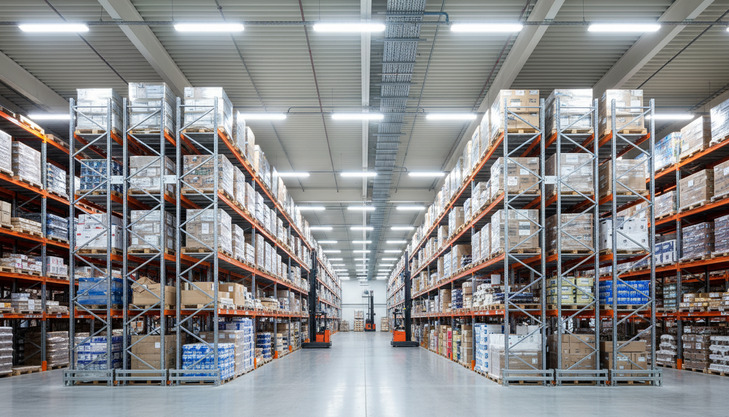
The right lighting is crucial for productivity, safety and energy costs in industrial operations. Modern LED industrial lighting has fundamentally changed the requirements for professional lighting systems. Where energy-hungry halogen or sodium vapor lamps used to provide sufficient brightness, highly efficient LED systems now perform this task with significantly lower power consumption.
Switching to LED technology offers considerable advantages for factories, production halls and warehouses. In addition to energy savings of up to 70 percent, companies benefit from longer maintenance intervals, better lighting quality and more flexible control options. In this guide, you will learn everything you need to know about planning and implementing modern hall lighting.
Why LED industrial lighting is the future in factories
The industrial sector is under increasing pressure to reduce operating costs and achieve sustainability targets at the same time. Lighting accounts for a significant proportion of total electricity consumption in many production facilities. Especially in companies with multi-shift operations, lighting systems often run around the clock. This is where the switch to LED technology pays off particularly quickly.
Modern LED industrial lighting achieves luminous efficacies of 150 to 200 lumens per watt. In comparison, conventional halogen lamps only achieve around 20 lumens per watt, while fluorescent tubes achieve a maximum of 100 lumens per watt. This technical superiority leads directly to measurable savings in electricity costs. In a typical production hall with 50 lights and 12 hours of operation per day, the savings quickly add up to several thousand euros per year.
Added to this is the significantly longer service life. While conventional industrial lamps have to be replaced after 10,000 to 20,000 operating hours, high-quality LED systems achieve 50,000 to 100,000 hours. This not only reduces material costs, but above all the effort required for maintenance work in hard-to-reach areas of the hall.
Advantages of LED hall lighting at a glance
Switching to LED has numerous advantages for industrial companies. First and foremost is the aforementioned energy efficiency. But LED hall lighting is also impressive in other areas.
Immediate full brightness when switched on is crucial for many production processes. Unlike gas discharge lamps, LEDs do not require a warm-up phase. This also enables the use of motion sensors and demand-based control without employees having to wait for sufficient lighting.
The light quality of modern industrial LED high-bay achieves color rendering indices of Ra 80 and higher. This means that colors are displayed true to life, which is essential for quality control in many production areas. At the same time, LEDs are flicker-free, which reduces employee fatigue and promotes concentration.
Another advantage is their robustness. LED luminaires are insensitive to the shocks and vibrations that often occur in production environments. Even frequent switching on and off does not shorten the service life, unlike with conventional light sources.
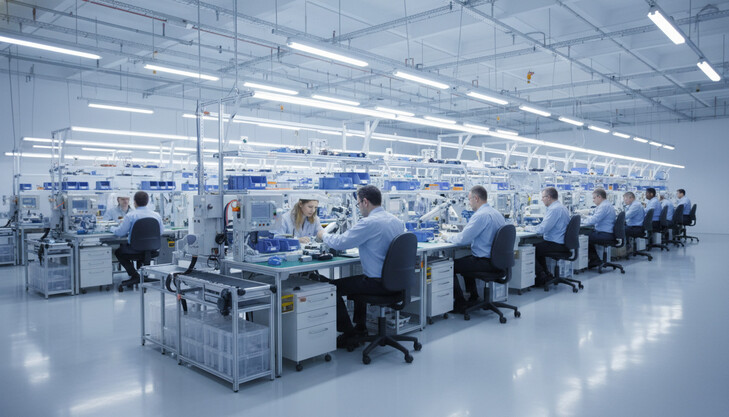
The lighting of industrial halls is subject to clear legal requirements. The Workplace Ordinance and DIN EN 12464-1 define minimum illuminance requirements depending on the activity. For simple storage activities, 100 lux is prescribed, for medium-duty work the value rises to 300 lux, and for fine assembly work 500 lux or more is required.
In addition to pure brightness, other factors also play an important role. The uniformity of the illumination prevents annoying shadow areas and enables fatigue-free working. Depending on the application, the glare value UGR should be below 19 to 25 in order not to impair visual performance.
When planning LED industrial lighting, the ambient conditions must also be taken into account. High temperatures, dust, moisture or aggressive chemicals place special demands on the protection class of the luminaires. IP65 or higher is recommended for many industrial applications.
Select LED high bay spotlights for high rooms
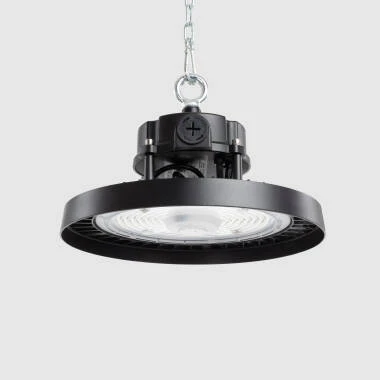
The ceiling height is a decisive factor when selecting suitable luminaires. In halls with heights of 6 to 15 meters, so-called high-bay luminaires are typically used, often in the characteristic UFO design. These industrial LED spotlights focus the light specifically downwards, achieving sufficient illuminance levels on the floor despite the high mounting height.
The power classes typically range from 100 watts for smaller areas to 200 watts and more for large hall areas. Depending on the model, the beam angle can be selected between 60 and 120 degrees. Narrower angles are suitable for very high rooms and selective illumination, while wider beam angles ensure more even distribution at lower ceiling heights.
The luminous efficacy of modern LED high bay spotlights is 120 to 200 lumens per watt. A 150-watt spotlight with 170 lm/W thus achieves a luminous flux of 25,500 lumens and easily replaces a 400-watt metal halide lamp. When making your choice, you should look out for branded components such as PHILIPS or LUMILEDS LEDs, which guarantee constant light quality over the entire service life.
Lighting design for factories and production facilities
Professional lighting design forms the basis for efficient hall lighting. The first step is to determine the actual lighting requirements. Different work areas within a hall often have different requirements that make zoned lighting sensible.
Several parameters are relevant for calculating the number of luminaires required. In addition to the required illuminance, the room geometry, the reflectance of the ceiling, walls and floor as well as a maintenance factor are included in the calculation. The maintenance factor takes into account the ageing of the LEDs and soiling of the luminaires over time.
As a rule of thumb: for every 20 to 25 square meters of hall space with a ceiling height of 8 to 10 meters, one 150-watt hall spotlight is required to achieve 300 lux. For higher requirements or greater ceiling heights, the requirement increases accordingly. Specialized lighting design software can make these calculations more precise and determine the optimum positioning of the luminaires.
Energy efficiency and cost savings with LED
The economic benefits of LED industrial lighting can be quantified in concrete terms. A typical conversion project pays for itself within two to four years, depending on the initial situation. After that, the company benefits permanently from the lower operating costs.
Example calculation: A production hall with 40 metal halide lamps of 400 watts each consumes 64,000 kWh per year over 4,000 operating hours. At an electricity price of €0.25 per kWh, this results in energy costs of €16,000. Converting to LED high-bay spotlights with 150 watts each reduces consumption to 24,000 kWh and costs to 6,000 euros. The annual saving is therefore 10,000 euros.
Intelligent control systems offer additional savings potential. Daylight-dependent dimming, presence control and time switches can reduce energy consumption by a further 20 to 40 percent. Modern industrial luminaires with integrated motion sensors automatically switch the light on only where it is needed.
Intelligent lighting control in industry
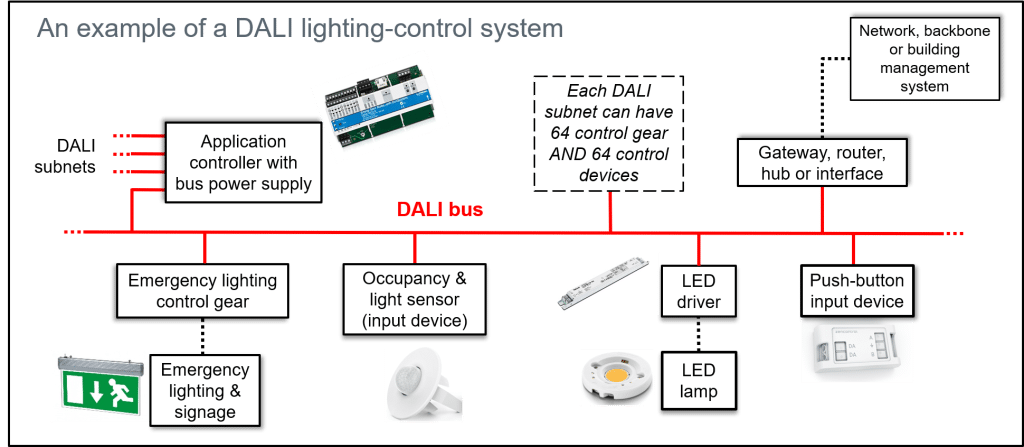
The networking of lighting systems opens up new possibilities for optimizing industrial processes. DALI (Digital Addressable Lighting Interface) has established itself as the standard for professional lighting control. Individual lights or groups of lights can be individually controlled and dimmed using this protocol.
IoT-based systems that integrate lighting data into higher-level building management systems go even further. Sensor data on utilization, energy consumption and operating statuses flow together in real time and enable needs-based control. If required, the lighting can be linked to production schedules so that lights are only switched on in actively used areas.
Dimmable high-bay spotlights with a 0-10V or 1-10V interface offer a cost-effective entry-level option for flexible lighting control. The infinitely variable control makes it possible to adjust the brightness precisely to current requirements and save energy at the same time. Matching control components and industrial LED lighting accessories round off the system.
Maintenance and durability of industrial luminaires
Low maintenance is one of the biggest advantages of LED technology. Unlike conventional light sources, regular lamp replacement is largely unnecessary. The long service life of 50,000 hours and more means maintenance-free operation for over ten years in typical industrial applications.
Nevertheless, LED industrial lighting should be checked regularly. Dust and dirt deposits on the luminaires reduce the luminous flux and should be removed at set intervals. Depending on the degree of soiling in the production environment, cleaning cycles of six to twelve months are recommended.
Thermal stress is a critical factor for the service life of LEDs. Sufficient air circulation should be ensured during installation, especially in environments with high temperatures.
Special applications in industrial lighting
Certain branches of industry place special demands on lighting. In the food industry, splinter-proof luminaires are required to prevent contamination of products in the event of damage. In potentially explosive areas (ATEX zones), only specially certified luminaires may be used.
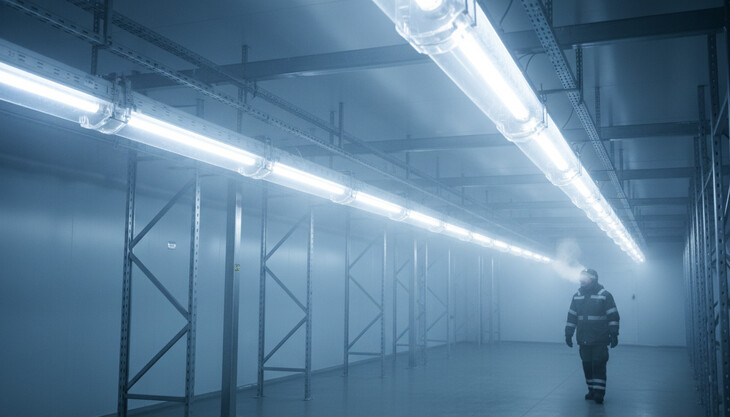
Cold stores and deep-freeze warehouses require luminaires that function reliably even at extreme sub-zero temperatures. Here, LEDs have a clear advantage over fluorescent tubes, as they immediately reach full brightness and are insensitive to cold.
Special industrial luminaires with CRI 90 and higher are available for workshops and assembly areas with high color rendering requirements. Industrial bulbs for existing lampholders also offer an uncomplicated way of converting individual areas to LED without having to replace the entire installation.
Conclusion: Switch to LED industrial lighting now
Converting to LED industrial lighting is an investment that pays off. Energy savings of 50 to 70 percent, reduced maintenance costs and improved lighting quality clearly speak in favor of the switch. The technical maturity of LED technology makes industrial luminaires the most economical solution for lighting factories, production halls and warehouses today.
The planning of modern hall lighting requires the consideration of numerous factors, from legal requirements to room geometry and specific work processes. Professional lighting design ensures that the chosen solution meets all requirements and that the full savings potential is exploited.