LED lighting for logistics & wholesale as an efficient solution for warehouses and salesrooms
Wholesale companies and logistics operations face particular challenges when it comes to lighting. Large storage areas, high shelves, refrigerated areas and at the same time prestigious salesrooms require different lighting solutions. Switching to modern LED technology offers enormous savings potential here and at the same time improves working conditions for employees and the shopping experience for customers.
Lighting for wholesale and logistics differs fundamentally from other commercial areas. While uniform, glare-free light is required in offices, vertical surfaces such as shelf fronts also need to be illuminated in warehouses. In this guide, you will find out which LED solutions are suitable for the different areas and how to plan the conversion economically.
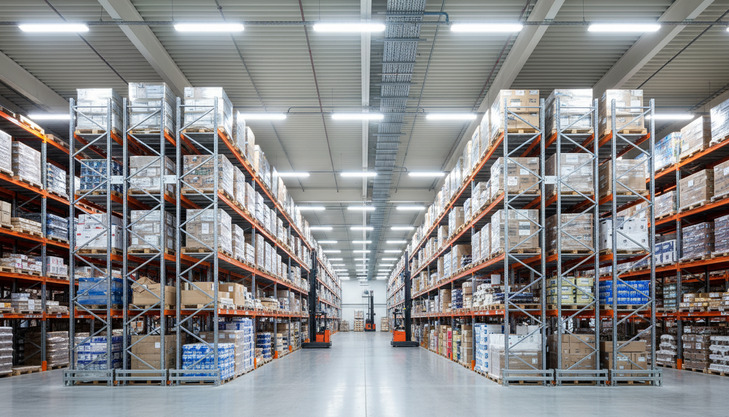
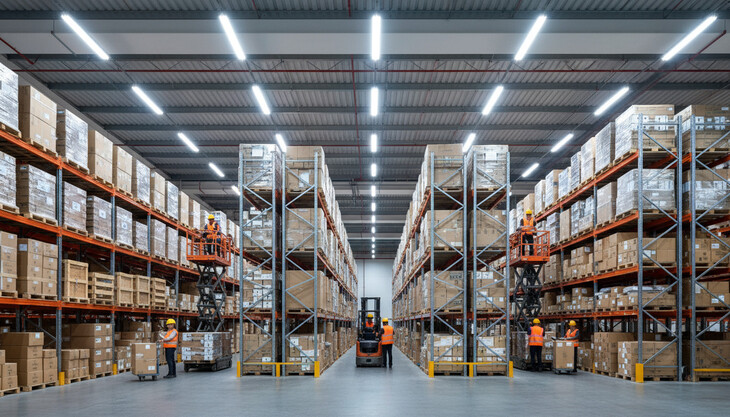
Warehouse lighting must fulfill several functions at the same time. The first is employee safety. Sufficient brightness prevents accidents during forklift traffic and manual order picking. The Workplace Ordinance stipulates a minimum of 100 lux for warehouses with occasional use, rising to 200 lux for regular use.
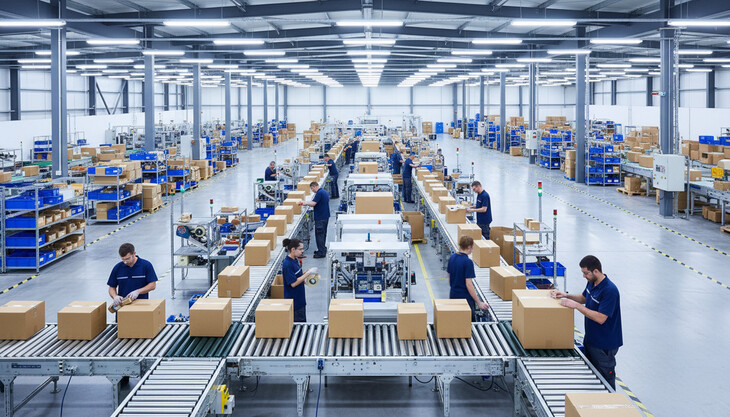
Higher illuminance levels are required for order picking and label reading. At packing stations and in areas with visual inspection tasks, 300 to 500 lux is recommended. The uniformity of illumination plays an important role here. Large differences in brightness between aisles and shelf surfaces lead to fatigue and increase the error rate.
One aspect that is often underestimated is vertical illuminance. In high-bay warehouses, the upper shelf levels must also be clearly visible. LED high-bay with asymmetrical light distribution that direct the light specifically onto the rack fronts are suitable here.
LED panels in retail: versatile solution for offices and showrooms
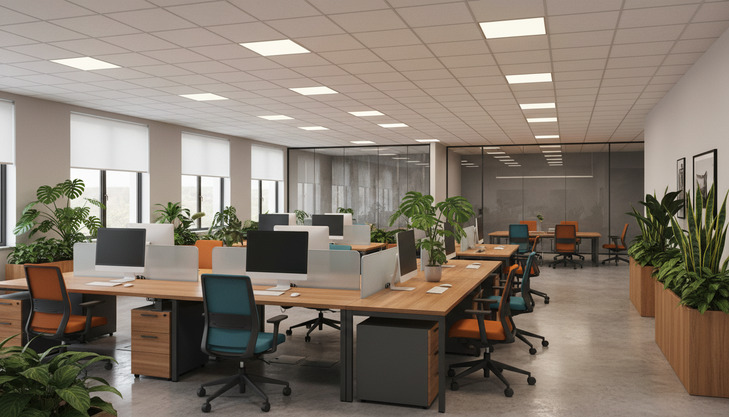
In addition to pure storage areas, wholesale companies typically have office areas, meeting rooms and often also prestigious exhibition areas. LED panels lights have established themselves as the standard solution for these areas. The flat luminaires blend harmoniously into suspended ceilings and provide uniform, glare-free light.
The standard 60×60 cm format fits exactly into grid ceilings and replaces old fluorescent tube recessed luminaires. With outputs of 36 to 42 watts, modern panels achieve luminous flux levels of 4,000 to 5,600 lumens. The UGR value of less than 19 ensures glare-free working on screens. Panels with a high color rendering index are recommended for showrooms and exhibition areas so that products are presented in natural colors.
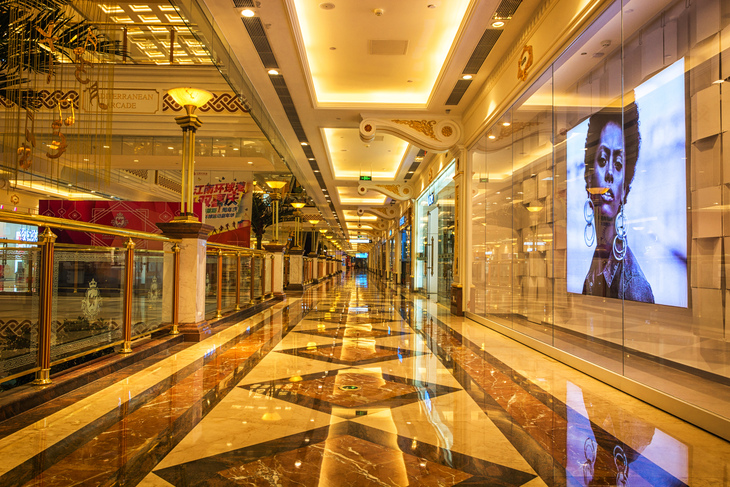
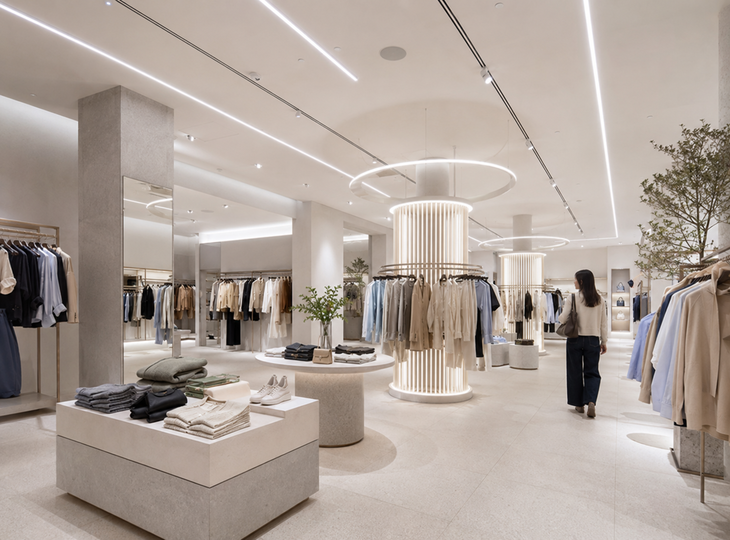
Lighting in sales rooms has special requirements. It is not just a question of functionality, but also of atmosphere and product presentation. Dimmable LED panels allow the brightness to be adapted to different times of day and situations of use. Combined with accent lighting using spotlights, attractive lighting environments are created that invite contemplation.
Logistics lighting: Solutions for high-bay warehouses
In modern logistics centers, shelves reach heights of 12 meters and more. Lighting in such logistics environments requires powerful luminaires with precise light control. UFO high bay spotlights with 150 to 200 watts and luminous efficacies of 170 lm/W have proven their worth here. A single spotlight delivers up to 34,000 lumens and adequately illuminates an area of 25 to 30 square meters.
The arrangement of the luminaires typically follows the aisle layout. The spotlights are mounted at regular intervals above the main traffic routes. The beam angle should be between 90 and 120 degrees in order to reach both the floor and the shelving surfaces. In very high halls, two-level lighting can be useful, with additional luminaires at half height providing vertical illumination.
Motion-controlled lighting offers particular savings potential in warehouses. In rarely used aisles, the light dims to a minimum and only switches to full brightness when an employee or forklift approaches. Sensors with radar technology also reliably detect slow movements and work independently of temperature and dust.
LED lighting in cold stores and deep-freeze warehouses
Cold stores and deep-freeze warehouses place extreme demands on lighting. Temperatures of minus 25 degrees and below as well as high humidity during temperature changes require specially designed luminaires. LED technology has clear advantages here compared to fluorescent tubes, which only start with a delay in cold conditions and emit less light.
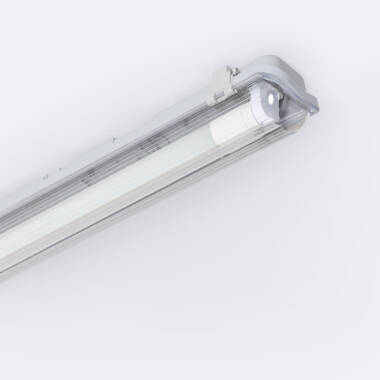
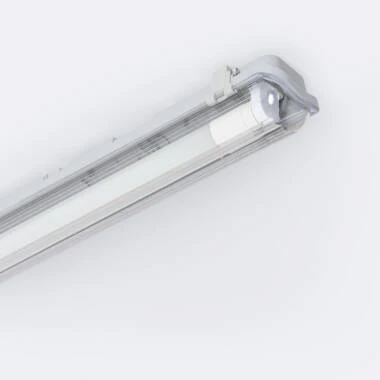
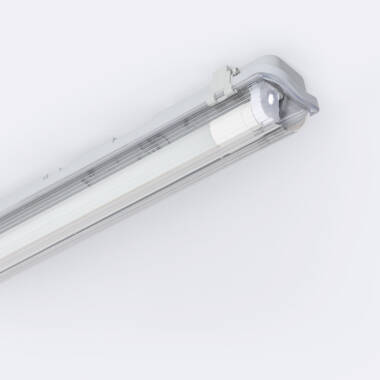
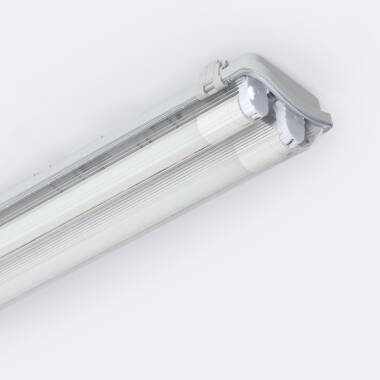
Tri-proof LED lights with protection class IP65 or higher are suitable for use in cold stores. The sealed housing prevents the ingress of moisture and protects the electronics from condensation. It is also important to select luminaires with drivers specified for low temperatures.
Immediate full brightness when switching on is particularly important in cold stores. Employees are only in the cold areas for a short time and need optimum visibility immediately. LEDs reach their full luminosity without a warm-up phase, whereas conventional lamps can take several minutes in extremely cold conditions.
Outdoor lighting for logistics areas and loading zones
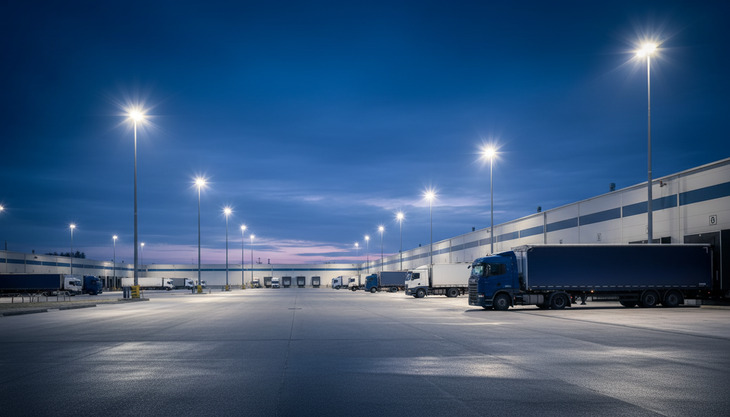
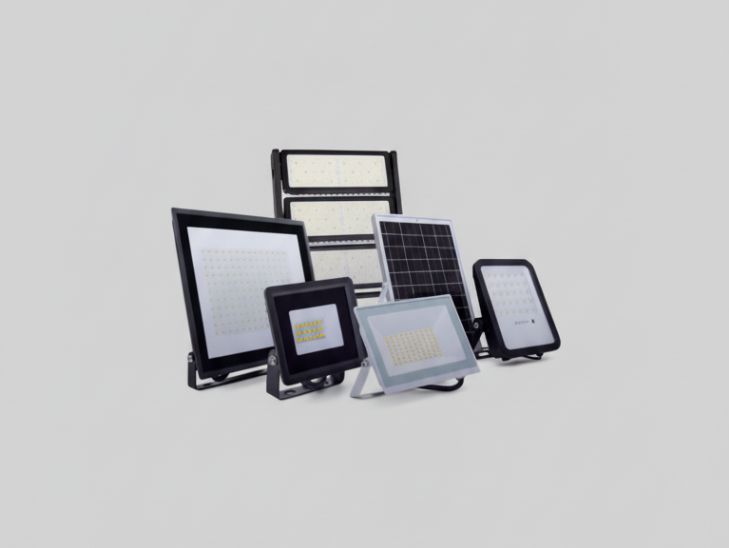
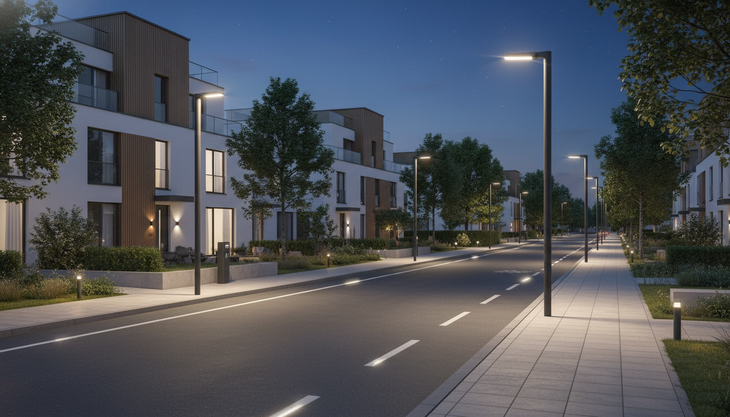
A complete lighting concept for wholesale and logistics also includes outdoor lighting. Loading zones, maneuvering areas and parking spaces must be sufficiently illuminated to ensure safe operation even in the dark. Weatherproof LED floodlights and LED street lights with the appropriate protection class are suitable for these areas.
The illuminance in loading zones should be at least 100 lux so that drivers and warehouse staff can work safely. Higher values of 200 lux are recommended at loading ramps. Asymmetrical reflectors direct the light specifically onto the work surfaces and prevent glare from road traffic.
Twilight switches and time controls ensure that the outdoor lighting is only active when required. In combination with motion detectors, energy consumption can be further reduced. Modern LED systems can be switched on immediately and can withstand frequent on/off cycles without wear.
Reduce energy costs with efficient warehouse lighting
Lighting accounts for a significant proportion of electricity costs in logistics companies. With large storage areas and multi-shift operation, the kilowatt hours quickly add up. Switching to LED technology reduces energy consumption by 50 to 70 percent compared to conventional lighting.
An example illustrates the savings potential: a logistics center with 10,000 square meters of storage space requires around 200 lights. Converting from 400-watt metal halide lamps to 150-watt LED high-bay spotlights reduces the installed output from 80 kW to 30 kW. With 4,000 operating hours per year, consumption is reduced from 320,000 kWh to 120,000 kWh. At an electricity price of 0.25 euros, this corresponds to an annual saving of 50,000 euros.
Additional savings result from intelligent control. Daylight-dependent dimming uses incident light from skylights and reduces artificial lighting accordingly. Presence control in rarely used areas and time-controlled dimming outside core working hours reduce consumption by a further 20 to 40 percent.
Low-maintenance lighting for continuous operation
In logistics companies with multi-shift operations, lighting often runs for 16 to 24 hours a day. The reliability of the luminaires used is correspondingly important. LED systems impress here with a service life of 50,000 to 100,000 hours. In continuous operation, this corresponds to a service life of six to twelve years without changing the light source.
Freedom from maintenance is a decisive advantage, especially in high-bay warehouses. Replacing light sources at a height of ten meters or more requires special lifting platforms and trained personnel. With LED lighting, this time-consuming and costly maintenance work is largely eliminated.
Nevertheless, LED luminaires should also be cleaned regularly. Dust deposits on the optics reduce the luminous flux and can impair heat dissipation. Cleaning is recommended every six to twelve months, depending on the degree of soiling in the environment. Modern luminaires with smooth surfaces and a high protection class make cleaning much easier.
Lighting design for wholesale and logistics
Professional lighting design takes into account all areas of use and their specific requirements. The first step is to define the required illuminance levels for each area. Suitable luminaire types are then selected and the optimum arrangement calculated.
For new buildings, it is advisable to integrate the lighting design into the building concept at an early stage. In this way, daylight elements such as skylights and strip lighting can be optimally dimensioned and the artificial lighting adjusted accordingly. For existing buildings, the starting point is an inventory of the existing lighting and its actual use.
Zoning the lighting allows it to be controlled according to requirements. Areas with different usage times or requirements are switched separately. For example, the incoming goods area can be illuminated independently of the main warehouse. Modern bus systems such as DALI enable flexible grouping and control of individual luminaires.
Conclusion: LED lighting as an investment in the future
Switching to LED lighting in wholesale and logistics is an economically sensible decision. Energy savings, reduced maintenance costs and improved lighting quality clearly speak in favor of this modern technology. The variety of products available enables tailor-made solutions for every area, from high-bay warehouses to showrooms.
Discover the complete range of LED tubes lights and fittings for retrofitting existing luminaires or opt for completely new lighting systems. With the right planning and the use of subsidies, the investment pays for itself within a few years and contributes to a permanent reduction in operating costs.