What are MacAdam Ellipses and why do they matter in lighting?
The quality of a light source does not depend solely on parameters such as power, efficiency or color temperature. There is a more subtle and critical component to light engineering: chromaticity. Chromaticity describes how we perceive the color emitted by a light source, and small variations in chromaticity can determine the visual uniformity of a space. In professional contexts, understanding chromaticity and its tolerances is not optional: it is essential.
In the technical field, one of the most widely used models to quantify these perceptible variations is the MacAdam Ellipses, an essential reference in optical engineering, luminaire design, quality control and international standards.
What exactly are MacAdam Ellipses?
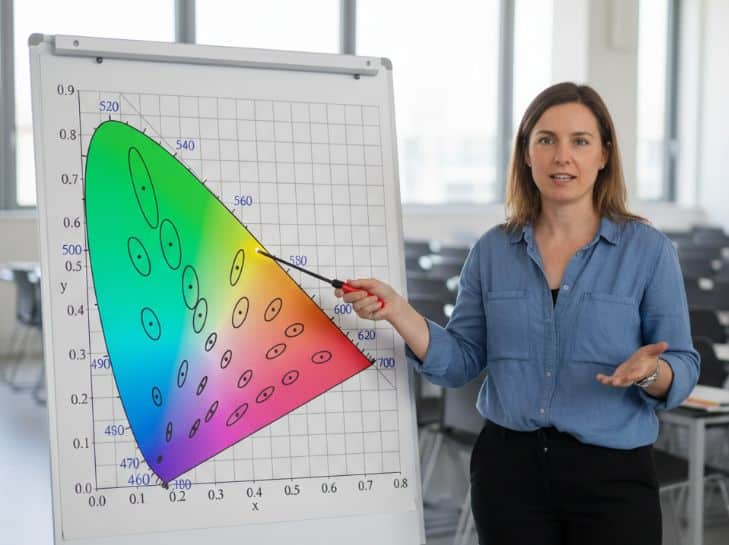
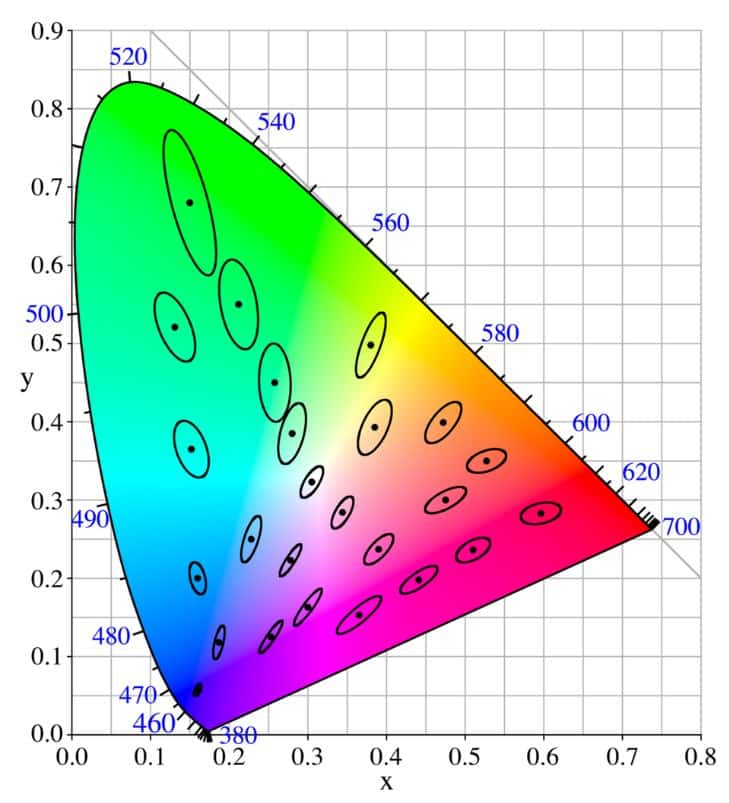
MacAdam Ellipses represent regions within the CIE 1931 chromaticity diagram where an average observer does not distinguish color differences. They were developed through psychophysical experiments conducted by David L. MacAdam in 1942, who analyzed the accuracy with which humans can match colors under controlled conditions.
Each ellipse delimits a set of chromaticities that are perceived as equivalent, even when physically they are not. Their size and orientation vary according to the area of the spectrum, due to the non-uniform sensitivity of the human visual system: we are more sensitive to changes in certain chromatic ranges (such as bluish tones) than in others (such as greens). This perceptual anisotropy causes the ellipses to be elongated or compressed depending on the reference color.
The origin of MacAdam’s ellipses (1942)
MacAdam ellipses have their origin in the experiments of physicist David L. MacAdam in the early 1940s.
His goal was to measure how different a color had to be before the human eye could perceive it as distinct from another. To do this, he designed a chromatic matching experiment, which was published in 1942-43 in the Journal of the Optical Society of America.
In this study, a trained observer simultaneously viewed two color fields: a fixed one (the test color) and an adjustable one, composed of combinations of red, green, and blue lights. The observer had to adjust the variable color until it visually matched the test color, keeping the luminance constant to eliminate differences in brightness.
In analyzing the data, MacAdam found that the chromatic matching points formed ellipses around the test color on the CIE 1931 xy diagram. These ellipses varied in size and orientation depending on the area of the color spectrum. For example, the eye is less sensitive to chromatic changes in shades of green, where the ellipses are larger, while in blue-violet shades, the ellipses are small, indicating greater sensitivity.
The study also revealed that the ellipses do not always have the same orientation, suggesting that the perception of color differences is not uniform: some chromatic deviations are more perceptible than others. MacAdam ellipses quantify this anisotropy in human color sensitivity.
MacAdam ellipses and CRI: different but complementary concepts
Although often mentioned together, MacAdam ellipses (SDCM) and CRI (color rendering index) do not measure the same thing and are not directly related. MacAdam ellipses describe the consistency of white color between different luminaires, i.e., whether various sources are perceived to be the same as each other. The CRI, on the other hand, evaluates how faithfully a light source reproduces the colors of objects. In technical terms they are independent parameters: it is possible to have a very uniform illumination in color (low SDCM) with a low CRI, or a high CRI with perceptible variations in hue between luminaires. Therefore, in demanding applications, both criteria should be considered in a complementary way.
What does it mean for a luminaire to have 3 MacAdam steps?
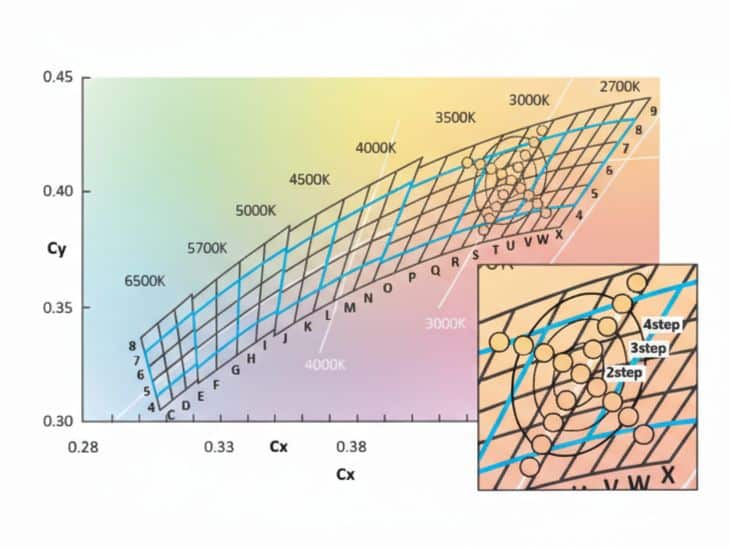
MacAdam steps” or SDCM (Standard Deviation of Color Matching) quantify how much color variation is acceptable with respect to a target point. In statistical terms, they represent standard deviations within the distribution of color matches.
Number of MacAdam steps
Technical and perceptual interpretation
1 step
Minimal, practically imperceptible variation
3 steps
Barely detectable variation; professional standard
5 steps
Appreciable difference in direct comparisons
7 steps
Clearly detectable variation
In professional applications, such as high-end retail, galleries, museums or hotel environments, 3 SDCM or less is usually required to ensure optimum color uniformity. In outdoor, industrial or street lighting, tolerances of 5-7 SDCM are acceptable, as viewing conditions reduce the sensitivity of the human eye to small variations.
Why do manufacturers classify LEDs according to MacAdam steps?
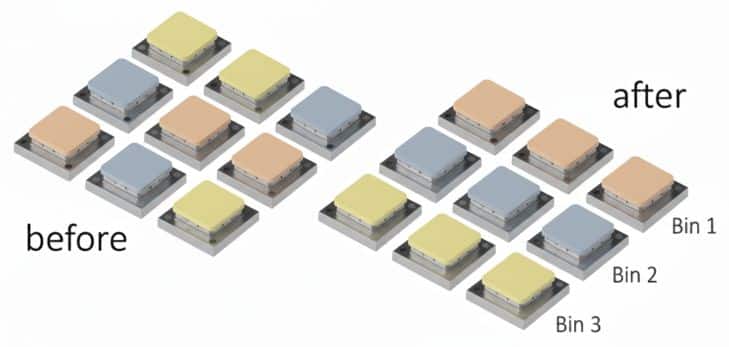
During LED manufacturing, micro-variations occur in the encapsulation process, phosphors, semiconductors and thermal conditions. This generates chromatic dispersion between units, even within the same model. To control these differences, the binning process is used, in which LEDs are grouped according to their measured chromaticity.
An LED classified within a 3 SDCM chromatic grouping ensures that its color is within the accepted perceptual tolerance ellipse. This process is essential to:
ensuring uniformity in large installations,
meet quality standards,
avoid visible color differences in adjacent luminaires,
and maintaining color consistency in architectural or commercial projects.
Although stricter ratings increase uniformity, they also increase selection and manufacturing costs due to rejection of out-of-range units.
When it is critical to select luminaires with low chromatic variation
In lighting engineering, color tolerance directly influences spatial perception, color rendering and user experience. Minimal differences can be decisive in environments where color is a factor of quality or precision:
Specialty retail: a slightly different shade of white in the light emitted by a series of track spotlights can alter the appearance of products.
Museums and galleries: precise lighting is key to maintaining color fidelity of sensitive works.
Hospitality and premium environments: visual consistency is part of the perceived quality of the space.
Modern offices: uniform lighting improves visual comfort and reduces fatigue.
Design homes: users expect a neat and homogeneous aesthetic.
In these applications, maintaining a maximum of 3 SDCM is recommended practice. In less critical scenarios (parking lots, industrial areas, outdoors) it is not necessary to be so strict. Differences of 5-7 steps in floodlights in a loading dock do not significantly compromise function or overall perception.
Regulations and standards (EU, ANSI, Energy Star)
The control of chromatic variation is not only an aesthetic issue: it is regulated by international bodies that define acceptable limits for the marketing of lighting products.
The main references are:
Energy Star (USA): requires < 7 SDCM for LED certification.
ANSI C78.377: defines chromaticity quadrants for different color temperatures.
Regulation (EU) 2019/2020: sets a maximum of 6 MacAdam for light sources marketed in the European Union.
These standards help to standardize expectations, guarantee uniformity between manufacturers and ensure that products meet minimum requirements for chromatic consistency.
How to select products according to MacAdam steps in ecommerce
On professional lighting platforms, SDCM information usually appears in datasheets or advanced product descriptions. To make the right choice:
Check that the label includes “SDCM ≤ 3” if the project requires high uniformity.
Compare products within the same category and brand to maintain consistency.
Consult technical sheets when the website does not include chromatic tolerance.
Prioritize luminaires with documented binning quality control.
Many ecommerce sites include advanced filters that allow you to select products based on their level of color consistency, which is especially useful for large-scale projects.
Technical tip: When installing multiple luminaires in a row (e.g., continuous LED strips or corridor downlights), use units with the same SDCM rating to avoid noticeable color disparities.
Are these differences really noticeable?
From a technical perspective, yes. Color variation influences perceived quality, color fidelity and spatial coherence. In fields such as interior design, museum lighting or retail, differences of just a few MacAdam steps can be evident.
MacAdam steps are not an abstract concept: they connect how we perceive color to practical engineering decisions. Understanding them allows us to design more consistent, predictable and efficient lighting systems.
In conclusion, the MacAdam Ellipses are an essential tool for lighting professionals, providing a quantitative framework for selecting and evaluating luminaires based on color accuracy and uniformity. Integrating them into decision making is key to obtaining high-level technical and aesthetic results.